At-Home Skincare Can't Do This — Here's Why

There is a particular kind of frustration that arrives quietly. You have followed the routines. You have ordered the serums, researched the actives, stocked the bathroom shelf with what the editors and the algorithms recommended. And yet the skin looking back at you in the mirror has not changed in the way you expected. Perhaps it has not changed at all.
This is not a failure of effort. It is a failure of access.
The Honest Conversation About At-Home Skincare
The market for esthetician-recommended skin care products is vast, well-funded, and extraordinarily good at communicating aspiration. Retinoids, vitamin C serums, AHA exfoliants, peptide complexes — these are not fraudulent products. Some of them do deliver measurable benefit. But they operate within a ceiling that most consumers are never told about clearly. The ceiling is biology. Specifically, it is the stratum corneum — the outermost layer of skin that evolved, with remarkable efficiency, to keep things out. Cosmetic formulations, regardless of how sophisticated their ingredient decks appear, are regulated and formulated to interact primarily with this surface layer. They cannot remodel dermal collagen. They cannot address vascular irregularities beneath the skin. They cannot retrain muscle movement, dissolve isolated fat deposits, or create the structural changes that produce the kind of results that prompt someone to say, quietly, that you look well. This is not a criticism of skincare as a category. It is a statement of physics and regulatory classification.Where the Gap Between Retail and Clinical Actually Lives
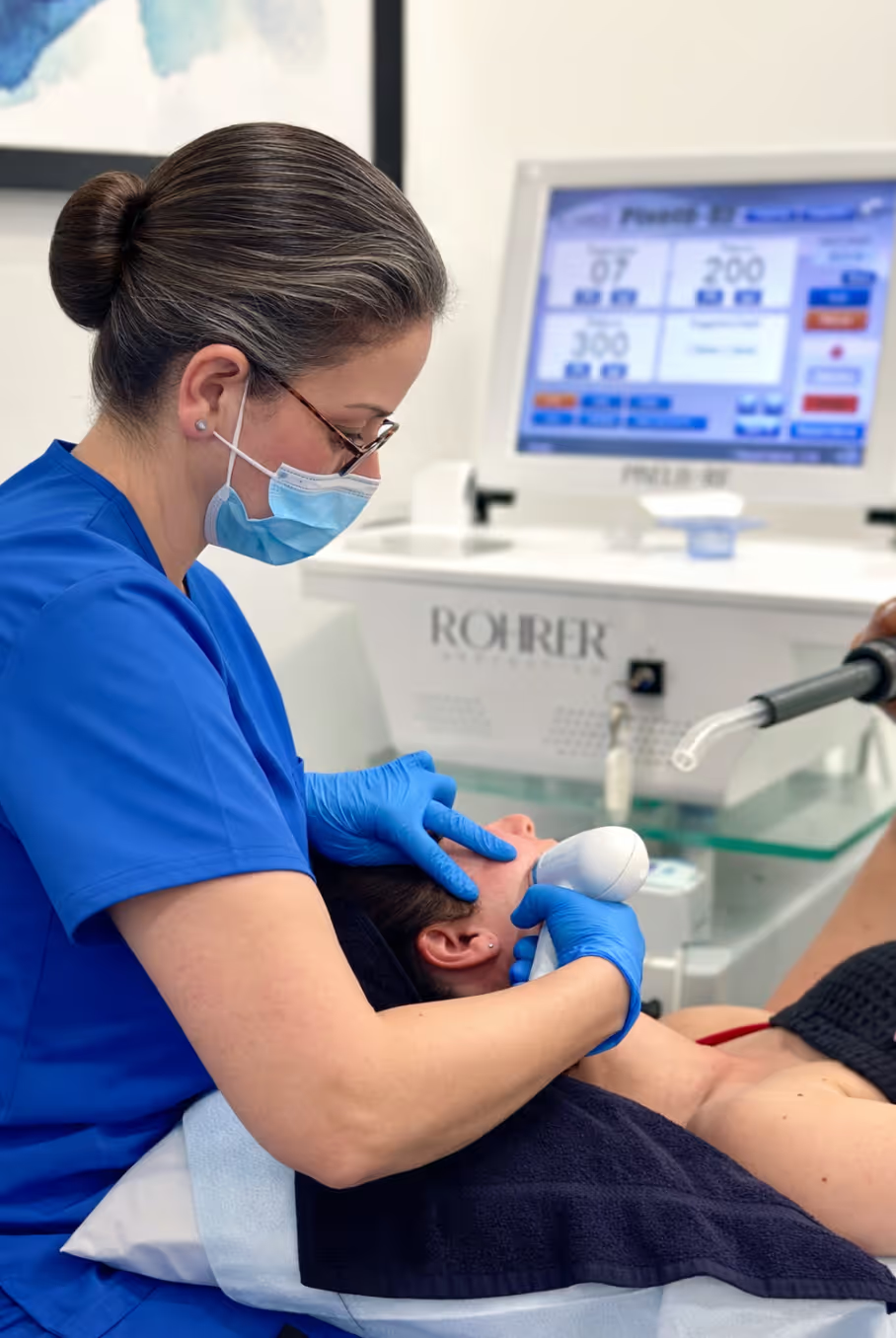
Consider what happens in a clinical environment that cannot be replicated at home, regardless of budget. Controlled depth of treatment. When our Medical Estheticians perform a Vi Peel Precision Plus, the formulation is calibrated to penetrate to a specific depth within the epidermis and upper dermis. This is not an at-home peel. The difference is not merely concentration — it is the clinical judgment required to assess skin type, active conditions, medication history, and Fitzpatrick classification before a single drop is applied. Energy-based remodeling. Devices like the Pixel8-RF radiofrequency microneedling system deliver controlled thermal injury to the dermis — triggering a wound-healing cascade that produces new collagen and elastin over months. This is a biologic process. No at-home LED mask, no microcurrent device, and no roller sold online creates this response at a meaningful clinical level. The radiofrequency energy required to initiate dermal remodeling cannot legally or safely be delivered by a consumer device. Vascular and pigmentation precision. IPL photofacial treatments target chromophores — melanin and oxyhemoglobin — with selective photothermolysis. This means the light energy is absorbed by pigmentation and vascular lesions specifically, leaving surrounding tissue unaffected. This is not something that can be approximated with brightening serums. It is a different category of intervention entirely. Neurotoxin and injectable treatments. This requires no extended argument. Treatments like Daxxify and Xeomin work by temporarily modulating neuromuscular activity. Nothing applied to the surface of the skin does this.The J Beauty vs. K Beauty Conversation — And Why It Misses the Point
A meaningful amount of content in the skincare world is currently occupied by the question of J beauty vs. K beauty — Japanese minimalism versus Korean layering, fermented essences versus glass skin routines. These are legitimate aesthetic philosophies with real cultural roots, and some of the products that emerge from both traditions are genuinely excellent. But the conversation tends to stay at the surface because it lives at the surface. It is a conversation about topical ritual. And topical ritual, however refined, does not address the structural changes that occur in skin after 35: collagen degradation, fat compartment atrophy, gravitational descent of soft tissue, accumulated photodamage in the dermis. A beautifully curated ten-step routine will not reverse the anatomical processes that drive visible aging. It may slow them at the margins. It will not stop them. The professionals we see at Tysons Elite Esthetics — many of them coming from McLean, Great Falls, Vienna, and the DC corridor — have often already been through this. They have tried the routines. They are not asking whether to use a sheet mask. They are asking what can actually move the needle, and they want an honest answer grounded in clinical evidence.What At-Home Skincare Does Well — And Why It Still Matters
To be precise about this: a strong at-home skincare protocol is not optional for our clients. It is foundational. The results achieved through clinical treatments last longer and perform better when supported by appropriate topicals at home — medical-grade retinoids, antioxidant serums, broad-spectrum SPF applied consistently, and barrier-supporting formulations suited to the individual's skin profile. The distinction is one of role, not hierarchy. At-home skincare is maintenance and protection. Clinical treatment is structural change. Both are necessary. Neither substitutes for the other. When our Medical Estheticians develop a skin plan for a client, the at-home protocol is part of that plan. It is not an afterthought, and it is not a generic recommendation. It is calibrated to what the clinical treatments are doing, what the skin is recovering from, and what goals the client is working toward.At-Home vs. Salon Hair Color — A Parallel Worth Drawing
The at-home vs. salon hair color debate offers a useful parallel for thinking about this. The chemistry available in a box at a pharmacy is not the same as what a skilled colorist applies in a professional setting. The application technique, the ability to assess how color will interact with existing damage or underlying pigment, the capacity to course-correct in real time — these are not things that come in the kit. And most people who have experienced both understand the difference viscerally, even if they cannot articulate the chemistry. Skin is the same, only higher stakes. The face is not something to experiment on with consumer-grade approximations of clinical tools. And unlike a hair color correction, some skin responses are not easily reversed. This is precisely why the oversight structure at Tysons Elite Esthetics is designed the way it is. Our licensed clinical team provides the clinical framework within which every energy device treatment and injectable service is executed. Our Medical Estheticians hold the highest licensure available in the Commonwealth of Virginia — a designation that requires advanced training in chemical resurfacing, lymphatic drainage, and medical-grade laser protocols. This is not a wellness brand with a laser in the back room.What Clinical Treatment Can Actually Do
For clients in the Tysons, McLean, and Northern Virginia corridor who are ready to move beyond the surface, the range of treatments available at Tysons Elite Esthetics addresses concerns that no retail product was designed to touch. Collagen loss and skin laxity respond to energy-based remodeling. CoolPeel Fractional Laser Resurfacing and Pixel8-RF radiofrequency microneedling both initiate controlled dermal injury that prompts the body's own repair mechanisms to produce new structural protein — results that accumulate over three to six months and continue to improve. Pigmentation and vascular irregularity respond to selective photothermolysis. IPL photofacial treatments can clear the kind of sun damage, diffuse redness, and uneven tone that even the most expensive brightening serum cannot reach. Volume loss — the deflation that makes a face look tired before it looks wrinkled — responds to dermal fillers and collagen biostimulators. Revanesse Versa and Revance RHA fillers restore the architecture of the face in ways that skincare cannot simulate. Dynamic lines from repeated muscle movement respond to neuromodulators — a category that includes Daxxify, Xeomin, and others — by temporarily softening the muscular contractions that etch lines over time. For clients in their mid-thirties who are thinking ahead, our published piece on preventive Botox for Tysons professionals offers a detailed clinical perspective. Stubborn fat deposits that resist diet and exercise respond to CoolSculpting Elite, which uses controlled cooling to selectively reduce adipocytes without surgery or recovery time. Skin texture and surface irregularity — including acne scarring, enlarged pores, and crepiness — respond to modalities like microneedling and ablative laser resurfacing, which create the kind of textural improvement that topical exfoliation cannot produce.The Conversation Worth Having
The clients who come to Tysons Elite Esthetics are not looking for a replacement for their skincare routine. They are looking for what their routine cannot do — and they want it delivered by a team that can be trusted with that decision. If you are in Tysons Corner, McLean, Great Falls, Vienna, Falls Church, or the broader DC Metro area and you are ready for a clinical conversation about what your skin actually needs in 2026, the consultation is the appropriate starting point. It is not a sales appointment. It is a clinical assessment. Tysons Elite Esthetics is located at 7777 Leesburg Pike, Falls Church, VA 22043, steps from the Greensboro Silver Line Metro station and adjacent to Tysons Galleria. To schedule a consultation, visit tysonseliteesthetics.com.Start your transformation
Schedule your consultation with our knowledgeable and friendly team.