Polynucleotide Skin Rejuvenation: What Tysons Professionals Should Know About PDRN and PN Injections Before Trying This Emerging Biostimulator Treatment

There is a category of client who has already tried the standard menu. They have explored neuromodulators, perhaps experimented with dermal fillers, and they maintain a consistent at-home regimen. Yet something in the skin's quality still feels slightly off. The texture is uneven. The tone is dull in ways that topical products cannot fully address. The skin looks tired even when they are not.
For this client, polynucleotide injections, also referred to as PDRN therapy, represent a category worth understanding. Not because they are new in a fashionable sense, but because the underlying science is substantive, and the clinical conversation is evolving quickly.
What Polynucleotides and PDRN Actually Are
Polynucleotides (PN) and polydeoxyribonucleotides (PDRN) are fragments of purified DNA, typically derived from salmon or trout sperm. This may sound unusual at first, but the biological logic is precise. These nucleotide chains are highly biocompatible with human tissue and have been studied for their role in activating cellular repair pathways.
At the cellular level, PDRN is believed to work primarily through the A2A adenosine receptor pathway, which may stimulate fibroblast activity, support collagen and elastin synthesis, and encourage tissue regeneration. The distinction from traditional biostimulators like Sculptra or Radiesse is meaningful. Where collagen stimulators work by provoking a controlled inflammatory response, polynucleotide therapy works by signaling the skin's own repair mechanisms at a more granular, cellular level.
Polynucleotide injections are also sometimes compared to skin booster injections like Restylane Vital or Juvederm Volite. They share a similar delivery method and the goal of improving overall skin quality rather than adding volume. The key difference is mechanism. Skin boosters primarily provide deep hydration through hyaluronic acid. Polynucleotides work through a regenerative, biostimulatory pathway rather than a hydration-based one.
What the Research Suggests and Where the Evidence Stands
It is worth being precise here. Polynucleotide therapy has a meaningful body of clinical research, much of it originating in South Korea, Italy, and other European markets where these products have been in clinical use for longer than in the United States. Studies have examined outcomes including improvements in skin hydration, elasticity, texture, and the appearance of fine lines.
Many clients in clinical trials have experienced measurable improvements in:
- Skin hydration and barrier function
- Elasticity and firmness, particularly in thinner skin areas
- Reduction in the appearance of fine lines and superficial creasing
- Overall skin luminosity and tone evenness
- Healing and tissue recovery following more intensive treatments
That said, this category is still considered emerging within the U.S. regulatory landscape. Products vary in their formulation, molecular weight, and concentration. These differences matter clinically. The formulation selected, and the expertise of the provider administering it, will influence outcomes considerably more than the category name alone.
For clients already exploring the broader biostimulator landscape, the blog post on biostimulator treatments for skin laxity after 50 offers relevant context for how regenerative injectables fit within a larger treatment philosophy.
Who Tends to Be a Good Candidate
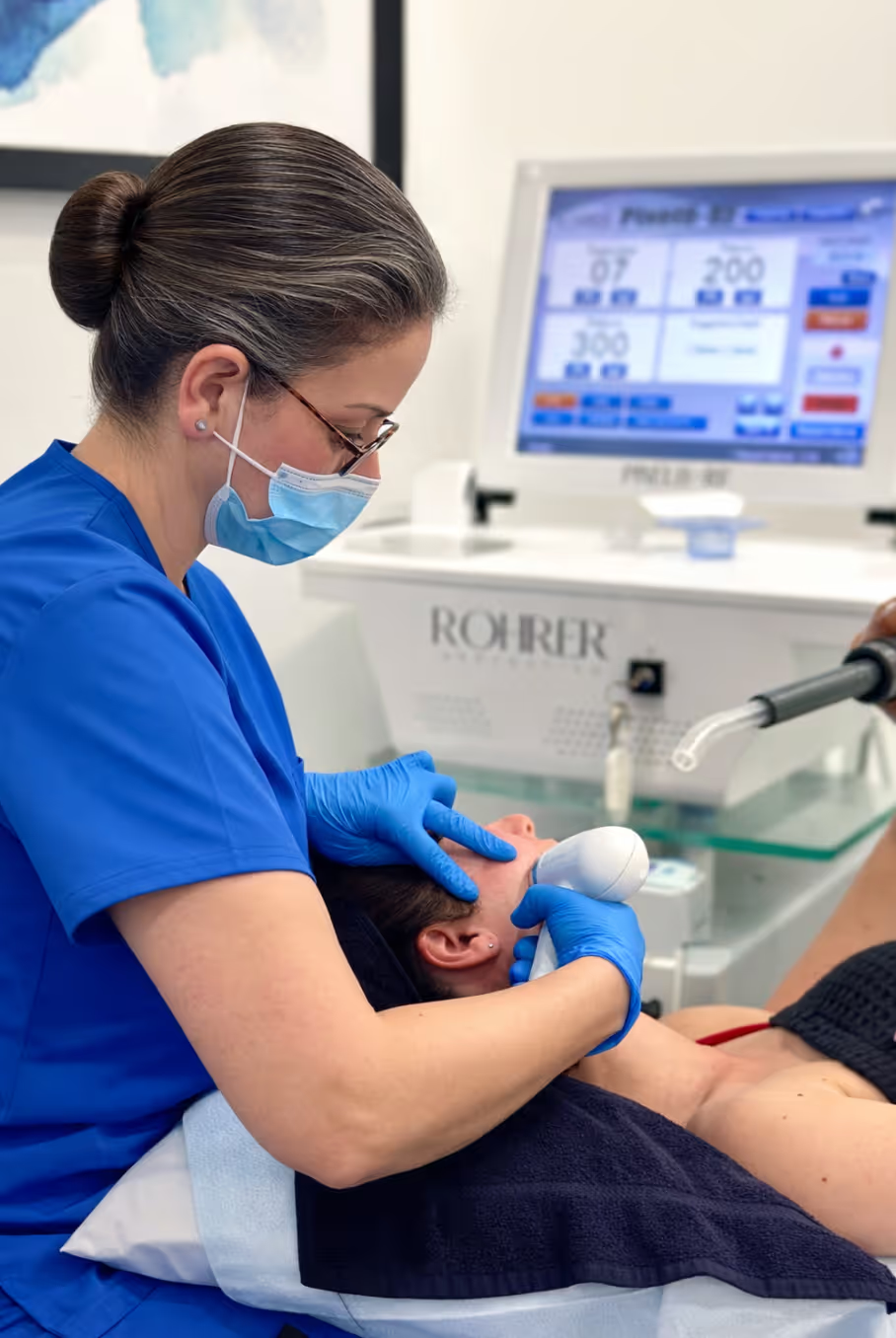
Polynucleotide therapy is not a replacement for volumizing fillers or neuromodulators. It does not address significant laxity the way a treatment like Pixel8-RF radiofrequency microneedling might. It is best understood as a quality-of-skin treatment, one that works at the foundational level of cellular behavior rather than surface correction or structural repositioning.
Clients who may be good candidates tend to share certain characteristics:
- Skin that appears dull, fatigued, or lacking in luminosity despite consistent care
- Fine texture irregularities or superficial creasing not fully addressed by topical or other in-office treatments
- Thin or fragile skin, particularly around the eyes, neck, or décolletage, where other injectables carry higher complexity
- A desire to support skin quality proactively rather than reactively
- Those recovering from more intensive resurfacing procedures, such as CoolPeel Fractional Laser Resurfacing, who are looking to support tissue regeneration during the healing phase
- Clients with sun-damaged skin seeking a regenerative adjunct to other correction-focused treatments
Polynucleotide therapy is also sometimes used in the under-eye area, where the skin is among the thinnest and most reactive on the face. For clients weighing options in that zone, the post on under-eye bags versus hollow under-eyes is a useful primer before that conversation.
What to Expect From Treatment and How Tysons Elite Approaches It
Polynucleotide injections are administered via a series of small intradermal or superficial injections across the treatment area. Sessions are typically spaced two to four weeks apart, with a protocol of three to four initial sessions commonly recommended before assessing results. Outcomes tend to build progressively, with many clients observing the most notable changes in texture and luminosity between the second and fourth sessions.
Downtime is generally minimal. Some clients experience mild redness or transient swelling at injection sites, which typically resolves within a day or two. The treatment is well-suited to clients who require a clean appearance for professional commitments.
At Tysons Elite Esthetics, every injectable treatment is conducted under the medical oversight of Dr. Navin Singh, a triple board-certified plastic surgeon and Johns Hopkins School of Medicine graduate. His surgical-level anatomical precision informs how the practice approaches even the most nuanced injection protocols, including emerging categories like polynucleotide therapy. This is not a category where clinical judgment should be an afterthought.
The practice was built on a philosophy our founder Luise Estelle describes as "Glow Refined," which means treatments selected and executed with precision, not volume. For clients in Tysons Corner, McLean, Great Falls, and Vienna who are considering polynucleotide therapy as part of a broader approach to skin health, a private consultation is the appropriate starting point. The right protocol depends entirely on an accurate assessment of your skin's current condition, your history of prior treatments, and your long-term goals.
Tysons Elite Esthetics is located at 7777 Leesburg Pike in Falls Church, convenient to clients throughout the Tysons-McLean corridor. We invite you to request a private consultation to determine whether polynucleotide therapy belongs in your treatment plan.
Start your transformation
Schedule your consultation with our knowledgeable and friendly team.