Sagging Jowls Without Surgery: Proven Non-Surgical Options for Tysons Patients

Jowls have a way of becoming the thing you notice first — in a mirror, in a Zoom call, in a photograph where you looked exactly like yourself but somehow older than you expected. The lower face tends to shift gradually, and then one day it doesn't look gradual at all. Skin that was once flush against the jawline begins to descend. The jaw loses its crispness. The face starts to look heavier, more tired — even when you feel completely fine.
For patients in Tysons, McLean, and the greater Fairfax County area, this is one of the most common concerns we hear in consultation. And it's also one of the most treatable — without surgery, without general anesthesia, and without the kind of downtime that disrupts a professional schedule. Understanding what's actually happening in the lower face is the first step toward choosing the right approach.
Why Jowls Form: It's Never Just One Thing
Jowl formation isn't a single problem with a single solution. It's the visible result of several aging processes happening simultaneously: collagen and elastin degradation causing the skin to lose its ability to recoil; fat compartment descent as the structural scaffolding of the midface weakens; bone resorption in the jaw and chin that narrows the base the lower face rests on; and muscle changes — particularly in the platysma — that pull downward over time.
This is why products alone can't address jowls. No serum reaches the depth where collagen remodeling needs to occur. No topical restores volume to a fat pad that has migrated. As we've written about in our post on what at-home skincare can't do, the gap between retail products and in-office treatments isn't marketing — it's anatomy.
Effective non-surgical jowl treatment requires addressing multiple layers: the skin itself, the subcutaneous tissue, and the structural support underneath. The good news is that the options available in 2026 are sophisticated enough to do exactly that — and the results, when treatments are properly sequenced and layered, can be genuinely significant.
The Non-Surgical Jowl Lift: What It Actually Means
The phrase "non-surgical face lift" gets used loosely, so it's worth being specific. A true non-surgical approach to jowling typically combines two or three of the following modalities, selected based on the individual patient's anatomy, degree of laxity, and timeline for results.
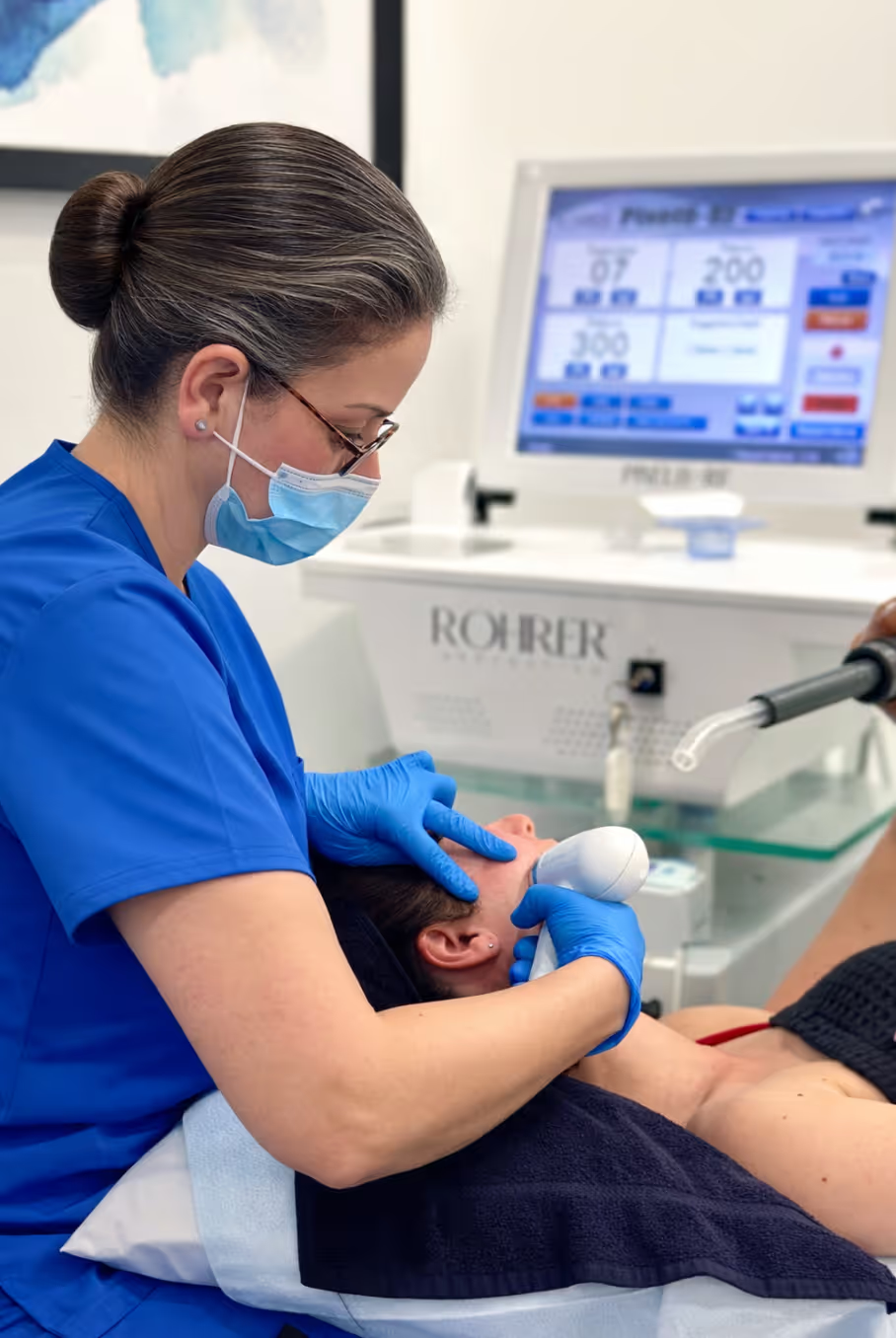
Radiofrequency Microneedling (Pixel8-RF)
Radiofrequency microneedling is one of the most effective tools available for skin laxity in the lower face and jawline. The treatment delivers bipolar radiofrequency energy through insulated microneedles directly into the dermis, generating controlled heat that triggers collagen and elastin remodeling at the tissue level. This is not surface-level stimulation — it's a genuine structural response.
For jowl-prone patients, Pixel8-RF is particularly effective along the mandibular border, the pre-jowl zone, and the lateral cheek. Most patients complete a series of two to three treatments spaced four to six weeks apart, with progressive improvement continuing for three to six months as new collagen matures. There's mild redness and swelling for twenty-four to forty-eight hours, but most patients return to work the following day. Our Pixel8-RF radiofrequency microneedling service page covers what to expect in more detail.
PDO Thread Lifts
For patients with more visible soft tissue descent, PDO threads offer a mechanical repositioning component that energy devices alone cannot provide. Barbed threads are placed beneath the skin and used to physically reposition descending tissue along the jawline, creating an immediate lifting effect that is then reinforced by the collagen response triggered by the thread itself as it dissolves over several months.
Threads work best when the skin retains some elasticity — they lift and anchor, but they require tissue quality to hold. This is why they're often combined with RF microneedling or biostimulators rather than used in isolation. We've covered the nuances of this approach in depth in our post on whether PDO thread lifts are worth it after 45, which is worth reading if you're considering this option.
Biostimulators: Sculptra and Radiesse
Biostimulators are among the most underutilized tools in jowl treatment — and among the most effective when used by someone with genuine expertise in lower face anatomy. Unlike hyaluronic acid fillers, which add immediate volume, Sculptra (poly-L-lactic acid) and Radiesse (calcium hydroxylapatite) work by stimulating your own collagen production over time. The result is a gradual, natural-looking improvement in skin quality, firmness, and structural support.
In the context of jowling, biostimulators are often placed in the midface and along the jawline to rebuild the scaffolding that has gradually weakened — addressing the root cause rather than masking the symptom. Results develop over three to six months and can last one to two years or longer. Our post on biostimulator treatments for skin laxity after 50 offers a detailed comparison of Sculptra and Radiesse for patients navigating this decision. For patients who want to understand how Sculptra fits into a longer-term prevention strategy, our post on when to start Sculptra is also worth reviewing.
Strategic Dermal Filler Placement
This is where precision matters enormously. Filler placed incorrectly in the lower face can worsen the appearance of jowling by adding weight to already-descended tissue. But filler placed strategically — in the pre-jowl sulcus to restore the smooth line of the mandible, along the jawline itself to sharpen definition, or in the chin to extend the structural base — can create a lift effect without repositioning a single thread.
The distinction between someone who places filler well in the lower face and someone who does not is not subtle. It shows in the results. Our post on marionette line filler and lower face volume restoration speaks directly to the nuances of treating this zone, and our jawline filler and non-surgical chin augmentation post goes further into how structural balance shapes the overall outcome.
Neuromodulators for the Nefertiti Lift
The platysma — the broad, flat muscle that runs from the chest up through the neck and attaches along the lower face — exerts a consistent downward pull as it tightens and bands with age. Strategically placed Botox or Dysport along the lower face and neck can relax this pull, allowing the upward-pulling muscles to work without competition. The result is a subtle but real improvement in jawline definition that works beautifully as part of a comprehensive lower face protocol.
This approach, sometimes called the Nefertiti Lift, is discussed in detail in our post on platysmal band treatment and the Nefertiti Lift. It's an elegant option for patients who want to complement their structural treatments with something that addresses muscle dynamics.
Non-Surgical Jowl Lift Cost: What Tysons Patients Actually Pay
Non-surgical face lift cost is one of the first questions patients ask — and one of the most difficult to answer honestly without first understanding what the patient actually needs. That said, transparency matters, so here's a realistic range.
A single RF microneedling session typically runs between $800 and $1,400 depending on the area treated and the device used. A PDO thread lift for the lower face ranges from $1,500 to $3,500 depending on the number of threads and the complexity of the placement. A Sculptra treatment cycle — typically two to three sessions — ranges from $2,000 to $4,500. Strategic filler for the lower face and jawline ranges widely, from $800 for a single syringe of pre-jowl correction to $3,000 or more for a comprehensive lower face restoration.
For patients considering a full-protocol approach — combining two or more of the above modalities — the total investment typically ranges from $3,000 to $8,000 over the course of three to six months. This is not a small number. But it's worth framing it against the alternative: surgical facelift costs in Northern Virginia typically begin at $12,000 to $20,000 including anesthesia and facility fees, require two to four weeks of recovery, and carry surgical risks that non-surgical approaches simply do not. Our post on why more Tysons patients are skipping surgery speaks to exactly this calculation. For a broader picture of what comprehensive facial rejuvenation costs, our full-face treatment plan cost guide is a useful reference.
We'd also note something that doesn't get discussed enough: the cost of waiting. Jowling that is addressed at the early-to-moderate stage responds far better to non-surgical treatment than laxity that has progressed for several additional years. Our post on the hidden costs of waiting too long to start skin treatments makes this case clearly — and it applies directly to jowl treatment.
How We Approach Jowl Treatment at Tysons Elite Esthetics
Our team brings more than 70 combined years of experience in medical aesthetics to every consultation — and that depth matters particularly in lower face treatment, where the margin between an excellent result and a disappointing one comes down to assessment, not just technique.
We don't recommend a protocol before we understand your anatomy. Lower face aging is not uniform. Some patients have primarily skin laxity; others have significant volume loss; others have both. The treatment that works beautifully for one patient can be the wrong choice for another with what looks like the same concern from across the room. This is why the consultation isn't a formality — it's where the real clinical thinking happens.
For patients who have experienced jowling alongside broader lower face aging — including marionette lines, loss of jawline definition, and descent of the lateral cheek — we typically approach the face as a unit rather than treating one area in isolation. Our post on combination skin tightening treatments explains the rationale for this stacked approach, and our thread lifts vs. fillers comparison is useful for patients weighing those two specific options.
We also want to be direct about what non-surgical treatment can and cannot accomplish. For patients with mild to moderate jowling, a well-designed protocol can create results that are genuinely striking — the kind of outcome where people tell you that you look well-rested, or ask if you've changed your hair, without being able to identify exactly why you look better. For patients with more advanced laxity, non-surgical treatment can meaningfully improve the appearance of jowling and slow further progression — but the honest answer in some cases is that surgery would produce a more complete result. We will tell you that if it's true. What we won't do is sell you a treatment that isn't right for your situation.
If you're considering your options and want a clear-eyed conversation about what would actually work for your lower face, we'd encourage you to start with a consultation. For patients who are newer to med spa treatments and want a sense of what that first appointment looks like, our post on where Tysons patients should start is a helpful introduction.
Start your transformation
Schedule your consultation with our knowledgeable and friendly team.