Goodbye Static Lines: When Botox Stops Working and What's Next

There's a particular frustration that long-time neuromodulator patients know well. You've been coming in every three to four months for years. The treatment works, you trust the process, and then — gradually, almost imperceptibly — it starts to feel like it's not doing quite as much. Your forehead lines return faster. That crease between your brows looks deeper at rest, not just when you're frowning. The results feel shorter. You find yourself scheduling sooner. And at some point you wonder: is Botox actually stopping working for me?
The short answer is that yes, this can happen — but it's rarely as simple as "Botox stopped working." What's more often happening involves a combination of factors: changes in the muscle itself, the biology of how neuromodulators interact with your neuromuscular junctions over time, and — critically — the difference between dynamic and static wrinkles, which respond to treatment in fundamentally different ways. Understanding that distinction changes everything about how you approach what comes next.
Dynamic vs. Static Lines: Why This Distinction Matters More Than You Think
Neuromodulators like Botox, Dysport, Xeomin, and Daxxify work by temporarily interrupting the signal between nerve endings and the muscles that contract beneath your skin. When those muscles stop contracting, the skin above them stops creasing. For dynamic wrinkles — lines that only appear with movement — this mechanism is elegantly effective. Relax the muscle, the line disappears.
Static wrinkles are a different problem entirely. These are lines that are visible at rest, when your face is completely neutral and no muscle is actively pulling. They've been etched into the skin through years of repeated movement, collagen loss, volume depletion, and cumulative sun exposure. By the time a wrinkle is truly static, the skin itself has been structurally altered. A neuromodulator can prevent it from deepening further — and in mild cases, relaxing the underlying muscle consistently over time can allow some partial softening — but it cannot reverse what's already there. Collagen has thinned. The dermis has lost elasticity. The crease exists independent of whether the muscle is moving.
This is where many patients hit a wall. They're being treated appropriately with neuromodulators for what began as a dynamic concern, but the line has progressed to static. The treatment continues to work — it's doing exactly what it's designed to do — but it's no longer sufficient on its own for the visible result the patient wants. The solution isn't a different neuromodulator. It's a different category of treatment, or a combination approach.
When Botox Resistance Is the Actual Issue
That said, true resistance does occur — and it's worth understanding when this is the more likely explanation. Botox resistance, more precisely called antibody-mediated resistance, happens when the immune system develops antibodies against the botulinum toxin protein. These antibodies neutralize the toxin before it can act on the neuromuscular junction, which is why results feel progressively weaker or shorter over time despite consistent treatment.
Resistance is more likely in patients who receive high doses frequently or who have had periods of very short intervals between treatments. It's relatively uncommon in standard cosmetic dosing, but not rare enough to dismiss. Some patients who have received therapeutic doses for conditions like cervical dystonia or hyperhidrosis in addition to cosmetic treatment carry a higher risk. It's also worth noting that not all products carry equal resistance risk — the protein load varies across formulations, which is one reason the comparison between Xeomin, Botox, Dysport, and Daxxify matters clinically, not just commercially.
Xeomin is the most commonly cited option for patients with suspected antibody-mediated resistance because it's a "naked" neuromodulator — stripped of the accessory proteins that surround the active toxin in Botox and Dysport. The theory is that fewer foreign proteins means a lower immunogenic load and less opportunity for antibody formation. For patients who have genuinely developed resistance to Botox, switching to Xeomin sometimes restores responsiveness. Results vary by individual, and our team will walk through whether this makes clinical sense for your specific history before recommending a switch.
Dysport vs. Daxxify: What the Conversation Actually Looks Like
For patients whose Botox results are shortening — wearing off closer to two months rather than three or four — the question often becomes whether a different neuromodulator might perform better for them specifically. This is where the Dysport vs. Daxxify comparison becomes genuinely relevant rather than just a marketing talking point.
Dysport has been available for years and has a loyal following for good reasons. It tends to diffuse slightly more broadly than Botox, which makes it particularly well-suited for larger treatment areas like the forehead. Some patients find it kicks in a day or two faster and feels slightly more natural in areas where they've found Botox too heavy. The dosing conversion is different — Dysport units are not equivalent to Botox units — so working with an experienced injector matters enormously here. Dysport duration is broadly similar to Botox for most patients, typically in the three-to-four-month range.
Daxxify is the newer entrant and represents a meaningful clinical advance in one specific dimension: duration. While Botox and Dysport last three to four months for most patients, Daxxify has demonstrated six-month results in clinical trials, with some patients maintaining results up to nine months. It uses a novel peptide-based stabilizer rather than the human serum albumin used in other formulations, which is also notable for patients with certain sensitivities. For patients who are metabolizing standard neuromodulators unusually quickly — a real phenomenon related to individual metabolic rate, muscle mass, and activity level — Daxxify may provide the sustained result they've been looking for. You can also read more in our detailed breakdown of what Daxxify is and how it differs from Botox.
The honest framing for any Dysport vs. Daxxify conversation: these are not interchangeable alternatives to choose based on preference alone. They have different diffusion profiles, different duration expectations, and different optimal use cases. Dysport may be a better fit for certain anatomical zones and injection styles. Daxxify may be the right choice for patients with fast metabolism or those who want to reduce the frequency of appointments. Our team will assess which product best fits your anatomy, your history, and your goals before making a recommendation — and that conversation is rarely one-size-fits-all. We wrote more on why neuromodulator results wear off faster for some patients if you want a deeper understanding of the underlying physiology before your consultation.
When the Answer Isn't a Different Neuromodulator
If static wrinkles are the primary concern — lines that are visible at rest and haven't responded meaningfully to continued neuromodulator treatment — the path forward almost always involves addressing the structural changes in the skin itself. This is where a conversation about neuromodulator alternatives becomes a conversation about a more complete approach to facial aging.
Dermal fillers can soften static lines by physically filling the crease from below, restoring volume that has been lost with age, and providing a scaffold that reduces the appearance of the line. This is particularly relevant for deep glabellar lines, forehead furrows that have been etched over decades, and perioral lines that have developed independent of muscle movement. The approach differs depending on the line — some respond well to a thin, soft hyaluronic acid product placed precisely within or just beneath the crease; others are better addressed by restoring volume more broadly in the face so the overlying skin is less tense and more supported. If you're specifically dealing with lines around the mouth, our piece on perioral lines and smoker's lines covers the combination approach in detail.
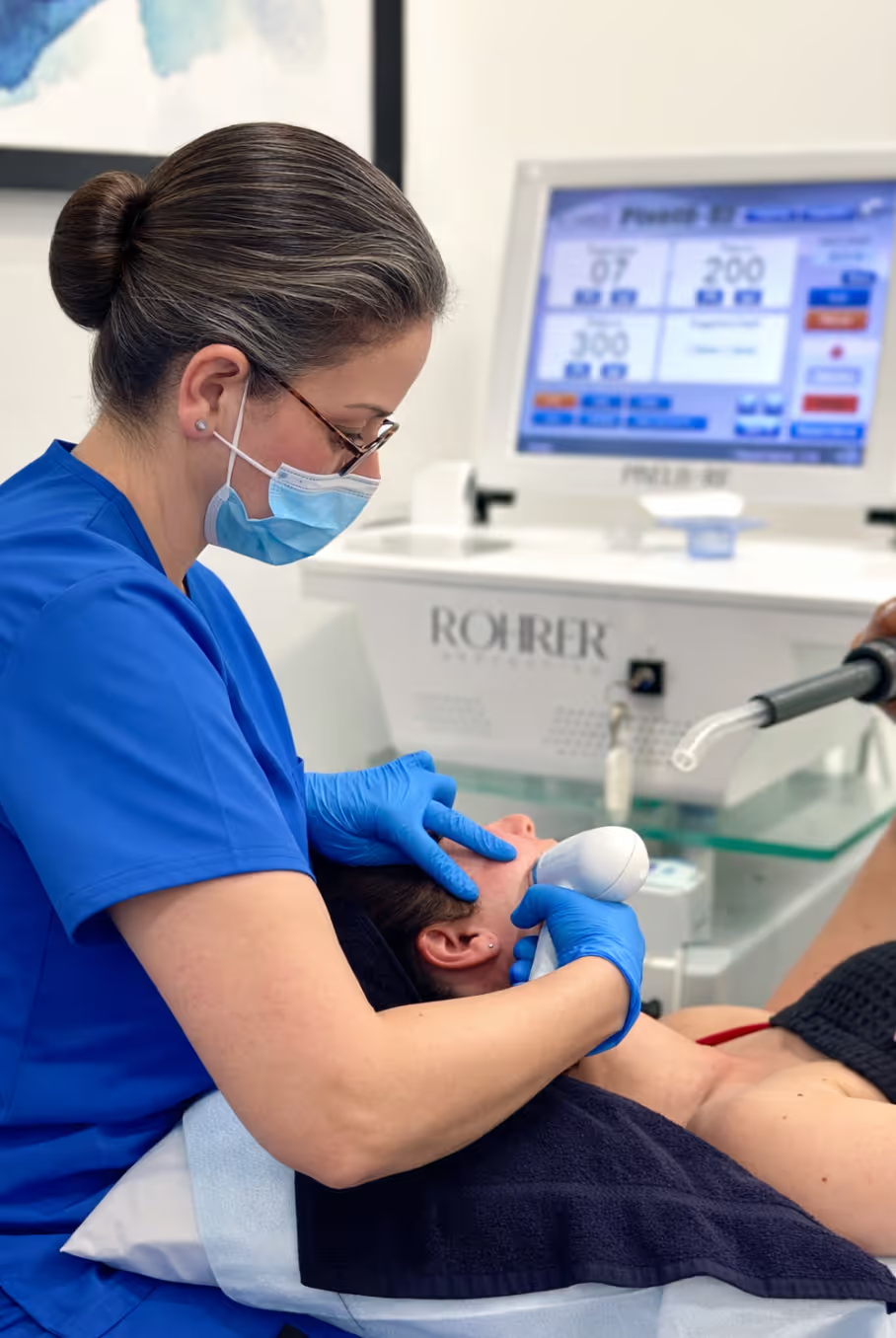
For patients with significant skin texture changes, thinning, or loss of elasticity contributing to static lines, resurfacing becomes the relevant category. CoolPeel Fractional Laser Resurfacing induces controlled injury to the skin that triggers a robust collagen remodeling response — the treated skin heals with improved texture, reduced fine lines, and greater density. This isn't a maintenance treatment; it's a more significant intervention with downtime, but for the right patient, the results address the underlying structural problem that neuromodulators were never designed to solve. Pixel8-RF radiofrequency microneedling offers a less aggressive alternative with less downtime, stimulating collagen through a different mechanism and building results progressively over several sessions.
Biostimulators like Sculptra represent another dimension of this conversation. Rather than filling a specific line or temporarily relaxing a muscle, Sculptra triggers the body's own collagen production over months, gradually improving skin quality, density, and support throughout the treated area. For patients whose static lines are part of a broader pattern of volume loss and skin laxity — which is the more common scenario after 45 — a biostimulator approach addresses the root cause rather than the surface symptom. Our team often discusses this in the context of the combination treatment approach that has largely replaced single-modality thinking in modern medical aesthetics.
What a Thoughtful Assessment Actually Looks Like
When a patient comes to us saying their Botox isn't working the way it used to, the first thing our team does is ask the right questions — and look carefully at what's actually happening in the face, not just what the patient is describing. Are the lines truly static or still dynamic? Has the dose been consistent? How frequently has treatment been occurring, and has the interval been shortening? What's the patient's activity level, stress history, and sun exposure pattern? Are there areas where the neuromodulator is clearly still working well alongside areas where it isn't — which would suggest a technique or dosing adjustment rather than a product switch?
The answer is almost never simply "switch to a different neuromodulator." Sometimes it is — and when it is, we'll tell you exactly why. More often, addressing the full picture requires thinking about what category of treatment best matches the actual problem. With a team carrying 70+ years of combined experience in medical aesthetics, these aren't abstract clinical questions; they're conversations our injectors have had hundreds of times with patients who came in exactly where you are now. The goal is never to recommend more — it's to recommend what's right.
If you're in Tysons, McLean, Vienna, or anywhere in Fairfax County and you've been wondering whether it's time to reassess your neuromodulator plan, we'd welcome the conversation. A consultation isn't a sales appointment — it's a chance to look at your skin honestly and figure out what's actually going to help.
Start your transformation
Schedule your consultation with our knowledgeable and friendly team.