Aging Neck Skin Responds Better to This Treatment Sequence

The neck has a way of revealing what the face has been quietly hiding. Clients who come to us after years of careful facial maintenance are often surprised — and frustrated — to find that the skin below their jawline tells a different story entirely. Neck laxity tends to accelerate faster than facial aging, and it responds differently to treatment. What works beautifully on the cheeks or forehead does not always translate to meaningful improvement when applied to crepey, loose neck skin without a thoughtful plan behind it.
After more than 70 combined years in medical aesthetics, our team at Tysons Elite Esthetics has learned something that does not appear in most treatment brochures: the sequence of neck rejuvenation matters as much as the treatments themselves. We see clients regularly who have received individual modalities elsewhere — a round of Ultherapy here, some filler there — without seeing the results they were promised. More often than not, the issue is not the treatment. It is the order.
Here is what our clinical experience consistently shows: attempting to tighten loose neck skin before addressing the quality of the skin itself produces limited, short-lived results. The tissue needs to be conditioned first. That typically means beginning with a regenerative foundation — often our Human Progenitor-Derived Exosomes, which Tysons Elite Esthetics is uniquely authorized to use in Northern Virginia. Applied in conjunction with microneedling, exosomes begin rebuilding the cellular environment of the skin, improving its capacity to respond to more intensive treatments that follow. When skin is structurally compromised — thin, dehydrated, and poorly vascularized — layering energy devices on top of it produces diminishing returns. You are asking a weakened material to contract and remodel when it lacks the biological infrastructure to do so. Starting with regenerative preparation changes that dynamic.
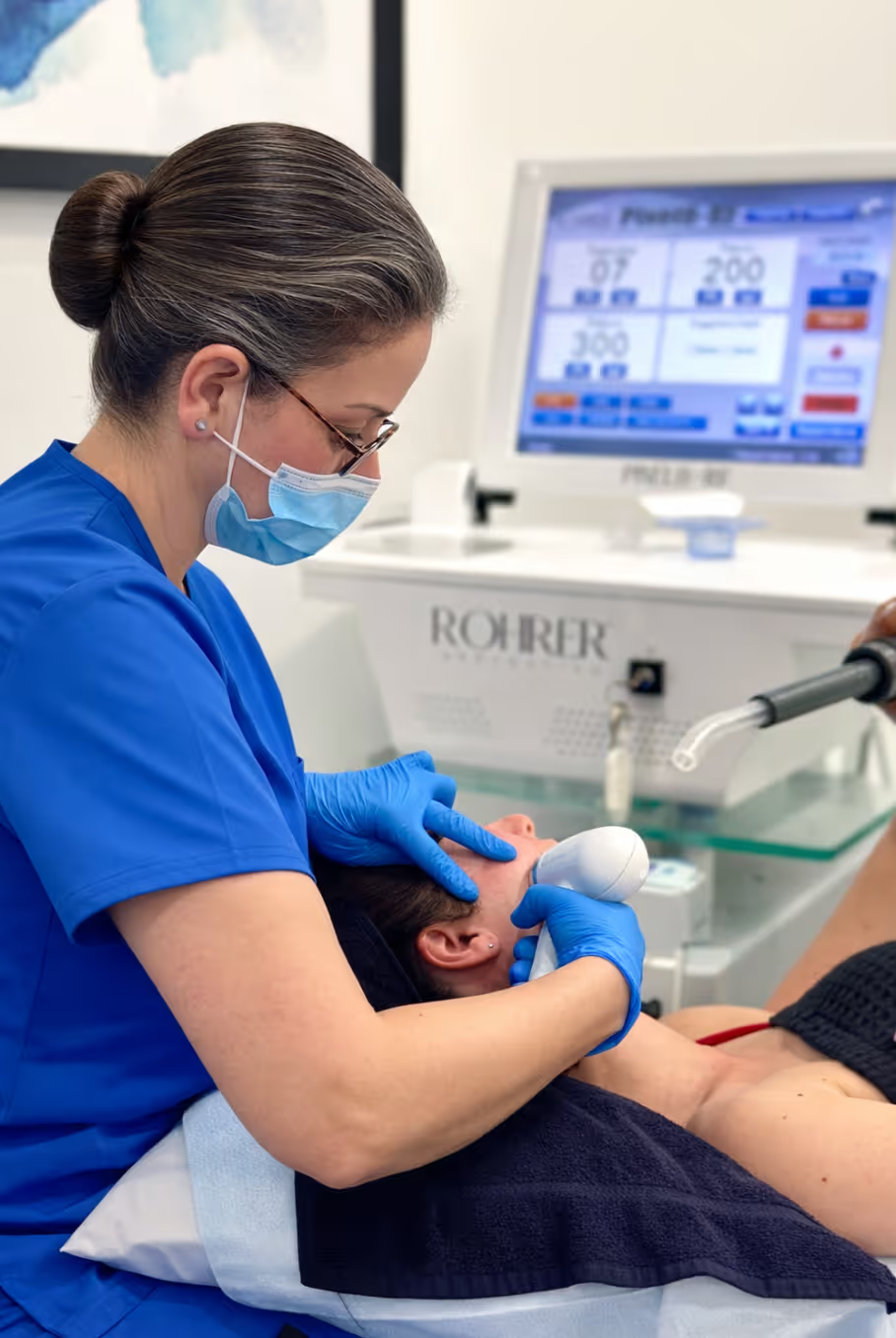
Once the skin's foundation has been strengthened, the next phase typically introduces a collagen-stimulating energy device. Pixel8-RF radiofrequency microneedling is frequently our first choice for neck laxity because it delivers fractional RF energy precisely into the dermis — triggering meaningful collagen remodeling without the recovery demands of ablative resurfacing. For clients with more significant laxity, we may incorporate CoolPeel Fractional Laser Resurfacing at a later stage in the sequence, once the tissue has shown it is ready to respond. The distinction matters: CoolPeel fractional laser on undertreated, unprepared neck skin can be unpredictable. The same treatment on skin that has been conditioned through prior regenerative and RF work tends to produce dramatically more reliable results.
Biostimulators have an important role in this sequence as well, though where they sit depends on the individual. For clients experiencing both laxity and volume loss below the jaw — a combination that becomes increasingly common after 50 — we often incorporate Sculptra or Radiesse into the mid-phase of treatment to build structural support from within. This is especially relevant for patients who have experienced significant weight changes, including those navigating the skin consequences of GLP-1 medications. A neck that has lost underlying volume will not tighten effectively with energy treatments alone; the tissue has nothing to contract toward. Restoring that support first allows tightening treatments to work with the anatomy rather than against it.
Neuromodulators — specifically the platysmal band injections associated with the Nefertiti lift technique — typically enter the sequence after the structural work has begun. Botox or Daxxify placed along the platysmal bands can relax the downward-pulling tension of the neck muscles, allowing the overlying skin to sit higher and smoother. When this step is taken before the skin itself has been treated, the muscular improvement is visible — but the skin quality still tells the story of its age. When it follows a period of regenerative and energy-based treatment, the combined effect is considerably more refined.
It is also worth noting that the neck and décolletage benefit enormously from coordinated treatment. Clients who focus exclusively on the neck while leaving the chest untreated often find that the visible boundary between treated and untreated skin becomes more pronounced over time — an outcome that can undermine the effect they worked for. Our team typically builds out a unified plan for both areas, using a combination of modalities calibrated to each zone's specific skin thickness, texture, and degree of laxity. If you have been exploring this area, our guide to neck and décolletage rejuvenation without surgery walks through many of these considerations in detail.
For clients who have been wondering whether it is too late to achieve meaningful improvement without going under the knife, the honest answer — based on what we see in practice — is that the right sequence of non-surgical treatments produces results that genuinely surprise people. Not because any single device is miraculous, but because when regenerative preparation, energy-based remodeling, structural support, and neuromodulator refinement are layered in the right order, the cumulative effect is substantially greater than any one treatment could achieve alone. That is the foundation of how we approach serious, non-surgical skin tightening — and why the conversation we have before your first appointment matters just as much as the treatments that follow it.
If you are based in McLean, Vienna, Falls Church, or elsewhere in Fairfax County and have been watching your neck change faster than you expected, we would welcome the chance to sit down with you, assess where your skin actually is, and build a sequence that is specific to your anatomy, your timeline, and your goals. That conversation is where real results begin.
Start your transformation
Schedule your consultation with our knowledgeable and friendly team.