Aging Skin Under Makeup: Which Treatments Actually Improve Cosmetic Wearability

There's a particular frustration that arrives quietly, usually sometime in your 40s or 50s. You've found a foundation you love, a concealer that used to work flawlessly, a setting routine that held all day. Then one morning the mirror tells a different story. The makeup that once glided over your skin is now settling into the fine lines around your mouth, emphasizing the texture along your cheeks, pooling faintly in the crepe beneath your eyes. You've tried switching products — lighter formulas, more hydrating primers, different application tools. Nothing quite solves it.
The honest answer is that no product fully solves a structural problem. What you're seeing in the mirror is not a makeup issue. It's a skin issue — specifically, the cumulative result of collagen loss, surface texture changes, and reduced hydration that come with age. The good news is that these are precisely the things medical aesthetic treatments address. If smoother skin texture is your goal, the path forward is understanding what's actually happening beneath the surface — and which treatments have a meaningful, measurable effect on cosmetic wearability.
Why Aging Skin and Makeup Stop Getting Along
Healthy, younger skin has a quality that makeup artists describe as "a good canvas" — a combination of even texture, adequate firmness, and natural moisture that allows product to sit on top of the skin rather than sink into it. As we age, several things happen simultaneously that erode that canvas.
Collagen and elastin production slows significantly after 30, and more rapidly after menopause. This leads to two related problems: first, the skin loses the structural scaffolding that keeps its surface smooth and plump; second, fine lines and pores that were once small enough to go unnoticed become visible channels that liquid and cream formulas flow directly into. At the same time, the skin's natural lipid barrier weakens, reducing its ability to retain moisture. Dehydrated skin — even in clients who drink water and use moisturizer — creates a surface that oxidizes and moves makeup faster.
There's also the matter of surface texture specifically. Sun damage accumulates over decades as microscopic areas of irregular pigmentation, slight surface roughness, and early actinic changes that make the skin's top layer uneven. Even a beautifully formulated foundation catches differently on rough patches than on smooth ones, which is part of why texture is often the first complaint clients raise when they notice makeup isn't wearing the way it used to.
Treating these concerns requires addressing the skin at multiple levels: the surface, the mid-dermis, and the deeper structural tissue. That's exactly why the clients who report the most significant improvement in how their makeup wears are the ones whose treatment plans address all three.
Surface Texture: Where Most Clients Need to Start
If your makeup is catching on rough patches, settling unevenly, or emphasizing pore size, surface texture is the primary problem. The treatments that create the most noticeable improvement here are the ones that actually remodel the skin's outermost layers — not just hydrate them temporarily.
Chemical peels are one of the most underrated tools in this category, particularly for clients who haven't tried a medical-grade formulation. The Vi Peel Precision Plus addresses surface irregularity, uneven pigment, and early sun damage in a single treatment with minimal disruption to a busy schedule — a meaningful consideration for clients who can't plan extended downtime. The result over a series is a measurably smoother surface that foundation simply glides over differently.
For clients whose texture concerns run deeper — acne scarring, larger pore structure, more significant sun damage — CoolPeel Fractional Laser Resurfacing delivers a level of surface renewal that topical products cannot approximate. The ablative process removes the outer damaged layer of skin while simultaneously stimulating collagen production in the dermis below, which means results improve for months after the initial healing period. Clients who have undergone CoolPeel resurfacing consistently describe a quality to their skin that makes foundation feel almost optional — which is, of course, exactly the goal.
Microneedling occupies an important middle ground. The microneedling pen creates controlled micro-injuries that stimulate collagen remodeling while refining surface texture — with significantly less downtime than ablative laser and a strong safety profile across a wide range of skin types. When combined with exosome therapy, the regenerative effect is substantially enhanced. As Northern Virginia's only med spa authorized to use Human Progenitor-Derived Exosomes, Tysons Elite Esthetics offers a version of this treatment that goes beyond standard microneedling in its ability to accelerate cellular repair and improve overall skin quality at the surface level. You can read more about microneedling with exosomes and how it differs from standard protocols.
Crepe and Fine Lines: The Texture Beneath the Texture
Fine lines and crepey skin present a slightly different challenge than rough surface texture. These are structural issues — the result of collagen and elastin loss in the dermis — and they require treatments that work at that deeper level rather than simply resurfacing the top layer.
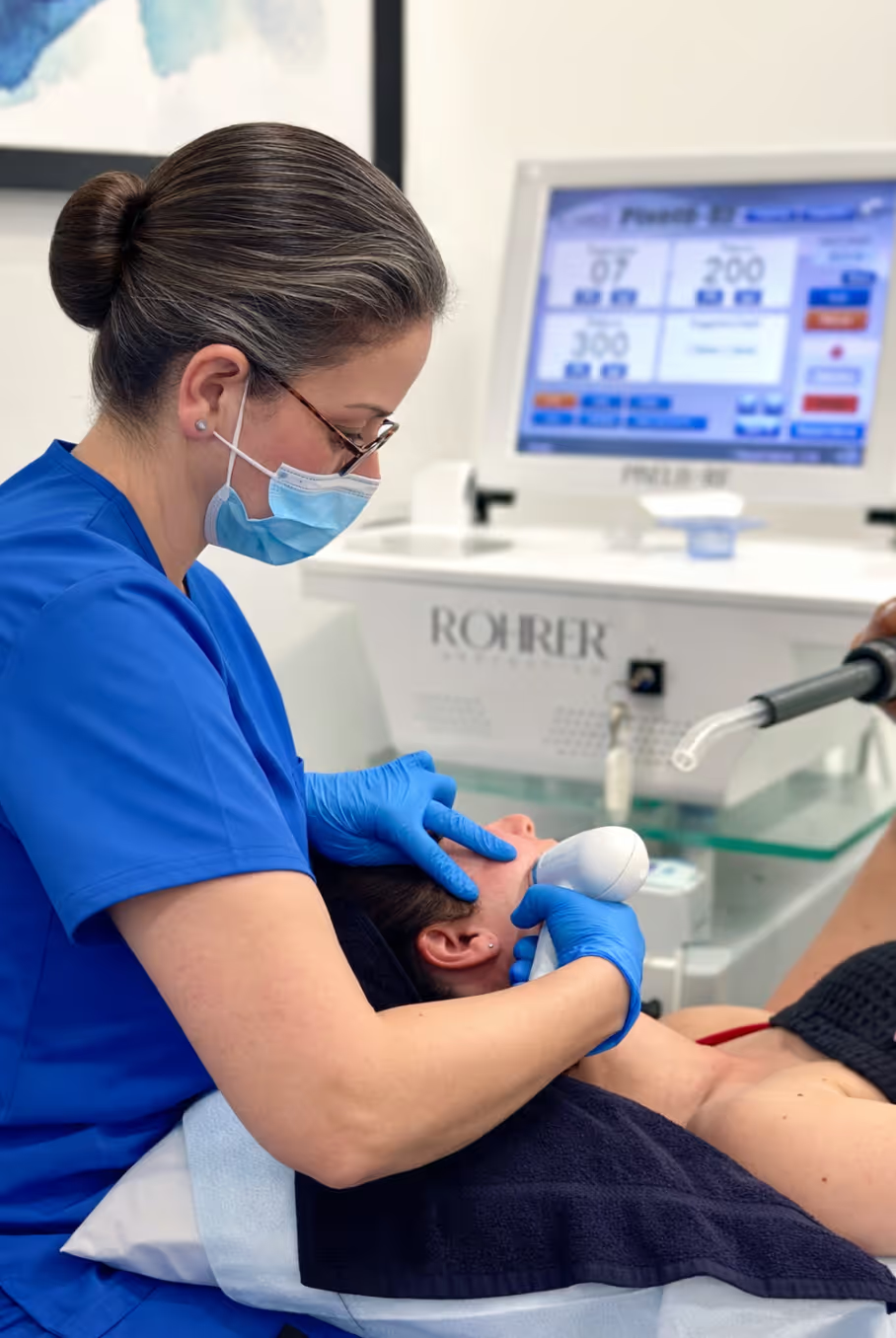
Radiofrequency microneedling is one of the most effective treatments available for this category of concern. The Pixel8-RF delivers radiofrequency energy through precision needles directly into the dermis, heating the tissue in a way that both tightens existing collagen and stimulates the production of new collagen and elastin over the following months. The result is skin that is measurably firmer, with fine lines that are genuinely less deep — not smoothed over with filler or obscured by product, but structurally improved. For clients whose primary makeup complaint is that foundation settles into lines around the mouth, nose, or under the eyes, RF microneedling addresses the root cause rather than the symptom.
It's worth noting that the clients at Tysons Elite Esthetics who report the most dramatic improvements in skin quality — including cosmetic wearability — are typically those on combination treatment plans rather than single-treatment protocols. Stacking RF microneedling with a surface-refining treatment like a chemical peel, or pairing it with a biostimulator like Sculptra, produces outcomes that neither treatment achieves alone. The team's 70+ years of combined experience in medical aesthetics is most visible here — in the ability to read each client's skin and design a plan that addresses multiple layers simultaneously without over-treating or creating an artificial result. You can explore the logic behind these combination approaches in our piece on combination skin tightening treatments.
Dehydration and Loss of Inner Glow: The Problem Primers Can't Fix
There's a specific quality that aging skin loses that is distinct from both texture and firmness — a kind of inner luminosity that used to make skin look naturally radiant without product. When this quality disappears, no highlighter fully replaces it. Foundation looks flat. Skin looks tired even when you're not. This is largely a hydration problem, but not the surface hydration that a moisturizer addresses. It's intrinsic hydration at the cellular level — the skin's ability to retain and distribute water within the dermis itself.
Skin booster injections and treatments like Profhilo work at this level, delivering hyaluronic acid directly into the dermis where it hydrates the tissue from within rather than sitting on top of it. The improvement in cosmetic wearability is often striking — clients describe their skin as looking "lit from within" in a way that translates directly to how foundation sits and how long it stays fresh. Our detailed comparison of Profhilo vs. dermal fillers is worth reading if you're not familiar with how skin remodeling treatments differ from volumizing ones.
The Oxifusion Facial is also worth considering for clients who want a same-day improvement in skin radiance and makeup wearability alongside longer-term treatment. This is one of the European medical aesthetic devices that distinguishes Tysons Elite Esthetics from standard med spas — an oxygen-based infusion treatment that delivers active ingredients into the skin while creating an immediate improvement in brightness and texture that clients often describe as the clearest their skin has looked in years.
Neuromodulators and Filler: The Role They Play in Makeup Wearability
Clients sometimes overlook the contribution that neuromodulators and strategic filler placement make to cosmetic wearability — not because they change the surface texture directly, but because they change the architecture beneath it.
When neuromodulators like Botox, Dysport, or Daxxify relax the muscles responsible for dynamic lines, those lines stop deepening with expression — which means foundation stops settling into them repeatedly throughout the day. A client who has treated forehead lines and crow's feet with a well-placed neuromodulator will find that makeup stays in place differently, particularly in areas where muscle movement was accelerating product breakdown.
Filler, when placed with the precision and restraint the team at Tysons Elite Esthetics prioritizes, restores the volume that gives skin its smooth, supported appearance. Hollow under-eyes, deflated cheeks, and flattened temples all create shadows and surface irregularity that no amount of color-correcting concealer fully neutralizes. Replacing lost volume — judiciously, with an experienced hand — restores the three-dimensional contour that skin needs to wear makeup evenly. The distinction between under-eye bags and hollow under-eyes is an important one here, because the treatment approach differs significantly and choosing the wrong one can worsen cosmetic wearability rather than improve it.
Where to Begin if You're Not Sure
If you're new to thinking about skin quality in terms of how it interacts with makeup, the most important first step is a thorough skin assessment — not a product consultation, but a clinical evaluation of what's actually happening in your skin. The team at Tysons Elite Esthetics takes time to understand not just what clients want to achieve, but the specific skin concerns driving those goals. That kind of individualized approach is what makes the difference between a treatment plan that produces real, lasting improvement and one that addresses the wrong problem entirely.
If you're not sure where to start with med spa treatments more broadly, our guide for new patients in Tysons is a useful introduction. And for those who have already been through a treatment or two and want to understand why they're not seeing the improvement in skin quality they expected, it's often worth revisiting the fundamentals — because the answer is almost always that at-home skincare and single-treatment protocols have a ceiling that professional combination care does not. That's a distinction worth understanding in detail, and one we explore in depth in our piece on what at-home skincare can't do.
Smoother skin texture isn't just an aesthetic goal. For clients in their 40s, 50s, and 60s who wear makeup daily, it's a genuine quality-of-life improvement — fewer minutes in front of the mirror, more confidence walking into a meeting or a dinner, and the quiet satisfaction of skin that looks the way it feels when it's at its best. That's a result worth pursuing with the right team.
Start your transformation
Schedule your consultation with our knowledgeable and friendly team.