Two Treatments at Once: When Stacking Makes Sense in Tysons

There's a moment in nearly every consultation when a client gestures at their face and says some version of: Can we just do everything today? It's a reasonable impulse. You've carved out the time, you're already here, and you want results. The question isn't whether combining treatments makes sense — sometimes it absolutely does — but whether the specific combination, on the specific day, in the specific order, will serve your skin or work against it.
Microneedling and Botox are two of the most requested treatments we see at Tysons Elite Esthetics. They address genuinely different concerns, and in many cases, they complement each other well. But the timing between them isn't arbitrary. There are clinical reasons for the guidelines we follow, and understanding those reasons helps you make a more informed decision — both about what to book and when to book it.
What Each Treatment Is Actually Doing to Your Skin
To understand why timing matters, it helps to understand what each treatment is doing at a physiological level.
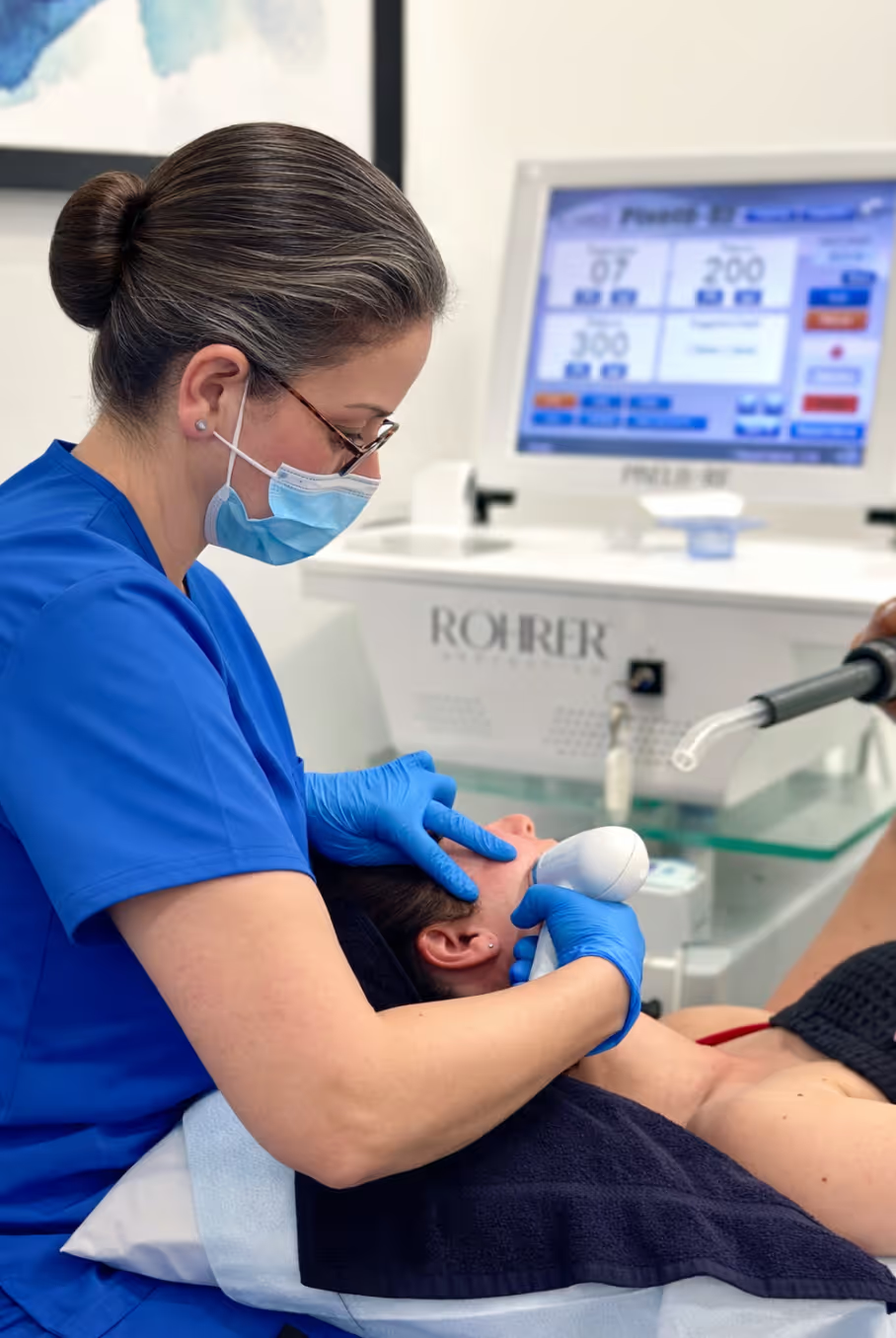
Microneedling — whether performed with a microneedling pen or with a device like Pixel8-RF radiofrequency microneedling — works by creating controlled micro-injuries in the skin. These injuries trigger your body's wound-healing response: collagen and elastin production increases, cellular turnover accelerates, and the skin gradually remodels. The process takes weeks to months to fully express itself, but in the immediate aftermath of a session, your skin is in a state of active recovery. The barrier is transiently compromised. Channels are open. Inflammation is present and intentional.
Botox — and its counterparts like Daxxify and Xeomin — works by relaxing specific muscles through precise injection of a neuromodulator. The product needs to stay exactly where it was placed. In the hours and days following injection, the neuromodulator is settling into the targeted muscle tissue. Any external pressure, manipulation, or disruption to that area carries the theoretical risk of product migration — moving it away from the intended site and toward unintended muscles.
These two biological realities are why we don't simply layer the treatments on top of each other without thought.
Can You Do Microneedling and Botox at the Same Time?
This is the most direct version of the question, and the honest answer is: it depends on what you mean by "at the same time," and it depends on your specific anatomy and treatment goals.
In some clinical scenarios, a skilled provider can perform Botox injections and microneedling in the same appointment — but typically with the neuromodulator administered first, followed by microneedling in non-overlapping zones, or with a deliberate buffer built into the sequence. This is not something to improvise. It requires a provider who understands how each treatment interacts, knows where the product was placed, and can adjust the microneedling depth and pressure accordingly.
What we generally advise against is microneedling directly over a freshly injected Botox site in the same session. The mechanical action of microneedling — the movement, the pressure, the micro-channels created — introduces real variables into where a neuromodulator ultimately lands. For most patients, the cleaner and safer approach is to separate the treatments, even if only by a few days.
If you're considering combination treatments for full-face rejuvenation, the conversation about sequencing should happen at your consultation — not at the front desk when you're checking in.
How Long After Botox Can You Get Microneedling?
The standard clinical guidance is to wait a minimum of two weeks after Botox before proceeding with microneedling. We typically recommend two to four weeks at Tysons Elite Esthetics, and sometimes longer depending on the dose administered and the areas treated.
Here's the reasoning: In the first 24 to 48 hours after injection, the neuromodulator is still migrating to its final position and binding to the target receptors. By day three or four, the product is generally settling. By the end of the first week, most patients begin to see the early effects. By two weeks, the full result is typically established — which is also why we schedule follow-up assessments at that interval.
Performing microneedling too soon after Botox introduces mechanical disruption to tissue that's still in a settling phase. Even with a skilled hand, the risk of unintended product spread increases. This is particularly relevant near the forehead and glabella, where neuromodulator migration — even modest — can affect brow position or eyelid heaviness. If you've ever read about heavy brows after Botox, you understand why precision at this stage matters.
Waiting the full two weeks also has a practical benefit: your Botox result is visible by then, which means we can assess what's working before adding another variable. If there's a touch-up needed, it's easier to identify and address before the skin has been through a microneedling session.
How Long After Microneedling Can You Get Botox?
The reverse question has a slightly different answer, and it's one that surprises some clients.
After a microneedling session, we recommend waiting at least two weeks before scheduling Botox — and for deeper treatments like RF microneedling, we may extend that to three to four weeks. The reason is that your skin is in active recovery during this period. Introducing needle injections into compromised tissue increases the risk of bruising, irritation, and uneven healing. More importantly, the inflammatory environment created by microneedling can theoretically interfere with how a neuromodulator behaves once injected.
There's also a practical reason to wait: your skin is changing. The first two weeks after microneedling involve visible recovery — initial redness, some peeling or tightness, gradual improvement in texture and tone. Assessing your face accurately for Botox placement is easier once that acute phase has resolved and your skin has returned to its baseline.
That said, the two-week guideline is a floor, not a ceiling. Some clients come in for microneedling and Botox in the same month with excellent results — they simply schedule them with appropriate separation. This kind of thoughtful treatment sequencing is something our team plans with you, not something you should have to figure out alone.
When Stacking Actually Makes Sense
The goal of combining treatments is synergy — each one doing something the other can't, without interfering with the other's mechanism. Microneedling and Botox can be a genuinely effective pairing when sequenced correctly.
Botox addresses dynamic movement. It softens the muscular contractions that etch lines into the skin over time — the crow's feet, the glabellar lines, the forehead creases. Microneedling addresses the texture, tone, and structural quality of the skin itself. It stimulates the collagen and elastin that give skin its resilience, and in combination with regenerative add-ons like exosomes, it can accelerate the remodeling process significantly.
Together, they work on two separate layers of the aging process: one targeting the muscles responsible for dynamic expression, the other rebuilding the skin matrix. When timed appropriately, they don't compete — they complement. Patients who maintain both treatments on a consistent schedule often see results that neither treatment could achieve alone.
At Tysons Elite Esthetics, this kind of pairing is something we discuss explicitly during consultations. Our team's combined 70+ years in medical aesthetics means we've seen what happens when timing is respected — and what happens when it isn't. The difference is not subtle.
If you're also considering other regenerative add-ons alongside microneedling, it's worth understanding the distinction between options like microneedling with PRP versus microneedling with exosomes — the choice of add-on affects both the depth of benefit and the recovery expectations.
What to Discuss With Your Provider Before Booking
Before you schedule either treatment — or both — there are a few things worth thinking through and raising with your provider:
What are your primary concerns? If movement-driven lines are the main issue, Botox may take priority. If skin texture, tone, and firmness are the focus, microneedling should come first. Many clients have both concerns, which is exactly where a sequenced plan is most valuable.
What's your timeline? If you have an event in four weeks, the order and timing of treatments matters. Microneedling requires recovery time that Botox doesn't, and Botox results take two weeks to fully develop. A provider who knows your social calendar can help you plan accordingly. This is something we address directly in posts like Botox timing before a major event.
Have you had either treatment recently? If you've already had Botox in the past few weeks, your provider needs to know — both the product used and where it was placed — before recommending microneedling. This isn't information that should be reconstructed from memory at the appointment; bring any records you have, or let us pull your history if you've been treated with us before.
Are you on any medications or supplements? Blood thinners, high-dose fish oil, NSAIDs, and certain vitamins can affect bruising and healing after either treatment. A thorough intake process covers this, but it's worth flagging proactively.
The decision to stack treatments is a clinical one, not a scheduling one. The best outcomes come from providers who plan with intention — not from fitting in as much as possible in one visit.
A Note on RF Microneedling Specifically
Standard microneedling and radiofrequency microneedling are related but not identical. RF microneedling — like the Pixel8-RF system we use at Tysons Elite Esthetics — delivers thermal energy through the needles, creating a deeper level of tissue remodeling than traditional microneedling alone. The recovery period is typically longer, the inflammatory response is more significant, and the tissue disruption is more substantial.
For this reason, the waiting period before introducing Botox after RF microneedling is generally longer than after standard microneedling. We typically recommend a minimum of three to four weeks. The same is true in reverse: if Botox has been administered recently, we'd want more time to pass before performing RF microneedling in overlapping zones.
If you're trying to understand how RF microneedling fits into a broader skin tightening plan — including how it compares to or works alongside other energy-based devices — the comparison between RF microneedling and laser resurfacing is a useful place to start.
The Short Version, for Those Who Want It
If you've had Botox, wait at least two weeks — and ideally three to four — before scheduling microneedling. If you've had microneedling, wait at least two weeks before getting Botox, and longer if your session involved radiofrequency. In some cases, a skilled provider can combine the treatments in one appointment with appropriate sequencing and zone separation, but this should be a deliberate clinical decision — not a matter of convenience.
The clients who see the best long-term results from combining these treatments are the ones who approach it as a plan rather than a one-time experiment. That planning is exactly what we do well.
Start your transformation
Schedule your consultation with our knowledgeable and friendly team.