Microcurrent Facials Versus RF Treatments: Which Actually Tightens Skin?

If you've spent any time researching non-surgical skin tightening, you've likely come across two very different categories of treatment: microcurrent facials, which have enjoyed a significant resurgence thanks to at-home devices and spa menus, and radiofrequency treatments, which have become a cornerstone of clinical aesthetics. Both are marketed with confidence. Both reference lifting, firming, and toning. And yet they work in fundamentally different ways — with meaningfully different outcomes, especially for patients who are dealing with genuine skin laxity rather than early-stage softening.
Understanding the distinction matters, particularly if you're weighing your options after 40 and looking for treatments that will hold up under scrutiny — not just in the week following your appointment.
What Microcurrent Actually Does
Microcurrent therapy delivers low-level electrical currents — measured in microamperes — to the facial muscles and overlying soft tissue. The theory behind it is compelling: by mimicking the body's own bioelectrical signals, microcurrent is thought to re-educate facial muscles, improve ATP (adenosine triphosphate) production at the cellular level, and encourage a modest increase in collagen and elastin synthesis over time.
In practice, microcurrent facials produce a visible, immediate result. Clients often leave looking more defined and lifted. Puffiness is reduced. Facial contours appear sharper. For many people, that immediate response is genuinely satisfying — and for certain candidates, particularly younger patients with good baseline skin quality and mild muscle laxity, a properly administered microcurrent series can deliver meaningful improvement.
What microcurrent does not do is remodel the deeper structural layers of the skin. It works primarily at the level of the muscle and superficial tissue, and its results are transient without consistent maintenance. Most clients require weekly or biweekly treatments to sustain the effect, and the results do not compound into lasting architectural change the way collagen-stimulating technologies do. There's also a ceiling: once significant skin laxity, volume loss, or dermal thinning has occurred, microcurrent simply does not have the tissue depth or thermal energy to address the underlying biology.
What Radiofrequency Actually Does
Radiofrequency (RF) energy works through a completely different mechanism. It delivers controlled thermal energy into the dermis and, depending on the device, into the deeper subdermal tissue. That heat does two things that matter enormously for skin tightening.
First, it causes immediate collagen fiber contraction — which produces a visible tightening effect shortly after treatment. Second, and more importantly for long-term results, it triggers a wound-healing response that stimulates new collagen and elastin production over the weeks and months that follow. This is genuine structural remodeling. The skin doesn't just look firmer in the short term; it becomes biologically denser over a three-to-six month period as new collagen matures.
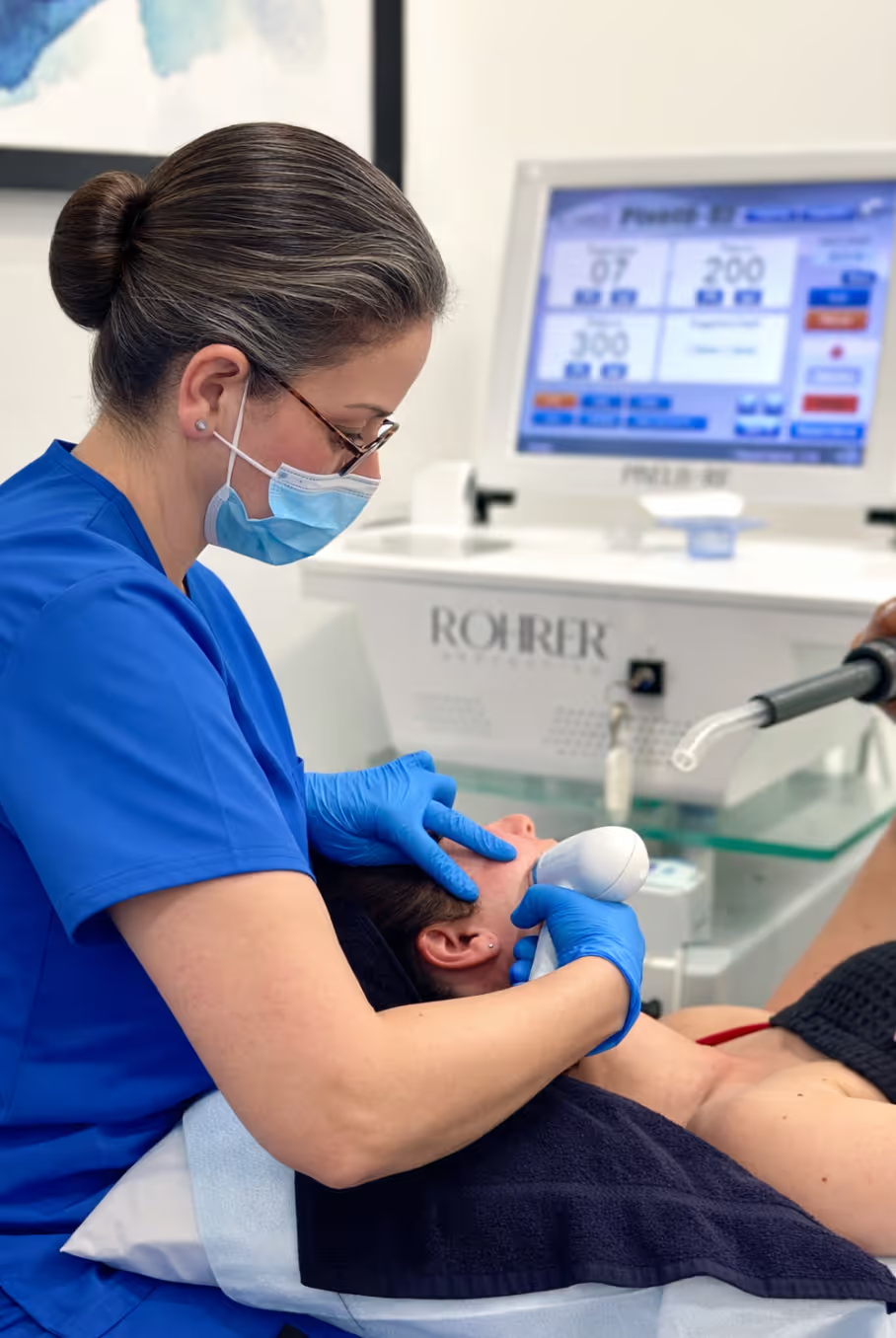
When RF energy is delivered via microneedling — as with Pixel8-RF Radiofrequency Microneedling — the precision increases substantially. The microneedles create micro-channels in the skin while simultaneously depositing RF energy at precise, adjustable depths. This allows the treating provider to target the exact tissue depth responsible for laxity, whether that's the mid-dermis or the subdermal layer depending on the concern being addressed. The combination of mechanical stimulation and thermal energy accelerates collagen induction well beyond what either approach achieves alone.
For patients researching rf skin tightening near me, it's worth knowing that not all RF devices are equivalent. The clinical outcome depends heavily on the device's technology, the depth capability of the system, and — critically — the experience of the provider operating it. Delivering RF energy at the wrong depth or with insufficient precision can mean underwhelming results at best and uneven outcomes at worst.
The Results Gap: What Clinical Evidence Shows
When you look honestly at the clinical evidence, the gap between microcurrent and RF for genuine skin tightening is significant.
Microcurrent studies show modest improvements in facial muscle tone and some evidence of increased collagen synthesis in shorter treatment windows — but the effect sizes are generally small, the populations studied tend to be younger, and durability without ongoing maintenance has not been strongly demonstrated. The technology has genuine merit in a comprehensive wellness and aesthetic routine, particularly as a complement to clinical treatments. As a standalone solution for skin laxity after 40, it falls short.
RF-based treatments, particularly RF microneedling, have a considerably stronger body of evidence behind them. Multiple peer-reviewed studies document measurable improvements in skin laxity, dermal thickness, and histological collagen density following RF microneedling series. Clinical photography consistently shows improvements in jaw definition, skin texture, and overall firmness that persist beyond six months — especially when patients follow appropriate maintenance protocols.
If you've been looking at non surgical face lift before and after images online and noticed that some results appear considerably more structural than others, the difference is often the technology underlying the treatment. The most compelling non-surgical facelift outcomes in clinical settings almost always involve energy-based devices — RF microneedling, RF alone, or combinations of RF with biostimulators — rather than topical or low-level electrical therapies alone.
For a deeper look at how combination approaches compound results, the discussion in Combination Skin Tightening Treatments is worth reading carefully, particularly if you're considering a multi-modal plan.
Who Is Each Treatment Right For?
Microcurrent facials are most appropriate for:
- Patients in their late 20s to mid-30s with good baseline skin quality who want to support muscle tone and maintain results from other treatments
- Anyone who has already undergone RF or other collagen-stimulating treatments and wants to extend results between sessions
- Patients who are not candidates for thermal energy treatments due to certain skin or medical conditions
- Those looking for a relaxing, zero-downtime facial experience with an immediate aesthetic benefit before an event
RF treatments — and RF microneedling in particular — are appropriate for:
- Patients in their late 30s through 60s experiencing visible skin laxity, jowl development, neck crepiness, or generalized loss of facial firmness
- Anyone who has been comparing options for a non-surgical facelift and wants clinically documented structural improvement rather than a temporary enhancement
- Patients who are concerned about skin quality alongside tightening — texture, fine lines, pore size, and mild scarring can all respond to RF microneedling simultaneously
- Those who want a treatment that compounds over time, with results continuing to develop for months after the session is complete
It's also worth noting that RF microneedling and microcurrent are not mutually exclusive. Some patients benefit from both: RF microneedling as the foundational remodeling treatment, with periodic microcurrent sessions to maintain muscle tone and support the skin in between. The key is understanding the role each plays — and not expecting one to do the job of the other.
What Separates a Good RF Outcome From an Average One
This is where clinical experience becomes the most important variable in the equation.
RF microneedling delivers energy into living tissue, and the outcome depends on choosing the correct needle depth, energy level, and pass pattern for each individual patient's skin quality, laxity pattern, and treatment goals. A 52-year-old woman with fair, crepey skin on the neck requires a different protocol than a 44-year-old with darker skin tone and concentrated laxity along the jawline. Generic settings and one-size-fits-all approaches produce generic results.
At Tysons Elite Esthetics, the team's 70+ combined years of experience in medical aesthetics means that patients are not receiving a templated protocol — they're receiving a clinical assessment followed by a personalized treatment plan. The difference in outcomes is real, and it's reflected in what clients consistently describe: results that look like themselves, only refreshed. As one patient put it, "my face looked five to six years younger" — not altered, not pulled, but genuinely more like they did years earlier.
For patients who have been researching whether different RF tightening technologies compare in clinical outcomes, or how RF microneedling stacks up against other energy devices, those comparisons are worth exploring in depth before committing to a treatment plan.
What to Expect From a Consultation
If you're weighing microcurrent against RF — or simply trying to understand which path forward makes sense for where your skin is now — the right starting point is always an honest, unhurried consultation with a provider who will look at your skin, ask about your history, and give you a clear-eyed assessment rather than a sales pitch.
That conversation should include: an evaluation of your current degree of laxity, a discussion of realistic outcomes and timelines, transparency about how many sessions you'd need to see meaningful change, and — importantly — an honest answer to the question of whether you're a better candidate for RF, a combination approach, or something else entirely. If you're earlier in the skin aging process, the answer may actually be that adding a collagen stimulator like Sculptra to an RF protocol will deliver far better long-term results than either alone.
The discussion in Biostimulator Treatments for Skin Laxity After 50 addresses exactly this — and is worth reading if you're trying to understand how modern skin tightening approaches layer different mechanisms for compounding benefit.
For patients who have already been evaluating their options more broadly, Sagging Jowls Without Surgery and What Is Skin Laxity and How Can Medical Aesthetics Treatments Help both provide useful context for understanding where RF microneedling fits within a full non-surgical tightening strategy.
Tysons Elite Esthetics serves patients in Tysons, McLean, Vienna, Falls Church, and throughout Fairfax County. If you're ready to move beyond the marketing and get a genuine clinical perspective on what will actually tighten your skin — and keep it that way — we're here for that conversation.
Start your transformation
Schedule your consultation with our knowledgeable and friendly team.