Microcurrent vs. RF: Which Device Actually Tightens Aging Skin?

If you've spent any time searching for non-invasive skin tightening options, you've likely come across both microcurrent facials and radiofrequency treatments — often positioned side by side, as if they're two versions of the same thing. They're not. These technologies work through fundamentally different mechanisms, produce different results on different timelines, and are suited to different skin concerns. Getting that distinction right before you invest your time and money matters — particularly if what you're actually after is meaningful tightening of aging skin, not a temporary refresh.
At Tysons Elite Esthetics, we work with clients across McLean, Vienna, Falls Church, and Fairfax County who come in having done their research — and still feel uncertain about which path makes sense for their skin. That uncertainty is understandable. The marketing language around both modalities tends to blur the lines. This post is our attempt to draw them clearly.
What Microcurrent Actually Does — and What It Doesn't
Microcurrent therapy delivers low-level electrical current to the facial muscles and skin. The technology was originally developed for medical rehabilitation purposes — specifically for facial paralysis — and has since been adapted for aesthetic use. The idea is that mimicking the body's own bioelectrical signals can re-educate and tone facial muscles, while also stimulating ATP (adenosine triphosphate) production, which supports cellular repair and collagen synthesis.
In practice, microcurrent facials produce a visible lifting and contouring effect — the kind of result that makes you look refreshed and rested in the days immediately following a session. Brow position often appears elevated. The jawline looks slightly more defined. Skin tone appears more even. For clients searching for a microcurrent facial near me, this is typically the experience they're anticipating: a treatment that delivers visible results with essentially zero downtime and a genuinely pleasant in-office experience.
The important caveat: these results are cumulative and require regular maintenance. Microcurrent doesn't create structural change in the dermis the way energy-based devices do. It works at the level of muscle tone and cellular stimulation — meaningful, but limited when the underlying concern is true skin laxity caused by collagen loss, elastin degradation, and dermal thinning. If your skin has begun to lose its structural integrity — which typically accelerates in your 40s and beyond — microcurrent alone is unlikely to address the root cause.
That said, microcurrent remains a genuinely useful tool in the right context. For clients in their 30s beginning to see early softening, for those maintaining results between more intensive treatments, or for anyone who needs to look their best with no downtime before an event, it holds real value. Think of it less as a facelift alternative and more as a high-quality maintenance protocol.
What Radiofrequency Skin Tightening Actually Does
Radiofrequency (RF) technology works through a different mechanism entirely. Instead of stimulating muscles with electrical current, RF devices deliver controlled thermal energy into the dermis — heating tissue to a precise temperature that triggers collagen contraction and initiates a wound-healing response. Over the weeks and months that follow, the body produces new collagen and elastin as part of that response. The result is progressive, structural tightening that builds over time rather than fading between appointments.
This is the key distinction: RF addresses the biological cause of skin laxity, not just its surface appearance. When collagen fibers contract under heat, immediate tightening occurs. When the regenerative process that follows deposits new collagen into the dermis, longer-term firmness develops. For clients experiencing true skin looseness — on the lower face, jawline, neck, or around the eyes — this mechanism is far more relevant than anything microcurrent can provide.
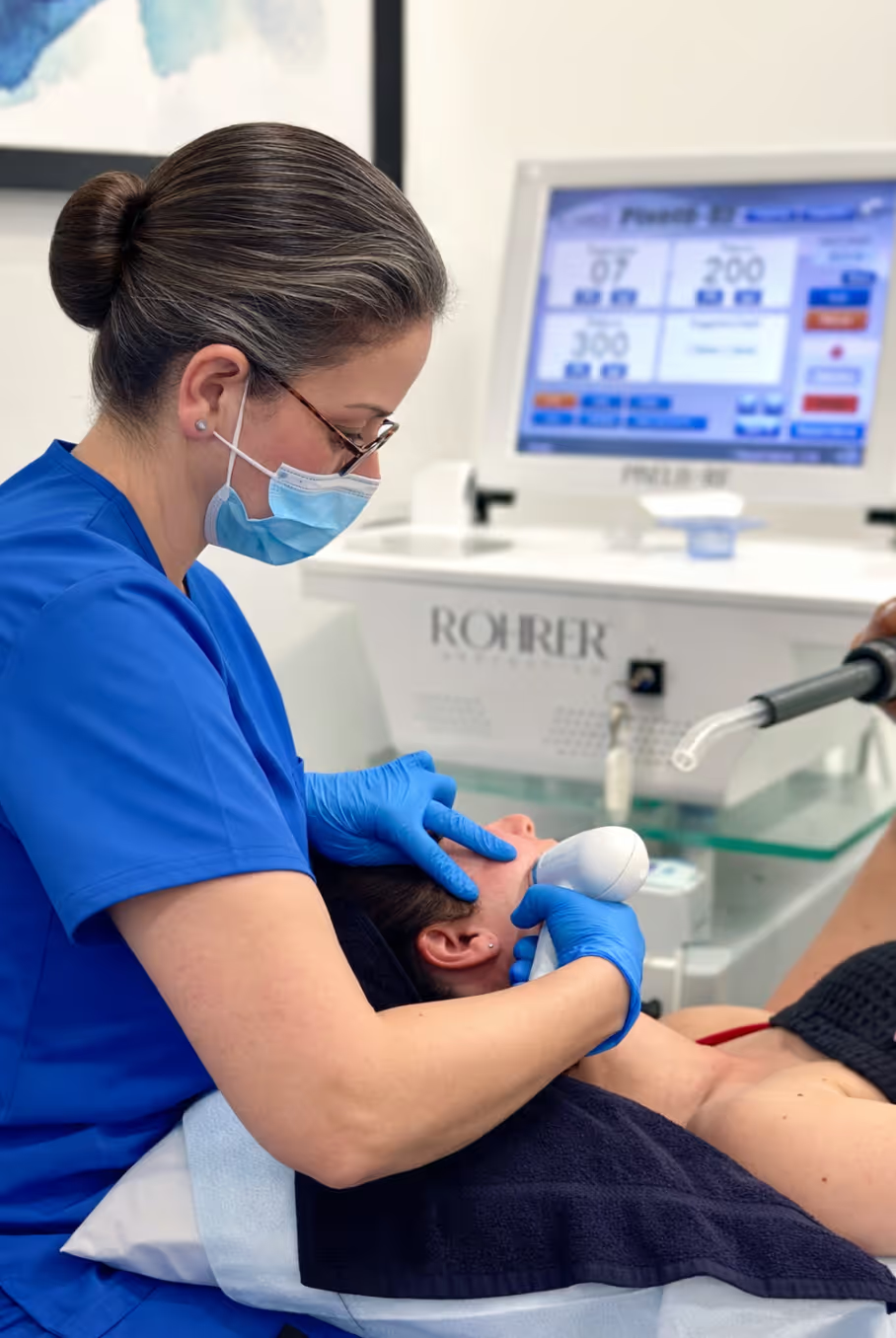
RF is delivered through several different device configurations, each with a different depth of penetration and clinical application. Standalone RF devices treat the superficial and mid-dermis. RF microneedling — such as our Pixel8-RF system — combines microneedling with RF energy delivered at precise depths via insulated needles, reaching deeper into the dermis and subdermal tissue where the most significant structural changes occur. This combination allows for both surface texture improvement and deep collagen remodeling in a single treatment.
For clients specifically searching for RF skin tightening near me, it's worth asking not just whether a practice offers RF, but which RF platform they use, at what depths they're treating, and whether their device is capable of the kind of precision that produces consistent, measurable results. These are not trivial distinctions.
How the Results Compare — Honestly
Microcurrent results are immediate and transient without consistent maintenance. You'll leave a session looking noticeably lifted and refreshed. That effect begins to fade within days to a week. Cumulative benefit develops over a series of treatments and requires ongoing sessions to sustain. There is no lasting structural change in the dermis.
RF results are progressive and lasting. Most clients begin to notice improvement four to six weeks after a session, with peak results visible at three to six months as the collagen remodeling process completes. A series of two to four treatments is typically recommended for optimal outcomes, with maintenance once or twice per year thereafter. The structural improvement — measurable tightening of the dermis — persists in a way that microcurrent results do not.
This doesn't make microcurrent inferior as a category. It makes it a different tool for a different job. The question is always: what is your actual skin concern, and what mechanism of action addresses it?
If you're in your late 30s and want to maintain tone and brightness between more intensive treatments, microcurrent may be exactly right. If you're in your 40s or 50s and dealing with visible laxity — the kind of softening along the jawline, under the chin, or around the lower face that skincare and facials can no longer address — RF microneedling is the more clinically appropriate conversation to have. As we've written before, serious skin tightening often starts with the right device combination, and RF sits at the core of that approach for most of our clients with meaningful laxity.
The Non-Surgical Facelift Question
Both microcurrent and RF are frequently marketed under the umbrella of a non surgical facelift — a term that, to its credit, captures what patients are actually looking for, even if it oversimplifies the clinical reality. The honest answer is that neither technology replicates surgical outcomes. What they can do, particularly when combined thoughtfully, is produce meaningful rejuvenation that was simply not available outside of an operating room a decade ago.
RF microneedling — particularly at the depths and energy levels achievable with a precision platform like Pixel8-RF — can produce tightening results that are visible, durable, and, for the right candidate, genuinely significant. When we pair RF microneedling with complementary treatments — biostimulators like Sculptra for volume restoration, neuromodulators for dynamic line reduction, or skin boosters for dermal hydration — the cumulative effect begins to approach what some clients have described as transformative. We've had clients tell us their face looked five or six years younger. We've heard that their skin has never looked or felt better. Those outcomes don't come from any single device. They come from a well-constructed treatment plan and a team experienced enough to build one.
For clients who want to understand how these devices fit into a broader skin tightening strategy, our posts on Morpheus8 vs. Ultherapy for facial tightening and what to expect from RF microneedling for skin laxity offer useful additional context.
Which One Is Right for You?
The answer depends on what your skin actually needs — which is a conversation worth having in person, not one that can be fully resolved by a blog post, no matter how thorough. What we can offer here is a framework.
If your primary concerns are fatigue, dullness, mild softening, and you want a treatment that is pleasant, requires no downtime, and delivers visible same-day results, microcurrent is worth exploring — particularly as part of a maintenance protocol.
If you're dealing with true skin laxity — visible looseness along the jawline, sagging below the chin, crepiness around the eyes or neck, or loss of structural definition that skincare products can no longer address — RF microneedling is the more appropriate starting point. The underlying cause is collagen loss, and RF is one of the most clinically validated tools we have for stimulating new collagen production in a controlled, reproducible way.
If you're uncertain which category describes your skin, that's precisely why a consultation exists. Our team brings more than 70 combined years of medical aesthetic experience to that conversation. We don't take a one-size-fits-all approach — every recommendation we make is grounded in what we actually see in your skin, your history, and your goals. Not what sounds most marketable.
If you're in Tysons, McLean, Vienna, or anywhere in Northern Virginia and want a clear-eyed assessment of where your skin is and what it actually needs, we'd welcome the conversation.
Start your transformation
Schedule your consultation with our knowledgeable and friendly team.