Mid-Year Skin Check: Are Your Treatments Actually Working?

There's something about the middle of the year that prompts reflection. You've kept your January resolutions — or haven't. You've had a few treatments, maybe adjusted your routine, and now you're catching your reflection in the unforgiving summer light and asking a question that deserves a real answer: is any of this actually working?
It's a fair question, and one we welcome at Tysons Elite Esthetics. Clients who ask it are usually the ones who get the best long-term results — not because they're more demanding, but because they're paying attention. The mid-year mark is genuinely one of the best moments to assess what's happening with your skin, what's performing as expected, and where a thoughtful adjustment could make a meaningful difference.
What "Working" Actually Means — and Why It's More Nuanced Than You Think
Before evaluating any treatment, it helps to clarify what you were expecting versus what the treatment was designed to deliver. This sounds obvious, but it's where most confusion begins. Botox, filler, energy devices, and regenerative treatments all operate on completely different timelines and mechanisms — and comparing them without that context leads to premature conclusions in both directions.
Clients sometimes tell us a treatment "didn't work" when, clinically, it performed exactly as intended — but the result wasn't visible yet, or they were evaluating the wrong area, or the concern required a different approach altogether. Conversely, some clients assume everything is fine when they've quietly metabolized their neuromodulator early and lost muscle relaxation weeks ago without noticing. A mid-year check-in exists precisely to close that gap.
How Do You Know If Botox Is Working?
Botox is one of the most common treatments we see clients second-guessing — usually because the timeline for onset and full effect isn't well understood. If you're wondering what does Botox feel like when it starts to work, the honest answer is: you may not feel much at all, but you'll notice it.
In the first 24 to 48 hours after injection, there's typically no change. Between days three and five, most clients notice the first signs — movement feels slightly restricted in the treated area, and it takes more effort to make certain expressions. By days seven to ten, the effect deepens. And the question of how long until Botox fully works has a consistent clinical answer: two weeks. At the two-week mark, your provider can accurately assess the result and determine whether any refinement is warranted.
So if you had Botox in late spring and you're reading this in mid-July, you are now at a point where the result should be fully visible and performing. Ask yourself: Has the movement in the treated area been appropriately softened? Are you seeing the expression lines you wanted to address less prominently at rest? Is the result still present, or has it begun to fade?
If your results wore off faster than expected, that's worth discussing. There are specific reasons — from muscle mass and metabolism to injection technique and dosage — that explain why some clients consistently see shorter duration. We've written about this in depth in our post on Botox results lasting less than 3 months. The solution is almost never to simply wait longer — it's to understand the mechanism and address it directly.
And if you're still uncertain how you know if Botox is working in a treated area: the clearest indicator is reduced dynamic movement. Gently attempt the expression the treatment targeted — a furrowed brow, raised forehead lines, squinted crow's feet. If full range of motion is still present without any restriction, your neuromodulator may not have taken full effect, may have been undertreated, or may have metabolized early. Any of these is addressable.
Evaluating Your Filler Results at the Midpoint
Filler operates on an entirely different timeline than Botox, and the mid-year check-in is an excellent moment to assess how your volume results have held. Most hyaluronic acid fillers placed in the first quarter of the year — January through March — will be approximately four to six months old by July. Depending on the product used, the area treated, and your individual metabolism, you may be at peak result, beginning to notice subtle settling, or in need of a maintenance touch.
The important thing to assess honestly is whether the result still looks like you — a refreshed, slightly younger version — or whether it's shifted into territory that feels off. Filler migrates differently in different areas over time. In the lips, it tends to soften and spread slightly. In the cheeks and midface, well-placed filler can look excellent for a year or more. Under the eyes, results are often more nuanced and may require earlier evaluation.
If you've been carrying filler from previous providers for multiple years without reassessment, now is the time to have an honest clinical conversation. Our post on when hyaluronidase makes sense first addresses this directly — sometimes the right starting point is a reset, not an addition.
Skin Tightening and Energy Devices: The Patience Problem
If you had RF microneedling, Ultherapy, or any collagen-stimulating energy treatment in January, February, or March, here is what to know: you may only now be seeing the beginning of your full result. These treatments work by stimulating your body's own collagen remodeling process, which takes three to six months to complete. By mid-July, a treatment performed in January is finally at or approaching its peak.
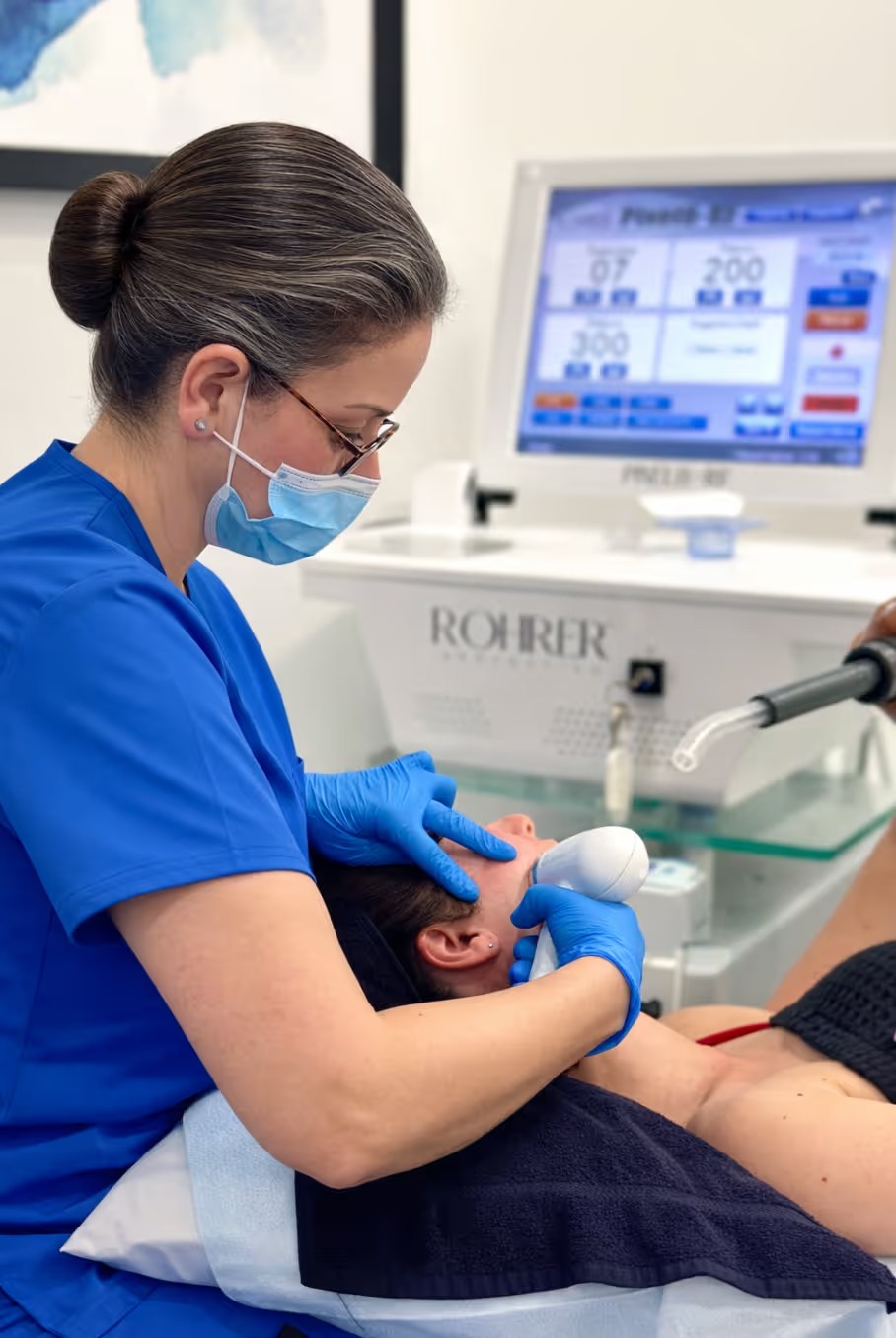
This is the category where most patients prematurely conclude a treatment "didn't work" — and most often, they simply needed more time. If you had Pixel8-RF radiofrequency microneedling in the first quarter, compare your current skin texture and firmness not to your immediate post-treatment skin, but to photographs from before your treatment. Side lighting and a consistent angle matter. The difference is frequently more visible in photographs than in the mirror, where we unconsciously normalize gradual improvement.
That said, if you are now six-plus months out from an energy device treatment and genuinely see no change in texture, laxity, or skin quality, that conversation is worth having. The cause might be suboptimal settings, an insufficient number of sessions, or a skin concern that would respond better to a different modality or combination approach.
Regenerative Treatments: A Different Set of Expectations
Clients who have incorporated exosome therapy, polynucleotides, or biostimulators like Sculptra into their plans this year are working with a category of treatment that prioritizes cumulative skin health over immediate visual change. The question "is this working?" requires a different lens entirely.
With Sculptra, for instance, the collagen production timeline means you should be evaluating changes in facial volume and structural support around the three-month mark after your final session — not after the first. If your Sculptra series concluded in early spring, mid-July is precisely when you should begin seeing meaningful results in skin firmness and volume distribution.
Exosome treatments, whether delivered topically post-microneedling or through our exclusive Human Progenitor-Derived Exosome protocols, support cellular communication and skin regeneration in ways that don't always produce dramatic before-and-after photography. What clients consistently report instead is a qualitative shift — skin that feels different, holds hydration better, recovers faster, and generally behaves more like younger skin. If you're not noticing that shift, it's worth discussing whether the protocol you received was appropriate for your concern and whether additional sessions would compound the benefit.
Your Skincare Routine Is Part of the Equation
Mid-year is also the moment to be honest about your at-home maintenance. The most precisely administered in-office treatment is working against resistance if you've let your medical-grade skincare lapse, changed products impulsively, or compromised your skin barrier with over-exfoliation in the summer heat.
If you've been using a retinol or tretinoin product and noticed unexpected irritation or what seemed like a breakout, our post on retinol purging versus breakouts explains how to tell the difference — and whether to push through or step back. Sun protection in July is equally non-negotiable; UV exposure is the most reliable way to undermine any skin investment you've made this year. The Virginia summer isn't forgiving, and July heat is actively accelerating skin aging in ways that are worth understanding before the damage accumulates further.
What to Do If Something Isn't Adding Up
If your honest assessment leaves you uncertain — if results feel incomplete, if you're not sure whether what you're seeing is normal progression or a gap in your plan — the right move is a clinical conversation, not more time spent waiting or second-guessing.
Our team brings 70+ years of combined experience in medical aesthetics, and these mid-year check-ins are genuinely one of the most productive conversations we have with long-term clients. We're not looking to add treatments for the sake of adding them. We're looking at what you actually had done, when you had it, what your skin is doing now, and whether the trajectory makes sense. Sometimes the answer is that everything is progressing exactly as expected and you simply needed reassurance. Sometimes one targeted adjustment changes everything.
Either way, the conversation is worth having. If you're in Tysons, McLean, Vienna, or anywhere in the greater Fairfax County area and you're due for a check-in, we'd welcome the opportunity to look at your plan with fresh eyes — and make sure the second half of 2026 builds meaningfully on the foundation you've already established.
Start your transformation
Schedule your consultation with our knowledgeable and friendly team.