Retinol Purging Versus Breakouts: What Tysons Patients Must Know

You finally committed to a medical-grade retinol serum. The consultation went well, your provider walked you through the protocol, and you felt genuinely excited about what the next few months could bring. Then, about two weeks in, your skin starts doing something unexpected — congestion surfaces, small bumps appear along your jaw, maybe a blemish or two around your cheeks. And the question that stops almost every new retinol user in their tracks: Is this normal, or did I just make my skin worse?
It's one of the most common concerns our team hears from clients in Tysons, McLean, and Vienna who are new to prescription-strength or medical-grade retinoid regimens. The answer matters — because responding incorrectly can either lead you to abandon a treatment that was actually working, or, on the other end, push through a product reaction that's doing real harm. Understanding skin purging versus breakout isn't just reassuring trivia. It's the difference between a protocol that transforms your skin over six months and one that quietly damages it.
What Skin Purging Actually Is — and Why It Happens
Skin purging is a temporary, physiologically predictable response to ingredients that significantly accelerate cellular turnover. Retinol — and its more potent counterparts, tretinoin and retinaldehyde — works by binding to retinoic acid receptors in the skin, which speeds up the rate at which cells shed and regenerate. Normally, your skin's natural cell cycle takes approximately 28 to 40 days, lengthening as you age. Retinoids compress that cycle dramatically, pushing it closer to 14 to 21 days at therapeutic concentrations.
What this acceleration means in practical terms: anything sitting beneath the surface — microcomedones that were already forming, congestion that hadn't yet declared itself — gets pushed to the surface faster than it otherwise would have. You aren't developing new breakouts in the true sense. You're watching a queue of existing skin issues arrive ahead of schedule, compressed into a shorter window. The skin is, paradoxically, doing exactly what it's supposed to do. It just looks alarming while it's happening.
This is why the question of skin purging versus breakout is so often misread by patients who are self-managing their retinol use without professional guidance. Purging looks like breakouts. Without context, it's genuinely difficult to tell them apart — which is precisely why we always prefer our clients begin medical-grade retinol protocols under the direction of a provider who knows their skin baseline, not through trial and error with an over-the-counter product they picked up based on a recommendation from a friend.
Purging vs. Breakout: The Clinical Differences
While no image or description can fully replace an in-person assessment — and if you've been searching for skin purging versus breakout pictures to self-diagnose, we'd gently encourage you to come in instead — there are distinguishing characteristics that point in one direction or the other.
Location. Purging tends to appear in areas where you already experience congestion or breakouts. If you've historically had clogged pores along your chin, jawline, or nose, that's where purging will surface. If blemishes are appearing in places that have never been prone to breakouts — your cheeks, forehead, or around your eyes — that's a meaningful signal worth paying attention to. A true irritation-driven breakout, or a product reaction, is less predictable in its geography.
Lesion type. Purging tends to manifest as small, superficial whiteheads or come-and-go congestion that resolves relatively quickly — individual blemishes that arrive and clear within a week or less. A breakout driven by an adverse product reaction is more likely to linger, deepen, become inflamed, or not follow the typical blemish lifecycle. Cystic, painful, or spreading lesions are not purging.
Timeline. Purging has a natural endpoint. Most clients experience it most intensely in weeks two through six of a retinol regimen, with gradual resolution as the skin adapts and the backlog of microcomedones is cleared. If you are several months into a retinol protocol and your skin is still actively breaking out — or if it never settled — something else is happening.
Response to adjustment. If you reduce the frequency of your retinol application from nightly to every third night and the skin calms noticeably, that points toward irritation rather than purging. Purging typically continues at a similar pace regardless of minor frequency adjustments, because the underlying cell cycle acceleration is already in motion. Irritation is more sensitive to dosage changes.
Why Medical-Grade Retinol Changes the Equation
Not all retinol is the same, and this distinction is foundational to understanding what you can realistically expect — and how to manage it. Over-the-counter retinol products vary wildly in concentration, encapsulation technology, and actual bioavailability. Many contain retinol in percentages too low to produce meaningful cellular turnover, which means patients who have used drugstore retinol for years without incident may assume they have "retinol-tolerant" skin — only to be surprised when a properly formulated medical-grade retinol serum produces a purge response the OTC product never triggered.
Medical-grade retinol formulations, including encapsulated delivery systems that time-release the active ingredient through the stratum corneum, are designed to reach the dermis at concentrations sufficient to produce real change. That efficacy is a feature — but it also means the adaptation period is real, and it requires proper sequencing. Our clients who come in having read our comparison of tretinoin versus medical-grade retinol arrive with a much clearer picture of what to expect, and they're consistently better prepared for the initial adjustment period as a result.
The clinical advantage of beginning a medical-grade retinol protocol under professional supervision isn't just about the product itself — it's about the full protocol design. Which supporting ingredients you pair with your retinol matters significantly. A robust moisturizing barrier, appropriately timed application, and the right cleansing approach can substantially reduce the intensity of the adaptation response without compromising efficacy. There is no reason the initial weeks of retinol use have to be a skin crisis.
What Purging Looks Like — and What It Doesn't
Because patients frequently search for skin purging versus breakout pictures hoping for a visual confirmation, it's worth being direct about the limitations of that approach. Images circulating online often lack clinical context: the person's skin type, their specific retinoid concentration, how long they'd been using the product, what else was in their regimen. Two patients with identical retinol products and nearly identical skin types can have meaningfully different purging responses based on the concentration and integrity of their skin barrier going in.
What we observe clinically in patients who are genuinely purging: small comedones and minor whiteheads clustered in historically congested zones, mild increase in skin texture for several weeks, and then a measurable clearing and smoothing that typically begins around weeks four to eight. Skin starts to look better than it did before retinol began. Pore appearance improves, texture becomes more refined, and the overall quality of the complexion begins to shift in the direction the treatment promised.
What we observe in patients who are reacting adversely: spreading inflammation beyond typical breakout zones, sustained redness that doesn't resolve with barrier support, blistering or peeling beyond the mild flaking that can accompany retinol use, and skin that feels increasingly reactive over time rather than settling. These patients need a protocol adjustment, not reassurance to push through.
If you are uncertain which category you fall into, that uncertainty itself is the signal to come in. A brief assessment takes far less time than the weeks many patients spend second-guessing themselves before reaching out.
How to Support Your Skin Through the Adaptation Period
The goal during a retinol purge is to support the skin's barrier function enough to keep the process manageable without suppressing the cellular turnover that's driving your results. Several practical principles apply regardless of the specific retinol formulation you're using.
Reduce, don't abandon. If weeks two through four feel particularly intense, dropping application frequency from nightly to every other night — or even every third night — gives the skin additional recovery time between doses without stopping the process entirely. Many clients find that a "low and slow" approach in the first six weeks produces the same eventual outcome with less initial disruption.
Prioritize barrier repair ingredients. Ceramides, niacinamide, and peptide-based moisturizers are particularly well-suited to the retinol adaptation period. They support the stratum corneum without occluding pores, and they counterbalance the mild irritation that can accompany accelerated turnover. What you do not want is a heavy, comedogenic occlusive used in an attempt to calm things down — it can trap the very congestion you're trying to resolve.
Protect with SPF, without exception. Retinol increases photosensitivity, and sun exposure during an active purge can worsen inflammation, create post-inflammatory hyperpigmentation around blemishes that are surfacing, and undermine the results you're working toward. In July heat — particularly relevant for our Northern Virginia clients right now — this is non-negotiable. If you've been managing summer-related skin changes alongside your retinol introduction, it may be worth pausing to read about how July heat accelerates skin aging in ways that compound the stakes of sun protection.
Don't stack actives. During the first six to eight weeks of a new retinol protocol, this is not the moment to introduce exfoliating acids, vitamin C at high percentages, or other potentially sensitizing ingredients. Layering actives during the purge period amplifies irritation without accelerating results. Simplicity in the rest of your regimen allows the retinol to do its work and makes it much easier to identify the source of any skin response that does occur.
When a Professional Assessment Changes Everything
One of the most consistent observations our team makes — across clients in Tysons, Vienna, Falls Church, and McLean — is that patients who begin retinol under professional guidance have meaningfully different experiences than those who self-manage. This isn't about access to a more sophisticated product, though medical-grade formulations do matter. It's about the baseline skin assessment that happens before the protocol begins.
When we introduce a medical-grade retinol serum as part of a comprehensive skin plan, we already know the client's barrier integrity, their history with breakouts, their sensitivity profile, and what other treatments are active in their regimen. We can predict, reasonably well, how intense their adaptation period is likely to be — and we design the protocol accordingly. A client with a compromised barrier gets a different starting concentration and frequency than a client with resilient, previously retinoid-exposed skin. That personalization is what makes the difference between a purge that feels manageable and one that leads a patient to give up on a treatment that would have genuinely changed their skin.
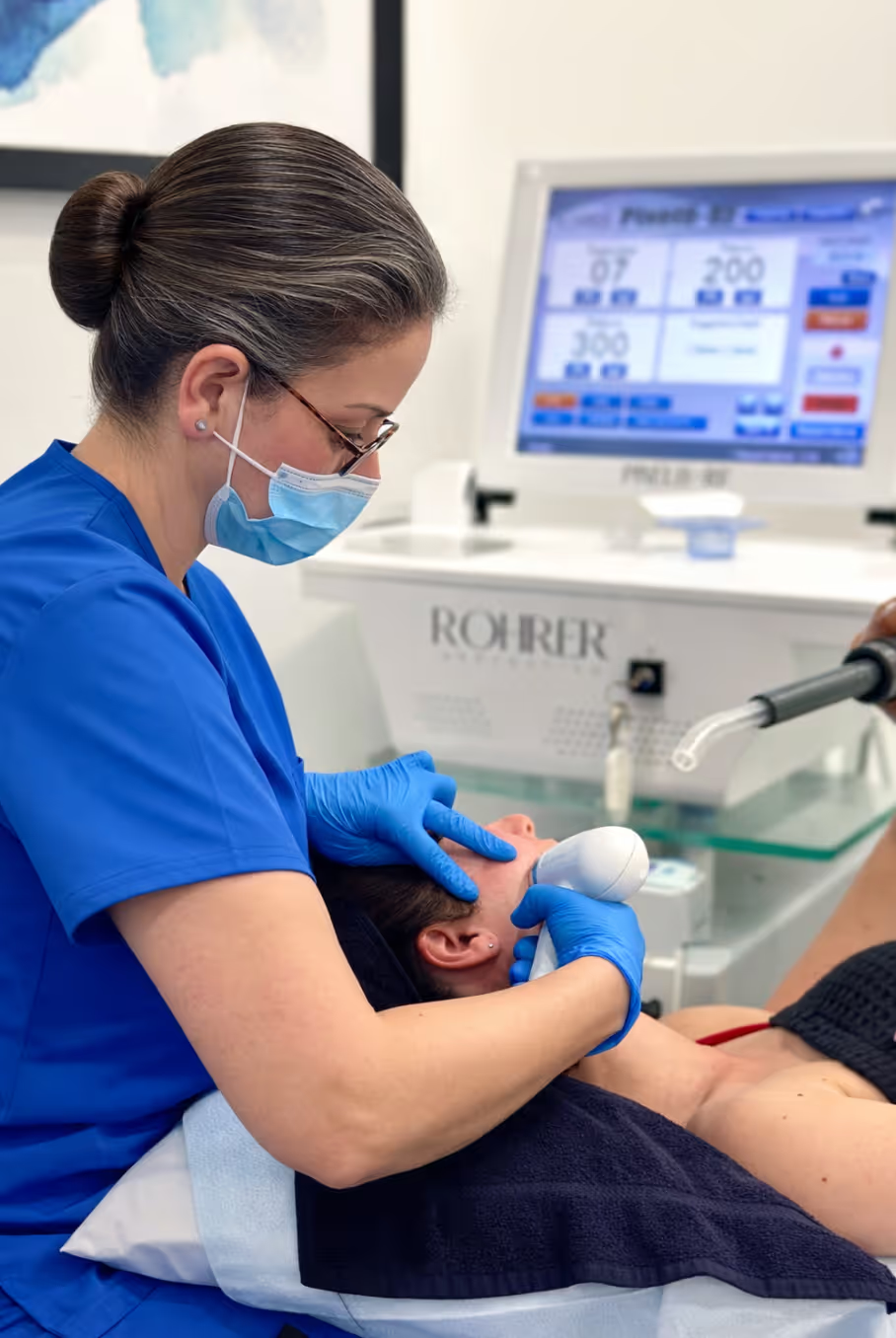
For clients who are also addressing concerns like texture, hyperpigmentation, or laxity alongside their retinol protocol, the interactions between at-home retinoid use and in-office treatments — whether that's Pixel8-RF radiofrequency microneedling, IPL photofacial, or a Vi Peel Precision Plus — need to be sequenced intentionally. Retinol use typically needs to be paused in the days surrounding certain in-office treatments, and reintroduction has a protocol of its own. This is the kind of detail that gets missed in self-managed skincare and managed well in a supervised regimen.
Retinol Is a Long Game — And That's Worth Remembering
The clinical evidence for retinoids is more robust than almost any other topical ingredient in aesthetic medicine. Long-term retinol use produces measurable improvement in fine lines, skin texture, pore appearance, and evenness of tone. It supports the collagen synthesis that begins to decline in our 30s and continues declining through our 40s, 50s, and beyond. For clients who are already investing in professional treatments — whether biostimulators for collagen rebuilding or energy-based devices for tightening — a well-managed retinol regimen at home extends and enhances those results between appointments.
The early weeks can be uncomfortable to look at. Purging is not photogenic. But the clients who come through that period with their protocol intact — who understand what they're seeing and why, and who have the support of a team that knows their skin — are consistently the ones who come in six months later and say their skin has never looked or felt better. That outcome is predictable when the process is managed well from the start.
If you're currently in the early stages of a retinol regimen and you're not certain whether what you're experiencing is purging or a true reaction — or if you've been wanting to start medical-grade retinol and want to do it correctly the first time — we'd welcome the conversation. Our team in Tysons has guided clients through exactly this transition for years, and we take the same care with your home protocol as we do with every in-office treatment we recommend.
Start your transformation
Schedule your consultation with our knowledgeable and friendly team.