Tretinoin vs. Medical-Grade Retinol: Which Actually Delivers Results?

If you've spent any time researching anti-aging skincare, you've almost certainly encountered the retinoid conversation. Retinol. Retinaldehyde. Tretinoin. Retin-A. The terms get used interchangeably in beauty editorial and social media, which creates a persistent and costly confusion: people spend months — sometimes years — using an over-the-counter retinol and wondering why their skin still looks the same.
The answer usually isn't their routine. It's the molecule.
Here's what most at-home skincare can't do on its own: deliver a retinoid in a form potent enough to produce measurable change in collagen density, cell turnover rate, and pigmentation. That distinction — between what's available over the counter and what requires a prescription or medical-grade professional sourcing — is exactly what this piece is about.
The Retinoid Family: A Quick Orientation
Retinoids are derivatives of vitamin A. They work by binding to retinoic acid receptors in the skin, which triggers cascading effects: accelerated cell turnover, increased collagen synthesis, suppressed melanin overproduction, and — over time — measurable improvement in fine lines, texture, pore appearance, and pigmentation.
But not every retinoid delivers retinoic acid to your skin with equal efficiency. The molecule your skin ultimately uses is retinoic acid. Everything else is a precursor — and each conversion step along the way means potency loss.
Here's the chain, from least to most active:
- Retinyl esters (retinyl palmitate, retinyl acetate) — found in drugstore moisturizers and mass-market products. Require three conversion steps. Minimal clinical impact at typical concentrations.
- Retinol — the gold standard of over-the-counter options. Requires two conversion steps. Effective at higher concentrations (0.5–1%), but most consumer products use far less.
- Retinaldehyde (retinal) — one conversion step from retinoic acid. Meaningfully more effective than retinol, with better tolerability than tretinoin. Rarely found in true concentrations outside of medical-grade formulations.
- Tretinoin (retinoic acid) — no conversion required. This is the active molecule. Prescription-only in the United States. The clinical gold standard against which all other retinoids are measured.
When clients ask what is medical grade skincare versus what they can buy at Sephora or online, this hierarchy is one of the clearest illustrations. Medical-grade products can contain retinaldehyde and higher concentrations of encapsulated retinol in formulations designed to maximize delivery and minimize irritation — with the guidance of a clinician who understands your skin barrier, your sensitivities, and your treatment goals.
What Tretinoin Actually Does — and Why No OTC Product Replicates It
Tretinoin has over 50 years of clinical research behind it. It's been studied for acne, photoaging, hyperpigmentation, and fine line reduction with a depth of evidence that no cosmetic ingredient comes close to matching. When applied consistently at appropriate concentrations, tretinoin:
- Accelerates epidermal cell turnover, sloughing off damaged surface cells faster than the skin would naturally manage
- Stimulates fibroblasts to produce new collagen — a process that takes months but produces lasting structural change
- Inhibits the enzyme tyrosinase, which is involved in melanin overproduction, making it one of the more effective tools for sun damage and melasma management
- Normalizes follicular keratinization, which is why it remains first-line for acne even decades after its introduction
The tradeoff — and it's real — is the adjustment period. In the first four to eight weeks of tretinoin use, many patients experience what's sometimes called "retinization": dryness, flaking, redness, and increased sensitivity. This is not damage. It's the skin adapting to an accelerated turnover cycle it isn't accustomed to. Managed correctly — with the right starting concentration, a buffering approach if needed, and appropriate supporting products — most patients move through this phase without significant disruption.
Managed incorrectly — started at too high a concentration, used too frequently, layered with incompatible actives — it can compromise the skin barrier in ways that set back results by months. This is one of the clearest reasons clinical guidance matters when you're working with prescription-strength retinoids.
So Where Does Medical-Grade Retinol Fit In?
Medical-grade retinol occupies a genuinely useful middle ground — but only when the term actually means something.
The phrase best medical grade retinol gets applied loosely in marketing. The meaningful distinctions are: concentration, encapsulation technology, and the formulation surrounding the active ingredient. A medical-grade retinol product that deserves the label will typically feature:
- Higher retinol concentrations than consumer-market options — often 0.5% to 1%, sometimes higher in encapsulated forms
- Encapsulation or time-release delivery that protects the retinol molecule from oxidation and releases it gradually, improving both stability and tolerability
- Supporting ingredients — niacinamide, ceramides, peptides, hyaluronic acid — formulated to work in concert with the retinol rather than accidentally undercutting it
- Clinical dispensing and guidance, meaning a provider has assessed your skin, understood your history, and recommended this specific product for your specific situation
For clients who aren't yet candidates for tretinoin — those with highly reactive skin, active rosacea, a compromised barrier, or who are pregnant — a well-formulated medical-grade retinol under professional supervision can still produce visible improvement over time. For those who have been on tretinoin for years and have developed excellent tolerance, medical-grade retinol products can serve as alternating options or daytime formulations where tretinoin is less appropriate.
What medical-grade retinol cannot do is replicate what tretinoin does. It's a different molecule at a different stage of conversion. That's not a marketing failure — it's biochemistry. But in the right context, with the right formulation, it's far more effective than anything positioned as a luxury serum at a department store counter.
The Conversation Worth Having Before You Decide
What most people approaching this decision actually need isn't a product recommendation — it's a skin assessment. The question of whether tretinoin or medical-grade retinol is right for you depends on variables that no blog post can resolve: your current skin barrier integrity, your history with retinoids, any inflammatory skin conditions, the medications you take, your sun exposure habits, and what you're actually trying to address.
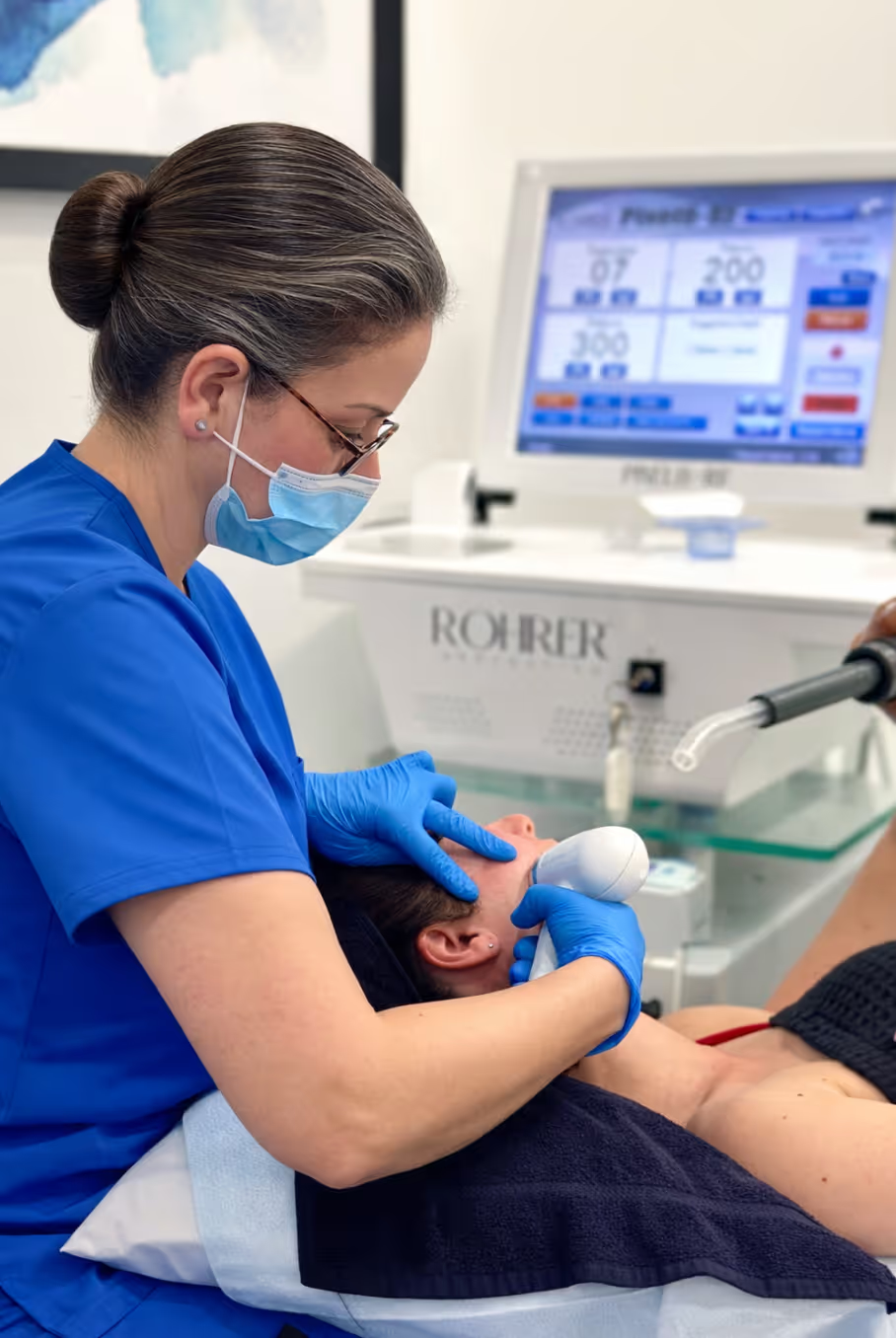
Someone with moderate photoaging, good barrier health, and no prior retinoid experience might start with a 0.025% tretinoin — a lower prescription concentration — and see more change in three months than they saw in three years of drugstore retinol. Someone managing active rosacea alongside early signs of aging might do better starting with a well-formulated medical-grade retinaldehyde product and layering in retinoids gradually once barrier function is restored. Someone in their mid-40s already on tretinoin who's hit a plateau might benefit more from combining their retinoid with a professional Pixel8-RF radiofrequency microneedling treatment than from switching products entirely.
These aren't decisions that product labels can make. They require clinical judgment — and ideally, a provider who's treated your skin long enough to understand how it behaves.
It's also worth understanding how retinoids fit into a larger skin health picture. The team at Tysons Elite Esthetics — with a combined 70+ years in medical aesthetics — approaches skincare prescribing the same way they approach in-office treatments: not as a one-size-fits-all protocol, but as a plan built around how your skin actually functions. If you've ever wondered when skincare stopped working for you, that question often points to a mismatch between the products you're using and what your skin actually needs at this stage.
Pairing Retinoids With Professional Treatments — What the Research Suggests
One of the more underappreciated aspects of retinoid therapy is how well it compounds with professional treatments when sequenced correctly.
Tretinoin used consistently in the weeks and months leading up to certain laser or energy-based treatments can prime the skin for better results — by increasing cell turnover, thinning the stratum corneum, and improving receptor responsiveness. Similarly, following certain procedures with a carefully reintroduced retinoid protocol can extend and deepen results by continuing the collagen remodeling process that devices initiate.
The caution: retinoids need to be paused before certain treatments. Timing matters. This is another reason why having a provider manage your topical protocol in conjunction with any in-office treatment plan — rather than managing them separately — produces better outcomes and fewer surprises.
For patients in Tysons, McLean, Vienna, or the broader Fairfax County area who are thinking seriously about preventive skincare and want to understand how topical retinoids fit into a broader anti-aging strategy, a consultation is the right place to start. The answer to "should I use tretinoin or retinol" isn't a product — it's a plan.
Practical Guidance for Getting Started or Switching
If you're currently using an over-the-counter retinol and haven't seen results in six months or more, here's what's likely happening: either the concentration is too low to produce measurable change, the formulation isn't stable enough to deliver the molecule effectively, or both. This is common. It's also fixable.
If you've been prescribed tretinoin but stopped because of irritation, that's typically a starting concentration or application frequency issue — not a sign that tretinoin isn't appropriate for you. A provider can walk you back in at a lower entry point or help you buffer the application to significantly reduce reactivity while still moving the needle on results.
If you've used tretinoin for years without issue and your results have plateaued, the conversation worth having is about what else is limiting your skin's response — and whether pairing your retinoid protocol with a treatment like CoolPeel Fractional Laser Resurfacing or biostimulator injections might address the structural changes that topicals alone can't reach.
The skin changes that matter most after 40 — collagen loss, laxity, deeper textural shifts — often require more than a topical to address meaningfully. A retinoid remains one of the most evidence-backed tools in any skin health plan. But knowing which one, at what concentration, in what formulation, paired with what professional treatments, is the work of an experienced clinical team. That's the difference between hoping your skincare does something and knowing it's doing exactly what you need it to do.
If you're in the Tysons area and ready to have that conversation, we're here for it.
Start your transformation
Schedule your consultation with our knowledgeable and friendly team.