Preventive Skincare for Professionals: When to Start Which Treatments

One of the most common questions our team hears — from clients in their late 20s and from those well into their 50s — is some version of the same thing: Did I start too late? The honest answer is almost always no. But timing does matter. The right treatment at the right age, started before visible damage accumulates rather than after, consistently produces better long-term results with less intervention overall. This guide is meant to give you a clear-eyed look at what to consider, and when, across each decade.
Your Late 20s: Laying the Foundation
Collagen production begins declining in your mid-to-late 20s — slowly, almost imperceptibly, but measurably. This is precisely the window where prevention is most efficient. You are not treating damage at this stage; you are slowing its accumulation.
The cornerstone of a late-20s regimen is a medical-grade skincare protocol anchored by daily broad-spectrum SPF, a retinoid introduced gradually, and a vitamin C serum applied in the morning. These are not glamorous, but they represent the highest return on investment available at any age. No in-office treatment reverses what daily sun exposure compounds over decades — protecting the skin you have is the most powerful thing you can do before anything else.
In terms of in-office treatment, this is the era of prejuvenation. For clients who are already noticing expression lines that linger faintly when the face is relaxed — typically along the forehead or between the brows — a conservative neuromodulator appointment makes clinical sense. The goal is not to erase movement but to prevent a dynamic line from becoming a static one etched into the skin at rest. If you're curious whether you're a candidate, our post on prejuvenation in your 20s outlines what that conversation typically looks like.
One question we hear often at this stage: when does Botox start working? For most clients, the neuromodulator takes full effect within 10 to 14 days of treatment. You may notice softening within the first few days, but the complete result settles at around the two-week mark — which is why we schedule all touch-up assessments after that window.
Beyond neuromodulators, a single annual chemical peel focused on brightening and texture is worth considering in your late 20s, particularly for clients experiencing early hyperpigmentation from sun exposure or post-inflammatory marks from breakouts.
Your 30s: The Prevention-to-Correction Transition
The 30s are where most of our clients begin investing more consistently in maintenance — and where those who started earlier begin to see the dividend clearly. Lines that were faint at 27 are more defined at 34. Volume that felt infinite at 25 begins to shift subtly at the temples, under the eyes, and along the midface.
Neuromodulators become a genuine maintenance treatment in this decade, not just a preventive experiment. Spacing appointments consistently — typically every three to four months — helps preserve the muscle relaxation and prevent static line formation. A common concern at this stage is how quickly results seem to come and go: when does Botox start to wear off? For most clients, the effect begins to diminish gradually around the three-month mark, with full muscle movement returning by four to five months in most cases. Consistency in scheduling is what maintains the cumulative benefit over time. Our post on why Botox wears off faster for some clients covers the factors — from metabolism to treatment frequency — that influence how long results last.
The 30s are also when filler conversations often begin — not for dramatic volume replacement, but for early support. A small amount of filler in the tear trough or along the cheek can restore a rested quality to the face that neither skincare nor neuromodulators address on their own. This is not the same as aggressive volume augmentation; it is precise, thoughtful placement that works with your anatomy rather than altering it. If you are considering your first filler appointment, our guide on where to start at a med spa is a useful orientation.
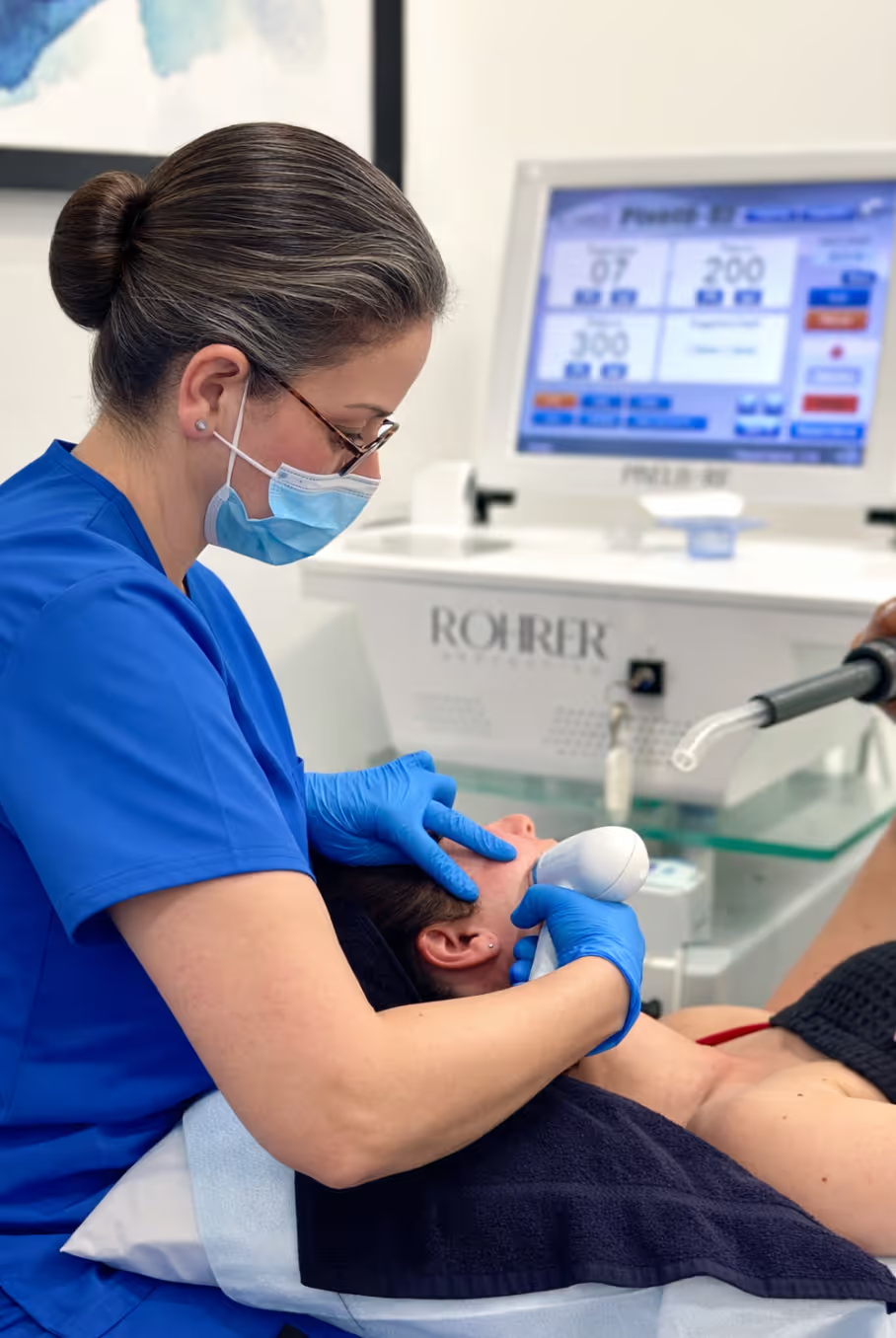
Skin quality treatments also belong in the 30s maintenance plan. An annual or biannual session of Pixel8-RF radiofrequency microneedling stimulates collagen in a way that topical products simply cannot replicate, supporting skin texture and firmness before laxity has a chance to develop. Pairing this with a microneedling session with exosomes is something we recommend for clients who want to accelerate regenerative results at the cellular level — particularly given that Tysons Elite Esthetics is the only med spa in Northern Virginia authorized to use Human Progenitor-Derived Exosomes.
What Age to Start Botox: Answering the Question Directly
There is no universally correct answer, but there is a useful framework. The right time to start Botox is when you have a line — or the beginning of one — that you would rather not have in ten years. For some clients, that conversation begins at 26. For others, it does not start until 35. Genetics, sun history, stress, and lifestyle all influence the pace at which expression lines become permanent.
What we consistently find is that clients who begin neuromodulator treatment before a dynamic line has fully converted to a static one have a meaningfully easier road ahead. A line that has been etched into the dermis over years of repeated muscle contraction requires more treatment to soften than one that was never allowed to fully set. This is the practical case for starting earlier, not an argument for unnecessary treatment.
Our posts on preventive Botox in your 30s and whether preventive Botox actually works explore this in more clinical depth for clients who want more than a surface-level answer before committing.
Your 40s: Addressing Volume, Laxity, and Line Depth Together
The 40s mark a meaningful shift in what the skin needs and what treatments can realistically accomplish. Collagen and elastin loss accelerates. Fat compartments in the face begin to migrate or deflate. The jawline softens. Skin that was firm at 38 may feel noticeably different at 43.
Neuromodulators remain essential here, but they increasingly need partners. Static lines — wrinkles visible at rest without any muscle movement — do not respond to Botox alone. This is where the conversation about biostimulators, energy-based devices, and structural filler becomes genuinely important. Our post on treating dynamic and static lines together after 45 explains the distinction and the rationale for combination approaches.
For clients experiencing early midface descent or hollow temples, this is typically the decade where targeted filler placement begins to serve a structural function rather than a purely cosmetic one. Temple filler is one of the most underutilized treatments for clients in their early 40s — restoring support in the upper face that ripples positively across the entire facial structure. Similarly, cheek filler used to restore youthful midface volume differs significantly from the augmentation-focused approach that dominated aesthetic trends a decade ago.
Biostimulators like Sculptra deserve serious consideration in the 40s as a foundational investment. Unlike hyaluronic acid fillers, Sculptra works by stimulating your own collagen production over time — a process that produces gradual, natural-looking improvement that compounds across multiple sessions. Starting Sculptra in your early 40s, before significant volume loss has occurred, typically requires fewer sessions to maintain results than beginning in the 50s. Our post on when Tysons patients should actually start Sculptra addresses the timing question directly.
Energy-based skin tightening also becomes a meaningful part of the maintenance plan in the 40s. RF microneedling, CoolPeel fractional laser, and combination device protocols address laxity at the structural level. Clients who are ready to invest in a more comprehensive approach will find our post on serious skin tightening with device combinations a useful overview of how these tools work together.
Your 50s and Beyond: Regenerative Strategies and Smarter Maintenance
The 50s and beyond do not represent a ceiling — they represent a shift in strategy. The treatments available today are meaningfully more effective than what existed a decade ago, and clients who invest thoughtfully in this decade consistently achieve results that feel natural and proportionate rather than overdone.
At this stage, regenerative treatments take on greater importance. Exosome therapy — particularly using Human Progenitor-Derived Exosomes, which we are uniquely positioned to offer in Northern Virginia — supports the skin's capacity for cellular renewal in ways that standard treatments do not. Whether paired with microneedling or used as a standalone regenerative treatment, exosomes represent a meaningful advancement for clients over 50 who want to address quality and resilience, not just surface appearance. Our post on exosome therapy for skin rejuvenation covers the science and the clinical application in depth.
Biostimulators remain central in this decade. For clients who have experienced significant volume loss — whether from aging alone or in conjunction with GLP-1 medications — the case for Sculptra and Radiesse over filler-only approaches is particularly strong. Our post on biostimulator treatments for skin laxity after 50 explains how these two categories of treatment serve different needs and why many clients benefit from both.
Skin tightening with RF microneedling for laxity after 50, PDO thread lifts for clients not yet ready for surgery, and non-surgical approaches to the neck and décolletage are all conversations worth having in this decade. The team at Tysons Elite Esthetics approaches these conversations the way a trusted advisor would — without pressure, without a preset protocol, and with the understanding that what works beautifully for one client may not be the right path for another.
The Overarching Principle: Start When It Serves You, Not When Someone Tells You To
The most useful thing we can tell you is that there is no single right moment — there is your moment. The clients who see the best long-term outcomes are not necessarily the ones who started earliest; they are the ones who started with a plan, worked with a team they trusted, and stayed consistent over time. A single Botox appointment once in a while is better than nothing. A thoughtfully designed maintenance protocol, adjusted as your skin and priorities evolve, is better still.
If you are unsure where to begin, the first step is simply a conversation. Our team has 70+ years of combined experience in medical aesthetics, and we treat every consultation as the beginning of a long-term relationship — not a transaction. Whether you are 28 and curious about prevention or 54 and ready to take a more comprehensive approach, we will tell you honestly what we think, what the evidence supports, and what we would recommend for someone we genuinely care about.
If you want to continue exploring before booking, our post on the hidden costs of waiting too long to start skin treatments is worth reading — not as a pressure tactic, but as an honest look at what the data actually shows about timing and long-term outcomes.
Start your transformation
Schedule your consultation with our knowledgeable and friendly team.