Spring Wedding Season: Timing Your Treatments for Perfect Skin
There is a particular kind of pressure that comes with a wedding on the calendar. Whether you are the one walking down the aisle, standing beside someone who is, or simply attending one of the many celebrations on Washington's social circuit this spring, the expectation is the same: you want to look like the best version of yourself in photographs that will exist for decades. The good news is that with the right plan and enough lead time, that is entirely achievable. The mistake most people make is not starting too early — it is starting too late.
At Tysons Elite Esthetics, we work with clients across McLean, Vienna, Falls Church, and Fairfax County who are navigating exactly this kind of event-driven skin planning. What follows is an honest, experience-based guide to timing your treatments so that results are fully settled, any residual redness has resolved, and your skin genuinely looks like it belongs to you — radiant, natural, and completely your own.
Start Here: Why Timing Is the Most Important Variable
Most aesthetic treatments require a recovery window before they look their best. Some procedures — particularly resurfacing and energy-based treatments — produce noticeable inflammation as part of the healing process. Others, like biostimulators and collagen inducers, work gradually over weeks and months. And certain injectables, while often well-tolerated, carry a small risk of bruising that requires buffer time before a major social event.
The key principle is this: the more transformative the treatment, the more lead time it requires. A good plan staggers procedures so that each one has time to fully resolve before the next begins, and so that all results are visible and stable well before the event date.
Spring wedding season in Northern Virginia typically runs from late April through June, with a notable secondary cluster around September. If your event falls in that April-to-June window, and you are reading this in July 2026, you are in an ideal position to be planning now for the following spring — or to be completing finishing touches for any remaining late-summer celebrations. Either way, what follows applies directly.
Six Months Out: Collagen Builders and Structural Work
If you want skin that looks fundamentally different — not just refreshed — the work begins here. This is the window for treatments that build from within.
Biostimulators like Sculptra and Radiesse do not produce immediate filler-like results. Instead, they trigger your own collagen production over a series of months, creating gradual volumization and structural support that looks natural precisely because it develops slowly. Clients who start Sculptra six months before an event often find themselves fielding compliments long before the wedding day arrives — and continuing to see improvement for months after. If you have been reading about biostimulator treatments for skin laxity and wondering whether the timeline makes sense for you, this six-month mark is the answer.
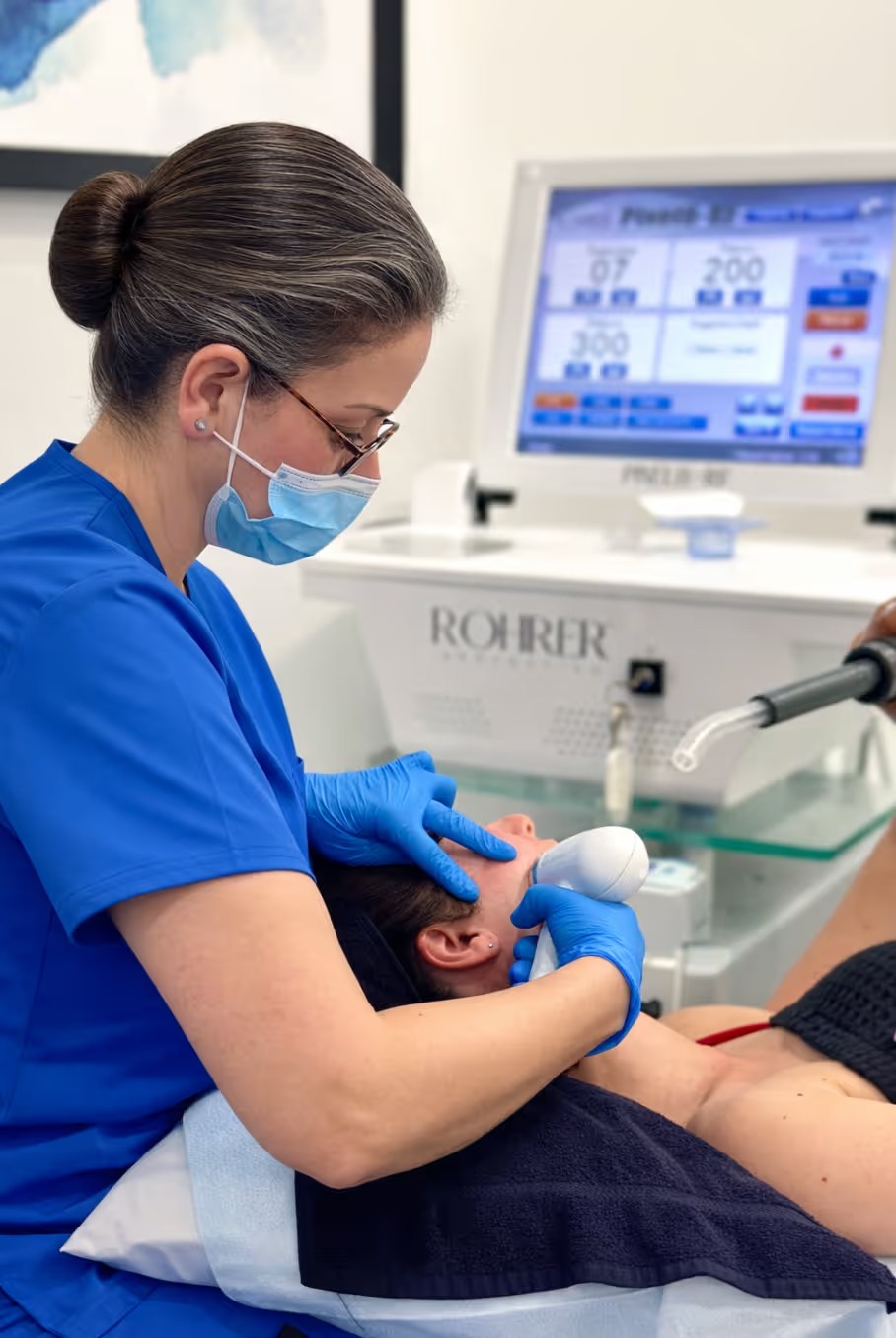
This is also the right time to address anything structural that requires a series of treatments. Pixel8-RF radiofrequency microneedling works best across multiple sessions spaced four to six weeks apart. Starting a three-session protocol now means your final results — tighter texture, reduced pore size, and improved laxity — will be fully visible with weeks to spare. The same logic applies to anyone considering CoolPeel Fractional Laser Resurfacing for deeper texture concerns, sun damage, or fine lines: six months gives adequate time for the resurfacing process to complete and your skin to settle into its best presentation.
Four Months Out: Energy Devices, IPL, and Targeted Correction
With structural work underway, four months out is the time to address surface-level concerns — pigmentation, tone irregularity, vascular redness, and the kind of dullness that no serum quite fixes.
IPL photofacial treatments are highly effective at clearing sun damage, brown spots, and redness, but they typically require two to four sessions for meaningful results on more significant pigmentation. A series starting at this point will be complete — and the darkened, shedding phase that follows each session will be well behind you — before any pre-wedding events begin. If you have been curious about how many IPL sessions you actually need before seeing change, the honest answer depends on starting point, but beginning at four months gives enough room for a real protocol rather than a rushed single session.
For clients dealing with melasma, post-inflammatory hyperpigmentation, or uneven tone that is more complex than sun spots, this is also the window to begin a supervised topical program alongside in-office treatment. Medical-grade retinoids, vitamin C serums, and prescription brightening agents work incrementally — four months of consistent use makes a measurable difference.
Three Months Out: Pre-Wedding Events and Ongoing Maintenance
Engagement parties, bridal showers, bachelorette weekends, rehearsal dinners — the pre-wedding social calendar is often as photographed as the wedding itself. Three months out is when your skin plan should be producing visible results, and when treatments become more about refinement and maintenance than foundational change.
This is an excellent time for a Vi Peel Precision Plus, which addresses pigmentation and texture with a recovery window of approximately five to seven days. With three months of runway, there is ample time to complete one or two peels, let the skin fully recover, and enjoy clear, even-toned skin well in advance of the event calendar. Chemical peels planned thoughtfully around social obligations are a well-worn strategy among our clients — if you want to understand the broader logic of timing chemical peels around your social calendar, the principle applies directly here.
If you are working on skin hydration and glow, this is also the moment to incorporate skin booster or polynucleotide injections into the plan. These treatments improve intrinsic skin quality — moisture retention, elasticity, surface luminosity — over a series of sessions and are well-tolerated with minimal downtime. The results are subtle and cumulative, which means starting now rather than in the final weeks makes a real difference in how your skin photographs.
Six to Eight Weeks Out: Botox and Neuromodulators
This is the most commonly misunderstood timing question in pre-event planning. The instinct is to schedule Botox close to the event so it looks fresh — but the reality is that neuromodulators need time to settle fully, and bruising, however uncommon, requires a buffer.
Six to eight weeks before your event or the event you are attending is the right window for Botox, Dysport, Daxxify, or Xeomin. By this point, the product has fully integrated, any asymmetry has been assessed and adjusted if needed, and the result looks natural and complete. For clients who have never had Botox before, or who are considering a new treatment area, this window is especially important — a first appointment should never be scheduled within two weeks of something significant. If you want to understand the precise logic of Botox timing before a major event, the short answer is: earlier than you think, with room for a follow-up if needed.
Three to Four Weeks Out: Filler Refinements
Dermal filler placed three to four weeks before your event allows time for swelling to fully resolve, any residual tenderness to pass, and the product to settle naturally into the tissue. At this stage, most clients are addressing refinements rather than major changes — softening a specific line, adding a touch of volume to the lips, or restoring lateral cheek structure that has shifted with time.
For anyone curious about how long dermal fillers actually last and whether a top-up before a spring wedding makes sense, the answer usually depends on when the last treatment was and which product was used. Our team can walk through this at a consultation and tell you exactly whether a refresh is warranted or whether what you already have is still working beautifully.
If you are considering lip filler for the first time before a wedding, this same window applies — but plan for a conservative approach. Natural-looking results on a meaningful occasion are always the goal, and the current lip filler approach at Tysons Elite prioritizes subtle enhancement over volume for its own sake.
One to Two Weeks Out: Glow Treatments and Finishing Touches
In the final one to two weeks, the focus shifts entirely to luminosity, hydration, and texture refinement. This is the window for our Oxifusion Facial, which delivers oxygen infusion, hydration, and surface brightening with zero downtime — ideal for the week before any event. Microcurrent facials and light hydrating treatments also fall appropriately into this window.
For clients who have incorporated IV therapy into their wellness and skin routine, a Beauty + Anti-Aging IV in the days before the event can provide the kind of systemic hydration and antioxidant support that translates directly to how your skin looks under light and on camera.
What does not belong in this final window: any resurfacing, any treatment with meaningful downtime, and any injectable you have never tried before. This is not the moment for experimentation — it is the moment to enjoy the results of everything that came before.
The Bride's Timeline at a Glance
To summarize what a well-sequenced plan looks like when working backward from a spring wedding:
Six months out — Sculptra or Radiesse if volume restoration is the goal; begin Pixel8-RF series or CoolPeel fractional laser if texture and laxity are the primary concerns.
Four months out — IPL series for pigmentation and tone; establish medical-grade topical protocol.
Three months out — Chemical peel; skin booster or polynucleotide series begins.
Six to eight weeks out — Botox or preferred neuromodulator; follow-up appointment if needed.
Three to four weeks out — Any filler refinements or targeted volume correction.
One to two weeks out — Hydrating and brightening facial; IV therapy if desired; no new treatments.
This structure is not rigid — it adapts based on each client's skin, history, goals, and starting point. A client who already has a strong injectable relationship with our team works from a different baseline than someone coming in for the first time. That is exactly why a consultation matters: not to sell a menu, but to build a plan that is specific to you.
A Note on Guests and Wedding Party Members
Wedding planning coverage tends to focus on the bride, but in practice, the people surrounding her are equally invested in looking their best. If you are a mother of the bride, a bridesmaid, or a guest attending multiple spring events this season, the same timing principles apply. The calendar advantage is the same: plan now, start early, and give every treatment the time it needs to produce the result you actually want.
Our team in Tysons has worked with families navigating exactly this dynamic — coordinating treatment timelines across multiple people for the same event, making sure no one is left in a recovery window on a day that matters. It is the kind of care that is only possible when a team knows you well enough to think ahead with you.
If you are beginning to think about pre-wedding events and want to build a treatment plan that accounts for your full spring calendar, a consultation is the right starting point. There is no pressure, no prescribed protocol — just an honest conversation about your skin, your timeline, and what is actually achievable.
Start your transformation
Schedule your consultation with our knowledgeable and friendly team.