Tretinoin After 40 Changes — Is Your Prescription Still Right?

If you've been using tretinoin for years, you already know it works. You saw the results: smoother texture, faded spots, fewer fine lines. But here's what most patients don't hear from anyone until they're sitting in a consultation chair: the skin that responded beautifully to tretinoin at 35 is not the same skin you're treating at 48, 55, or 68. The biology changes. The barrier changes. And the prescription that once felt like a revelation can quietly start working against you — causing persistent irritation, dryness, or sensitivity that you've been managing without realizing it's a signal that something needs to adjust.
This isn't a reason to abandon tretinoin. It's one of the most studied and clinically validated topicals in dermatology, and for many patients in their 40s, 50s, and beyond, it remains a cornerstone of a well-designed skincare protocol. But "well-designed" is the operative phrase. What changes after 40 is that tretinoin no longer works in isolation the way it once did — and the concentration, frequency, formulation, and supporting products around it all matter more than they did a decade ago.
What Actually Changes in Skin After 40 — and Why It Affects How Tretinoin Performs
The foundational shifts are worth understanding clearly. After 40 — and accelerating significantly around menopause — skin undergoes a measurable reduction in estrogen, which directly affects collagen density, barrier integrity, and moisture retention. Transepidermal water loss increases. The skin's ability to repair itself between tretinoin applications slows down. Sebaceous gland activity decreases, which means the natural oils that once buffered retinoid-related irritation are simply less available.
What this produces clinically is a skin that is simultaneously in need of more support and less tolerant of aggressive intervention. Tretinoin is, by nature, a controlled stressor — it accelerates cell turnover and triggers a repair response that produces collagen remodeling and pigment correction over time. In younger skin with robust barrier function, that stress-and-repair cycle works efficiently. In post-40 skin, particularly post-menopausal skin, the same stress-and-repair cycle can tip into net damage if the prescription isn't calibrated appropriately.
Patients often describe this as their skin "changing" — suddenly feeling tight, reactive, or dry in ways that weren't present before. Sometimes they increase their moisturizer and push through. Sometimes they stop tretinoin altogether and wonder why their skin deteriorates. Rarely does anyone pause and ask whether the prescription itself needs updating. But that's exactly the right question.
How Long Does It Take to Adjust to Tretinoin — and Does That Timeline Change With Age?
The classic adjustment period for tretinoin — redness, flaking, sensitivity — typically runs four to eight weeks in a first-time user. This is the process your skin goes through as it adapts to accelerated turnover, and it's well-documented and expected. Most patients who have been using tretinoin for years have moved well past this initial phase.
But here's what's less commonly discussed: if your skin is showing signs of renewed sensitivity to a tretinoin concentration you've used comfortably for years, that's not the same as the original adjustment period. That's a signal that the balance has shifted. After 40, and especially after 50 or into the 60s and 70s, the skin's tolerance threshold can change, meaning a concentration that was well-tolerated for years may now be producing more inflammation than benefit. The adjustment window doesn't reset — the formulation may simply need to change.
This is particularly relevant for patients who are using 0.1% tretinoin and experiencing chronic irritation, peeling between cycles, or sensitivity that never fully resolves. In many cases, stepping down to 0.05% or 0.025% — used consistently — will produce equivalent or superior results with substantially less barrier compromise. Lower concentrations used regularly outperform higher concentrations used erratically due to ongoing irritation, which is a pattern more common in mature skin than most patients realize.
Is Tretinoin Good for Skin in Your 60s and 70s?
Yes — with the right approach. The research on tretinoin in older skin is genuinely encouraging. Studies have shown that tretinoin can stimulate collagen synthesis, improve the appearance of photoaged skin, reduce fine and coarse wrinkles, and correct pigmentation irregularities in patients well into their 70s. The mechanism doesn't stop working because someone is older. What changes is how much supporting infrastructure the skin needs to tolerate the treatment and benefit from it.
For patients asking whether retinol is appropriate for skin at 70, the more precise question is whether the full protocol around the retinoid is appropriate. In older skin, tretinoin — when used at the right concentration, with appropriate frequency, and surrounded by barrier-supportive products — remains one of the most effective topical tools available. But it cannot work well in skin that is simultaneously depleted, barrier-compromised, and under-moisturized. Ceramide-rich moisturizers, gentle cleansing, and strategic application (sometimes called the "sandwich method," applied over a thin layer of moisturizer) become increasingly important at this stage.
The patients who do best with tretinoin in their 60s and 70s are typically those whose protocol has been adjusted over time — not those who are still using the same prescription they were given at 45 without any modification. Skin at 70 is not skin at 45, and a prescription that treats it as though it is will underperform or cause unnecessary sensitivity.
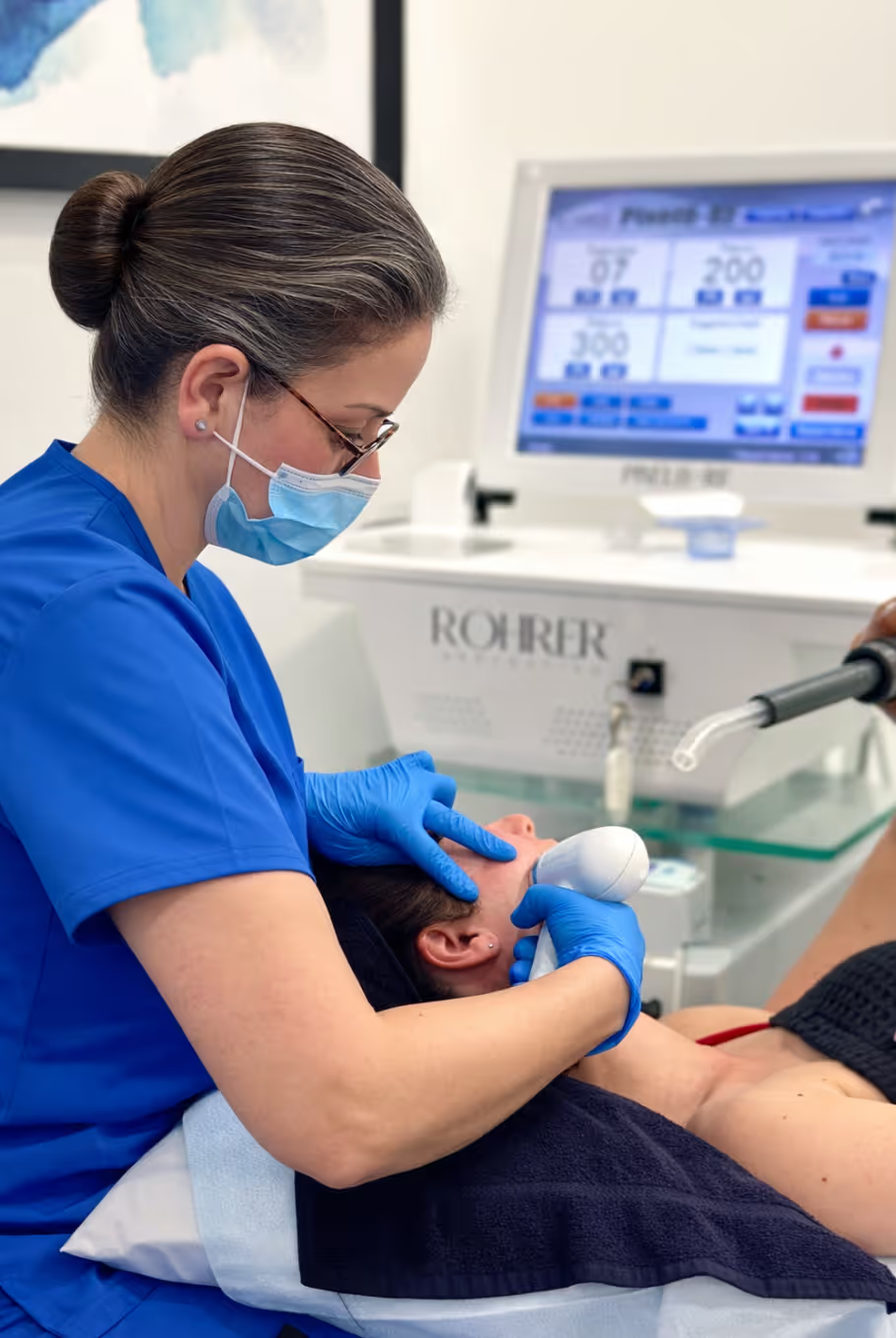
It's also worth noting that tretinoin doesn't exist in a vacuum at this stage. When patients are asking how to address texture, pigmentation, and volume loss together, a well-sequenced combination approach — tretinoin as the home-care foundation, paired with in-office treatments when appropriate — tends to produce the most meaningful and durable results. Our team has written about how treatments like RF microneedling and laser work alongside a solid home-care protocol for exactly this kind of comprehensive skin improvement.
Is Tretinoin Covered by Insurance — and What Does That Mean for How You Access It?
Insurance coverage for tretinoin depends almost entirely on how it's prescribed. When tretinoin is prescribed for acne — an FDA-approved indication — it is more likely to be covered, though coverage varies significantly by plan, formulary, and the specific product. Brand-name formulations like Retin-A or Altreno tend to have limited coverage, while generic tretinoin cream or gel formulations are more commonly covered or available at lower cost.
When tretinoin is prescribed for cosmetic antiaging purposes — which is how most patients over 40 are using it — insurance coverage is far less predictable. Many plans will not cover it for this indication, and patients often end up paying out of pocket. Generic tretinoin is generally affordable through standard pharmacy channels, and some patients access it through compounding pharmacies that can customize concentration, base, or combination formulations (tretinoin combined with niacinamide or azelaic acid, for example) that may not be available as commercial products.
The practical takeaway: if you are using tretinoin for skin maintenance and antiaging rather than acne treatment, it's worth confirming with your prescriber and pharmacy exactly what you're paying and what alternatives exist. A compounded formulation at a lower concentration — or combined with a complementary ingredient — may serve your skin better at this stage and be cost-competitive with what you're currently using.
When Professional Treatments Change the Equation
One of the most important conversations patients over 40 can have with their clinical team is about how tretinoin fits into a broader treatment protocol — not as the only tool, but as one layer of a more comprehensive approach. As skin changes with age, the limits of what topicals alone can achieve become more apparent. Collagen loss, laxity, textural irregularities, and persistent pigmentation often require in-office intervention to address what even consistent, well-managed tretinoin use cannot fully reach.
This doesn't mean abandoning tretinoin — it means understanding what it does well (surface renewal, pigment correction, fine line improvement) and what it doesn't address on its own (structural laxity, deep lines, significant volume changes). The patients who tend to see the most meaningful results are those whose at-home protocol and in-office treatments are designed to complement each other. Tretinoin that has been appropriately adjusted for current skin biology is a foundation; professional treatments build on top of it.
For patients navigating what a full treatment picture looks like at this stage, our piece on how healthy skin at 40 differs from skin at 30 offers useful context. And for those wondering where tretinoin fits alongside energy-based treatments, our overview of sequencing in-office treatments is worth a read before your next appointment.
Similarly, if you've been using tretinoin alongside retinol products and aren't sure where the line is between the two, our clinical comparison of tretinoin versus medical-grade retinol breaks down exactly what each one does — and when one is a better fit than the other depending on your skin's current tolerance.
What a Prescription Review at Tysons Elite Esthetics Actually Looks Like
When patients come to us with questions about their tretinoin — whether it's still working, whether the irritation they're experiencing is normal, or whether they should be doing something different — we treat that as a clinical conversation, not a quick answer. Our team brings 70+ years of combined experience in medical aesthetics, and a significant portion of that experience is in understanding how skin changes across decades and how to adjust protocols accordingly.
A prescription review in this context means looking at your current formulation and concentration, understanding how your skin has changed since it was written, assessing your barrier function, and thinking through what combination of home-care and in-office treatments will actually move the needle at this stage of your skin's life. It's not a one-size-fits-all conversation. It's specific to you — your skin, your history, your goals, and what you're willing to commit to consistently.
If you're in Tysons, McLean, Vienna, Falls Church, or anywhere in the greater Fairfax County area and you've been using tretinoin for years without reviewing whether it's still calibrated for where your skin is now, that conversation is worth having. The prescription that served you well at 35 deserves a second look at 50 — not because it's wrong, but because your skin has changed, and so should the approach.
Start your transformation
Schedule your consultation with our knowledgeable and friendly team.