Glabellar Lines Still Showing at Rest? Treatment Options Explained

There's a specific moment when frown lines shift from a cosmetic inconvenience to a clinical concern — and most people notice it in a still photo. Not while squinting at a screen or concentrating in a meeting, but in a relaxed image where they expected to look calm, and didn't. That crease between the brows, sitting there even when the face is at rest, is what clinicians call a static glabellar line. And how to get rid of frown lines between eyebrows depends almost entirely on correctly identifying where in that progression your skin currently sits.
The glabellar complex — the group of muscles responsible for that vertical pinch between the brows — is one of the most active areas of the face. The corrugator supercilii and procerus muscles contract dozens of times an hour, often without any awareness. Over years, that repeated folding teaches the skin to crease in the same place, even when the muscles are completely relaxed. What begins as a dynamic line — visible only during expression — eventually becomes etched into the dermis itself. When frown lines between the eyebrows are visible at rest, the skin is no longer simply following the muscle. The tissue has been structurally compromised at the dermal level.
Understanding this distinction matters because it directly changes the treatment strategy. Many patients arrive having heard that Botox is the answer for glabellar lines — and they're not wrong, exactly. Botox for frown lines between eyebrows remains one of the most well-established and effective interventions in aesthetic medicine, and our team at Tysons Elite Esthetics has administered it for combined decades across thousands of patients. When lines are dynamic, neuromodulators work beautifully: they interrupt the neuromuscular signal, allow the skin to rest, and over several treatment cycles, often allow those folds to soften and partially reverse. But when lines have become static — present at rest, visible in an expressionless face — neuromodulator treatment alone treats the cause without fully addressing what's already been done to the skin.
This is where the nuance of clinical assessment becomes the most valuable thing a patient can access. At our Tysons practice, we don't book a treatment and walk away. We take the time to look at your skin in motion and at rest, evaluate the depth of the fold, assess the surrounding tissue quality, and determine whether what you're dealing with is a muscle issue, a volume issue, a skin quality issue, or — most commonly — some combination of all three. It's the kind of evaluation that requires 70+ years of combined clinical experience to do well, and it's what separates a thoughtful treatment plan from a reflexive one.
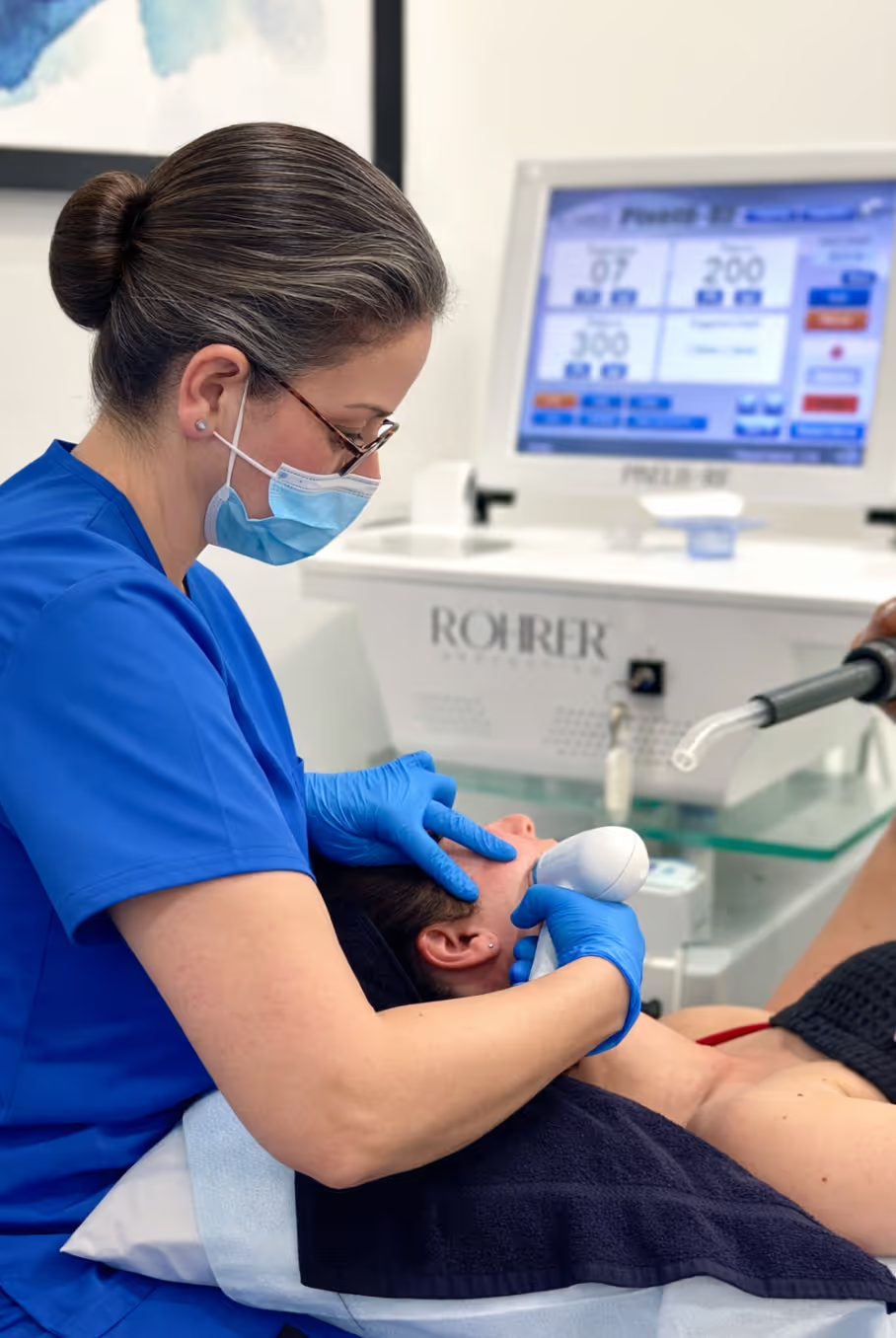
For static glabellar lines with measurable depth, the approach that consistently delivers the best outcomes pairs neuromodulator treatment with one or more additional modalities. Botox for frown lines between eyebrows should still anchor the plan — relaxing the muscle prevents further deepening and creates the conditions in which every other treatment performs better. But layering in a skin-quality intervention addresses the dermal damage that has already occurred. Pixel8-RF radiofrequency microneedling, for example, delivers fractionated RF energy precisely into the dermis, triggering collagen remodeling in the tissue planes that have been repeatedly compressed. Over a series of treatments, patients see not just softening of the line, but genuine textural improvement in the skin surrounding it.
For glabellar lines that have developed a valley-like depth — where the skin is genuinely indented at rest — careful micro-droplet filler placement can provide immediate structural improvement. This is technically demanding work in the glabellar region due to vascular anatomy, and it should only be performed by injectors with advanced training and a thorough understanding of facial vasculature. When placed correctly by the right hands, a small amount of a soft hyaluronic acid filler can lift the floor of a deep crease and create a smoother transition across the brow. Our team approaches glabellar filler with precision and conservative intent — the goal is never to fill a line to invisibility, but to restore enough structural support that the overlying skin sits the way it should.
Beyond injectables, skin quality at the glabellar zone often benefits from regenerative approaches that improve the tissue itself rather than simply displacing or relaxing it. Tysons Elite Esthetics is the only med spa in Northern Virginia authorized to use Human Progenitor-Derived Exosomes — a distinction that matters clinically, not just commercially. When applied following a microneedling or energy-based treatment, these exosomes deliver signaling molecules that accelerate cellular repair and collagen synthesis in a way that conventional PRP or standard growth factor serums cannot match. For patients with deeper static lines who want to improve the underlying tissue rather than simply mask the surface, this regenerative layer is worth serious consideration. You can explore more about how exosome therapy works for skin rejuvenation if you're curious about the science before your consultation.
There's also a broader conversation worth having about the surrounding anatomy. Glabellar lines rarely exist in isolation — they're typically part of a larger pattern of upper face aging that includes brow position, forehead texture, and the quality of the skin between the eyes. A brow that has descended even slightly will increase the mechanical load on the glabellar tissue, exaggerating the appearance of lines regardless of how well they're otherwise treated. A non-surgical brow lift with Botox and filler addresses this upstream factor and often produces a more complete result than treating the glabellar lines in isolation. Similarly, patients who have already reviewed the topic of forehead versus frown line treatment zones understand that these areas influence each other — treating one without considering the other frequently leads to outcomes that look incomplete.
One pattern we see regularly among patients who've had Botox for frown lines between eyebrows elsewhere: results that felt adequate initially but have progressively shortened, or lines that have deepened despite consistent treatment. If that description sounds familiar, it may not be a product issue or a dosing issue — it may be that the treatment plan hasn't evolved alongside the skin. Neuromodulator longevity is influenced by several factors, and our team evaluates each patient's full history before recommending whether to adjust, supplement, or rethink their approach entirely.
For patients in McLean, Vienna, Falls Church, and across Fairfax County who've been told — or who've assumed — that their options for static glabellar lines are limited, this is worth revisiting. The combination of neuromodulators, energy-based skin remodeling, precision filler when indicated, and advanced regenerative treatments offers a genuinely comprehensive path forward. The goal isn't to erase every line — it's to restore the version of your face that looks naturally rested, without appearing treated. That outcome requires clinical depth, and it's what we focus on every day.
Start your transformation
Schedule your consultation with our knowledgeable and friendly team.