Sun Damage Shows Up Years Later — Here Is Why
You have not spent every summer baking on a beach. You wear sunscreen most days, you are careful, and your skin looks reasonably good for your age. So why, somewhere around your late thirties or forties, did brown spots start appearing on your cheeks? Why did your skin tone become uneven almost overnight? Why does the texture feel different than it did five years ago?
The answer is not what happened last summer. It is what happened fifteen, twenty, sometimes thirty years ago — and it has been building quietly beneath the surface ever since.
The Biology Behind the Delay
Ultraviolet radiation damages skin in two distinct ways. The first is immediate — the redness, burning, and peeling that happens after a bad day in the sun. The second is cumulative and silent. UV exposure degrades the DNA inside skin cells and disrupts melanin production at a cellular level. That damage does not disappear when the tan fades. It accumulates in the deeper layers of the dermis over years and decades, slowly overwhelming the skin's natural repair mechanisms.
Melanocytes — the cells responsible for pigment — can be dysregulated by UV damage long before any visible change appears on the surface. They continue producing uneven amounts of melanin over time, and what eventually emerges as a sunspot or patch of hyperpigmentation is the visible endpoint of a process that began years before. Collagen and elastin, similarly, break down through a process called photoaging. The structural proteins that keep skin firm and smooth are degraded by enzymes triggered by UV exposure — and because collagen turnover is slow, the full visible consequence of that breakdown often does not appear until the skin's natural reserves are sufficiently depleted, typically in the fourth or fifth decade of life.
There is also a compounding effect. Each new season of sun exposure adds to the cumulative load. A single bad sunburn in your twenties does not cause a visible spot that year — but it contributes to a threshold that, once crossed, produces visible changes that can feel sudden even though the process has been underway for decades.
What Delayed Sun Damage Actually Looks Like
Patients who visit our Virginia anti aging clinic for sun damage often describe a similar experience: their skin looked relatively unchanged for years, and then it seemed to shift all at once. That perception is accurate, in a sense. Visible sun damage often crosses a threshold rather than progressing in a slow, linear way.
The most common presentations we see include:
- Solar lentigines (sun spots): Flat, well-defined brown spots that appear on the face, décolletage, and hands — areas that received the most cumulative UV exposure over a lifetime.
- Diffuse hyperpigmentation and uneven tone: A general muddying of the complexion that makes the skin look less clear and luminous, even without discrete spots.
- Textural changes: Rough patches, coarser pore appearance, and a loss of the smooth reflectivity that characterizes younger skin — all driven by photoaged collagen.
- Skin laxity appearing earlier than expected: UV-driven collagen degradation accelerates the loss of firmness, particularly in the lower face and neck, often years ahead of what genetics alone would produce.
- Actinic keratoses: Rough, scaly patches that represent the most advanced form of UV-accumulated cellular damage and warrant evaluation by a medical professional.
The décolletage and hands are particularly telling — they receive consistent sun exposure throughout life and lack the protective oil glands that give facial skin some degree of resilience. Clients who are meticulous about facial sun care often discover that their chest and hands have quietly accumulated years of visible damage. If that resonates, our piece on treating décolletage and chest skin is worth reading before your next appointment.
Why Sun Damage Near Me Is Different to Treat Than Other Skin Concerns
One of the most important things to understand about treating delayed sun damage is that it is not a single condition. What looks like a simple brown spot on the surface may involve melanocyte dysregulation, dermal collagen damage, and surface textural changes simultaneously — and each of those requires a different treatment approach. Choosing the wrong one does not just fail to help; in some cases, it makes the problem worse.
This is why getting an accurate diagnosis before choosing a treatment matters so much. The differences between melasma, solar lentigines, and post-inflammatory hyperpigmentation are clinically significant and require different protocols. We have written in detail about how to distinguish between these conditions — and why that distinction changes everything about how treatment should proceed.
The other variable is skin depth. Surface-level discoloration responds well to certain modalities; deeper dermal damage requires treatments that reach the structural layer of the skin. At Tysons Elite Esthetics, our team's combined 70+ years of experience in medical aesthetics means that we are not applying a single protocol to every presentation. We assess each client's specific damage pattern, skin tone, and treatment history before recommending a path forward.
The Treatments That Actually Work on Delayed Sun Damage
Effective treatment of sun damage that has been accumulating for years typically requires more than a topical regimen. Medical-grade treatments address the problem at the depth where it actually lives.
IPL Photofacial (Photo Rejuvenation) remains one of the most effective options for surface-level pigmentation and diffuse redness associated with photoaging. Intense pulsed light targets melanin directly, breaking up pigmented lesions so the body can clear them naturally. Results for solar lentigines are often dramatic within a single session, though a series is typically recommended for comprehensive correction. Our IPL Photofacial service is one of the most requested treatments at our Tysons practice for exactly this reason.
CoolPeel Fractional Laser Resurfacing addresses a deeper level of sun damage — the textural irregularities, collagen loss, and more stubborn pigmentation that does not respond to light-based treatments alone. Ablative resurfacing removes damaged surface layers while stimulating robust collagen remodeling in the dermis. The recovery is more significant than IPL, but so are the results, particularly for clients dealing with both pigmentation and textural changes simultaneously. Our CoolPeel Fractional Laser Resurfacing service is especially well-suited to patients in their forties and fifties whose damage has been accumulating long enough to affect multiple skin layers. We have also covered this in greater depth in our guide to CoolPeel Fractional Laser Resurfacing for sun damage.
Chemical Peels — particularly medical-grade options like the Vi Peel Precision Plus — accelerate cellular turnover, helping the skin shed damaged surface layers and replace them with healthier tissue. They are particularly effective for diffuse pigmentation and uneven tone, and they can be timed strategically around a client's social schedule. Our guide on timing chemical peels around your calendar is worth reading if that is a consideration for you.
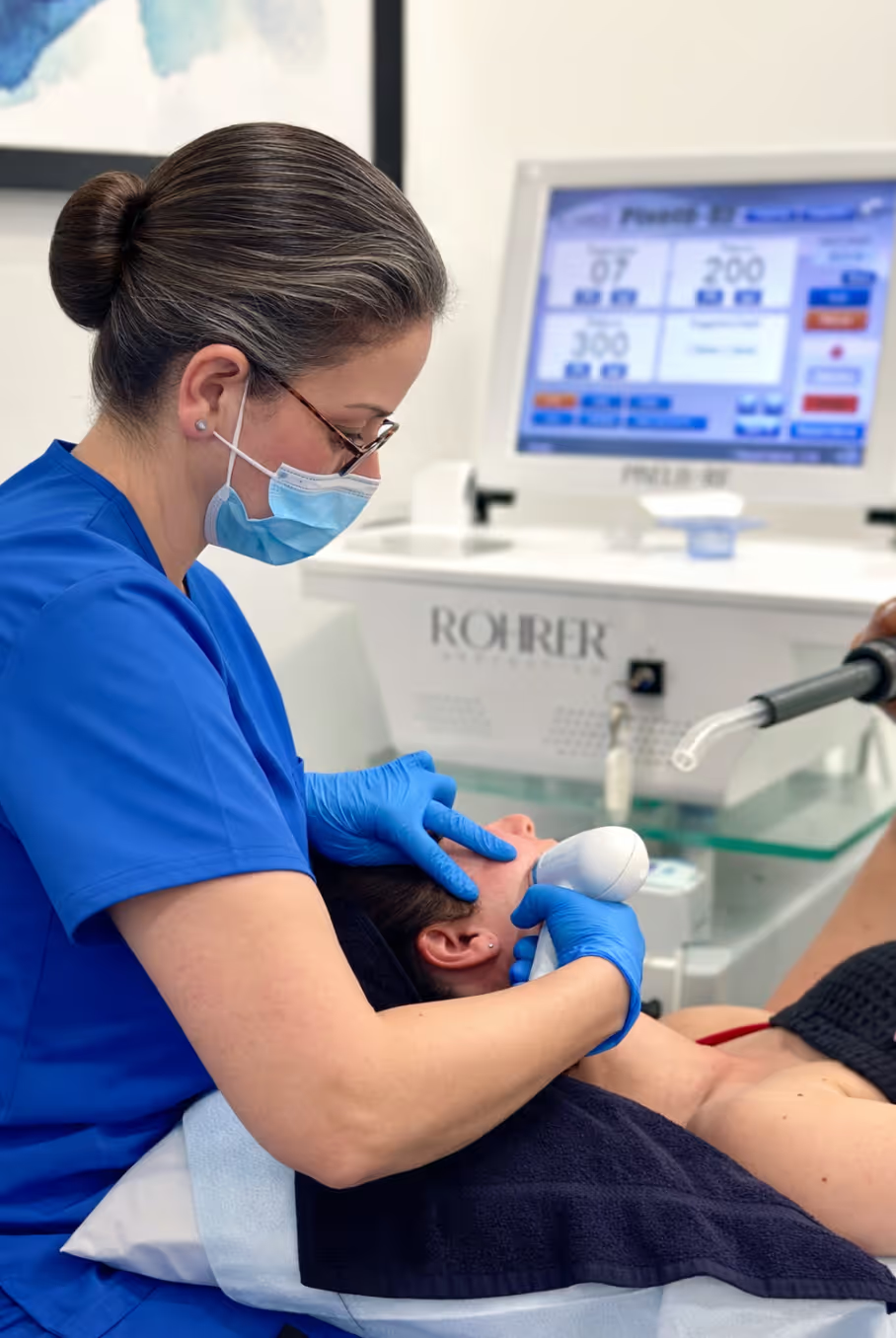
RF Microneedling addresses the collagen damage component of photoaging — the loss of firmness and texture that UV exposure drives over decades. By delivering radiofrequency energy precisely into the dermis, treatments like Pixel8-RF trigger genuine collagen remodeling rather than surface-level improvement. For clients whose sun damage has produced laxity in addition to pigmentation, combining RF microneedling with a pigment-targeting treatment often produces more complete results than either approach alone.
Exosome-Enhanced Treatments represent the most advanced regenerative option we offer — and one that is genuinely rare in Northern Virginia. As the only med spa in the region authorized to use Human Progenitor-Derived Exosomes, we can pair these with microneedling to accelerate cellular repair and reduce inflammation in skin that has been under chronic UV stress. For clients with significant photoaging, the difference in recovery time and depth of renewal is meaningful. You can read more about how this works in our overview of exosome therapy for skin rejuvenation.
The Window You Have Right Now
Late spring and early summer mark a particularly important moment for sun damage treatment. Temperatures are rising, sun exposure is increasing, and for many patients — especially those in Fairfax County, McLean, and the broader Northern Virginia area who spend time outdoors — the cumulative UV load for the year is about to climb significantly.
Certain treatments, particularly ablative resurfacing and aggressive chemical peels, are best completed before peak sun exposure rather than during it. Others, like IPL, can be performed with appropriate sun avoidance protocols in place. Our fall skin reset guide covers what post-summer repair looks like for patients who delay — but the most straightforward path is addressing existing damage now, before the season adds another layer to what has already accumulated.
If you have noticed changes in your skin tone, texture, or clarity that feel like they appeared too quickly for what you remember doing to cause them, that is almost certainly the delayed signature of earlier UV exposure becoming visible now. The damage is real, it is treatable, and the team at Tysons Elite Esthetics has the tools and the clinical experience to address it precisely — not with a one-size-fits-all protocol, but with a treatment plan built around your skin's specific history and what it needs to genuinely improve.
Reach out to schedule a consultation. We will take the time to assess exactly what you are working with and recommend a path forward that makes sense for your skin, your timeline, and your goals.
Start your transformation
Schedule your consultation with our knowledgeable and friendly team.