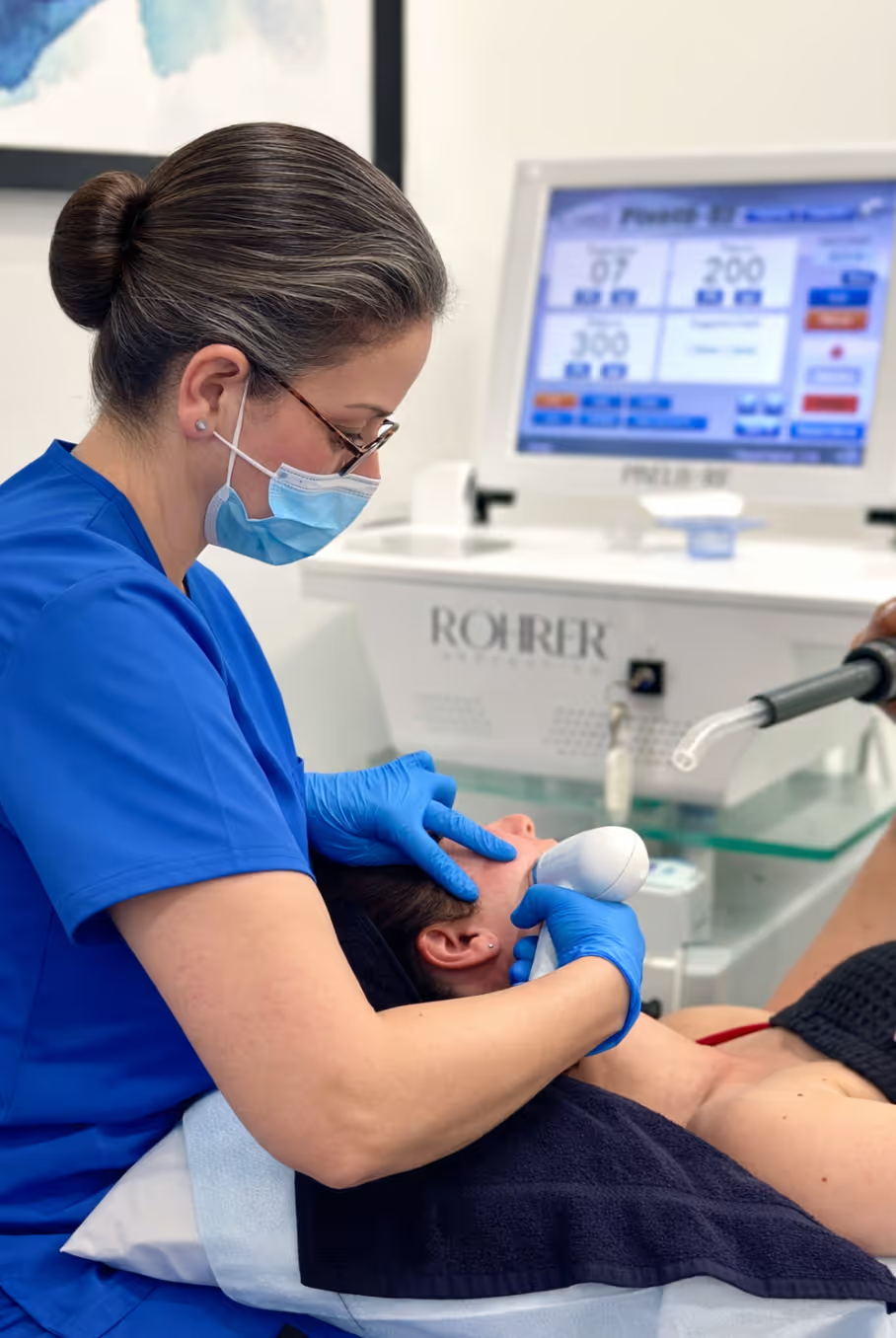
Beyond Lasers: Treating Broken Capillaries on Sensitive Skin in Tysons

Broken capillaries are one of those concerns that seem straightforward until you actually try to treat them. You can see them clearly — thin, reddish threads across the nose, cheeks, or chin — but knowing how to address them without triggering a flare, prolonged redness, or lasting irritation on sensitive skin is a different question entirely. It's one our team has navigated for clients across Tysons, McLean, and Vienna for years, and the honest answer is that laser is not always the right starting point.
For skin that already reacts — to temperature changes, skincare ingredients, wind, stress, or the general unpredictability of a Northern Virginia summer — the clinical approach to broken capillaries has to be calibrated around the skin's baseline reactivity, not just the visible vessels themselves. Treating aggressively without accounting for underlying sensitivity can worsen redness, compromise the skin barrier, and make the underlying condition harder to manage over time. That matters before we even discuss what devices or treatments may be appropriate.
What Are Broken Capillaries, and Why Does Skin Type Matter So Much?
Broken capillaries — more precisely called telangiectasias — are small, dilated blood vessels that have become permanently visible just beneath the skin's surface. They're not broken in the way a bone breaks; they've simply lost their ability to contract. Triggers include chronic sun exposure, rosacea, temperature extremes, certain topical ingredients, and genetic predisposition. For many clients, they appear gradually over years and become more prominent after significant sun exposure — which is relevant given how much UV accumulation Northern Virginia summers can deliver, as we've discussed in our post on how sun damage shows up years later.
The reason skin type complicates treatment is not trivial. Sensitive or reactive skin — particularly skin with a compromised barrier, active rosacea, or a history of flushing — responds differently to heat-based energy devices than more resilient skin types. Standard laser parameters calibrated for a typical patient can produce excessive post-treatment inflammation, paradoxical vessel dilation, or prolonged erythema when applied to reactive skin. Before any device is placed near your face, a skilled clinician needs to understand whether visible capillaries are isolated vessels or part of a broader condition like rosacea. If you haven't yet had that distinction clearly explained, our post on flushing, redness, and rosacea — and getting the diagnosis right first is worth reading before your consultation.
Why Laser Isn't Always the First Step for Sensitive Skin
Laser treatment for broken capillaries — specifically vascular lasers and intense pulsed light — works by delivering targeted energy to hemoglobin in the blood vessel, causing the vessel to collapse and be reabsorbed by the body. When performed correctly, on the right skin, it is effective. The problem is that "the right skin" qualifier matters enormously.
For clients with sensitive, reactive, or rosacea-prone skin, several variables complicate standard laser protocols. First, inflamed or compromised skin has a lower tolerance threshold for thermal energy, which increases the risk of post-inflammatory erythema and barrier disruption. Second, active rosacea is generally considered a relative contraindication for high-energy laser parameters — not because laser can never be used, but because protocol must be significantly modified. Third, the timing of treatment matters. Treating skin that is already flushed, inflamed from allergens, or sensitized by summer humidity and heat is categorically different from treating calm, stable skin in fall or winter — a distinction we explore in our post on hypersensitive skin after summer.
None of this means laser is off the table. It means that the first conversation should not be about which laser to use — it should be about whether your skin is ready for energy-based treatment at all, and what has to happen before it is. That is the kind of assessment our team prioritizes, and it's not a step we skip regardless of how clear-cut the visible vessels may appear.
What We Consider Before Any Treatment Plan for Broken Capillaries
A thorough evaluation for broken capillaries on sensitive skin involves more than identifying the vessels themselves. Our team — with 70 years of combined experience in medical aesthetics — looks at the full picture: skin barrier integrity, history of reactivity, current topical regimen, any underlying diagnoses, and what previous treatments have or haven't been tried. We also look at lifestyle factors specific to our Northern Virginia clients — office environments, travel schedules, outdoor activity — that affect how the skin behaves between appointments and how quickly it is likely to recover.
From there, a realistic treatment plan for sensitive skin with broken capillaries might include some or all of the following, depending on what the skin needs and what it can reasonably tolerate:
- Barrier repair and stabilization first. If the skin is reactive and compromised, the smartest first step is not a device — it's creating a foundation that allows the skin to respond well to treatment and recover efficiently afterward. This often means a medical-grade regimen and possibly a series of calming, barrier-focused treatments before any energy device is introduced.
- IPL Photofacial with modified parameters. For clients whose skin has been stabilized and who have telangiectasias without active inflammatory rosacea, IPL Photofacial can be highly effective. The key is protocol customization — lower fluence, longer pulse durations, appropriate cooling, and conservative spacing between sessions. Done correctly on prepared skin, IPL can address both visible vessels and the diffuse redness that often accompanies them. The question of how many sessions produces meaningful change is one we address honestly in our post on IPL photofacial results and how many sessions to expect change.
- Vascular-specific laser options. For more discrete, persistent vessels that do not respond adequately to IPL, targeted vascular laser energy may be appropriate. This is evaluated case by case and is never the starting point for reactive skin without prior stabilization.
- Regenerative support for skin repair. One of the things that distinguishes our practice is our ability to incorporate regenerative treatments — including Human Progenitor-Derived Exosomes, which we are the only med spa in Northern Virginia authorized to use — into recovery and skin optimization protocols. For clients whose sensitive skin needs genuine repair alongside vessel treatment, this layer of care can make a meaningful difference in how the skin tolerates and recovers from energy-based procedures. Our exosome treatments and STEMEX Exosomes are available for clients where regenerative support is part of the plan.
- Topical ingredient review. Many clients with broken capillaries are inadvertently using products that worsen vascular reactivity — certain active ingredients, alcohol-based formulations, and even some SPF formulas can be problematic for sensitive skin. Our team reviews the full topical regimen at consultation, and we often flag issues that have been quietly working against progress. If you're uncertain about your current SPF choices, our post on sunscreen ingredients that actually harm sensitive skin is a useful reference.
What Results Look Like — and What They Require
Treating broken capillaries on sensitive skin is not a single-appointment fix. For most clients, meaningful improvement in visible vessels, background redness, and overall skin tone requires a thoughtful sequence of treatments over several months — starting conservatively, monitoring the skin's response at each stage, and adjusting accordingly. What we do not do is push aggressive protocols on skin that isn't ready for them, because the cost of that approach — setbacks, barrier compromise, prolonged inflammation — is always higher than the time invested in doing it right.
The clients who see the best long-term outcomes are those who commit to the full plan: the preparatory work, the treatment sessions, the follow-up care, and the maintenance regimen that keeps vessels from recurring as quickly. Skin that has been properly treated and supported holds results longer. That's true of vascular concerns specifically, and it's true of skin health generally — which is why so many of our clients find that addressing broken capillaries becomes part of a broader relationship with their skin that evolves over time, not a one-time transaction.
If you're searching for broken capillaries treatment near me or exploring options for laser treatment for broken capillaries near me and you have sensitive or reactive skin, the most important thing to know is that the right answer starts with a genuine evaluation — not a treatment recommendation made before anyone has looked closely at your skin. Our team is here for exactly that conversation.
Start your transformation
Schedule your consultation with our knowledgeable and friendly team.