Polynucleotides vs. PRP: Which Regenerative Treatment Wins in 2025?

If you've been researching regenerative aesthetics lately, you've almost certainly encountered both polynucleotides and PRP. They're often mentioned in the same breath — both are positioned as natural, biologically intelligent treatments, both have meaningful research behind them, and both are increasingly popular among patients who want results without the look of intervention. But they are not the same treatment, they don't work through the same mechanism, and for many patients, choosing between them matters more than most people realize.
At Tysons Elite Esthetics, we've worked with both approaches across a wide range of skin concerns and patient profiles. What follows is an honest clinical comparison — not a pitch for either treatment, but the kind of clear, experience-backed explanation we give clients during consultations with our team, whose combined 70+ years in medical aesthetics means we've watched these technologies evolve in real time.
What PRP Actually Does — and Where It Excels
Platelet-Rich Plasma, or PRP, is derived from your own blood. A small draw is centrifuged to concentrate platelets, which are then rich in growth factors — proteins that signal your skin to repair, regenerate, and produce collagen. When injected or applied topically during microneedling, PRP essentially amplifies your skin's own healing response.
PRP has a well-established track record, particularly for hair restoration. For patients noticing scalp thinning, scalp PRP treatments remain one of the more clinically supported non-surgical interventions available. For facial skin, PRP performs best when the underlying goal is improving overall radiance, accelerating recovery after energy-based treatments, or stimulating mild-to-moderate collagen synthesis. Patients who've had microneedling with PRP often describe a noticeable glow and improved skin tone in the weeks following treatment — not dramatic structural change, but genuine skin quality improvement.
The limitation of PRP is that it's highly variable. Because it's derived from your own blood, the quality and concentration of your PRP is directly tied to your platelet count, your age, and even your current health status. A patient who is nutritionally depleted, chronically stressed, or dealing with a deficiency like low Vitamin D may produce PRP that is simply less potent than that of a healthier patient — with no visible difference in the tube. That biological inconsistency is a real clinical consideration.
PRF, or Platelet-Rich Fibrin, is a next-generation variation of PRP that many practices now prefer. It's processed without anticoagulants, releases growth factors more slowly, and has a different viscosity that makes it particularly suitable for delicate areas like under the eyes. If you want a deeper comparison, our post on PRP vs. PRF for skin rejuvenation and hair loss walks through those distinctions in detail.
What Polynucleotides Actually Do — and Why the Science Is Different
Polynucleotides — also referred to as PDRN (polydeoxyribonucleotide) injections — work through a fundamentally different biological pathway. Rather than concentrating your own growth factors, polynucleotides are fragments of highly purified DNA, typically derived from salmon or trout sperm, that interact directly with adenosine receptors in your skin tissue. This stimulates fibroblast activity, promotes new collagen and elastin synthesis, reduces inflammation, and — importantly — supports cellular repair at a level that PRP simply doesn't reach.
The regenerative mechanism here is more targeted and more consistent. Unlike PRP, polynucleotides deliver a standardized, pharmaceutical-grade concentration every time. There's no biological variability from patient to patient. The treatment outcome is more predictable, and the effects tend to build progressively over a series of sessions as the tissue repair cascade accumulates.
Polynucleotides are particularly impressive for patients dealing with skin quality issues that go beyond surface texture — chronic dryness, loss of elasticity, crepiness, dullness that doesn't respond to topicals, and under-eye concerns that fall somewhere between hollow and deteriorated in quality. Our post on polynucleotides for dark circles versus tear trough filler explores one of the most common scenarios we see: patients who've been told filler is their only option for under-eye concerns, when in fact polynucleotides address the tissue quality problem that filler never touches.
For patients over 45 comparing their options among injectable skin treatments, we've also done a direct comparison between Profhilo and polynucleotides, as well as between polynucleotides and Sculptra — two comparisons that come up frequently in consultations with patients who want to understand the full landscape before committing.
The Real Difference: Repair vs. Stimulation
Here is the clearest way to frame the distinction. PRP is fundamentally a stimulation tool — it floods the tissue with growth factors that prompt your skin's own regenerative processes. Polynucleotides are a repair tool — they work at the cellular level to rebuild the machinery that produces collagen, elastin, and healthy extracellular matrix over time.
For patients in their 30s with generally healthy skin who want to maintain radiance, recover faster from energy treatments, or support hair density, PRP remains a clinically sensible and cost-effective choice. For patients in their 40s, 50s, or 60s who are dealing with genuine tissue deterioration — skin that has lost its structural integrity, shows fine crepiness, or simply doesn't respond to what used to work — polynucleotides tend to deliver a more meaningful and durable result.
This is why we so often have the conversation about where a patient is in their skin aging journey. Patients who are just beginning to notice changes are not in the same clinical territory as patients who have been managing visible aging for a decade. If you're unsure where you fall, our post on what healthy skin at 40 looks like compared to 30 offers useful context.
Can You Combine Them?
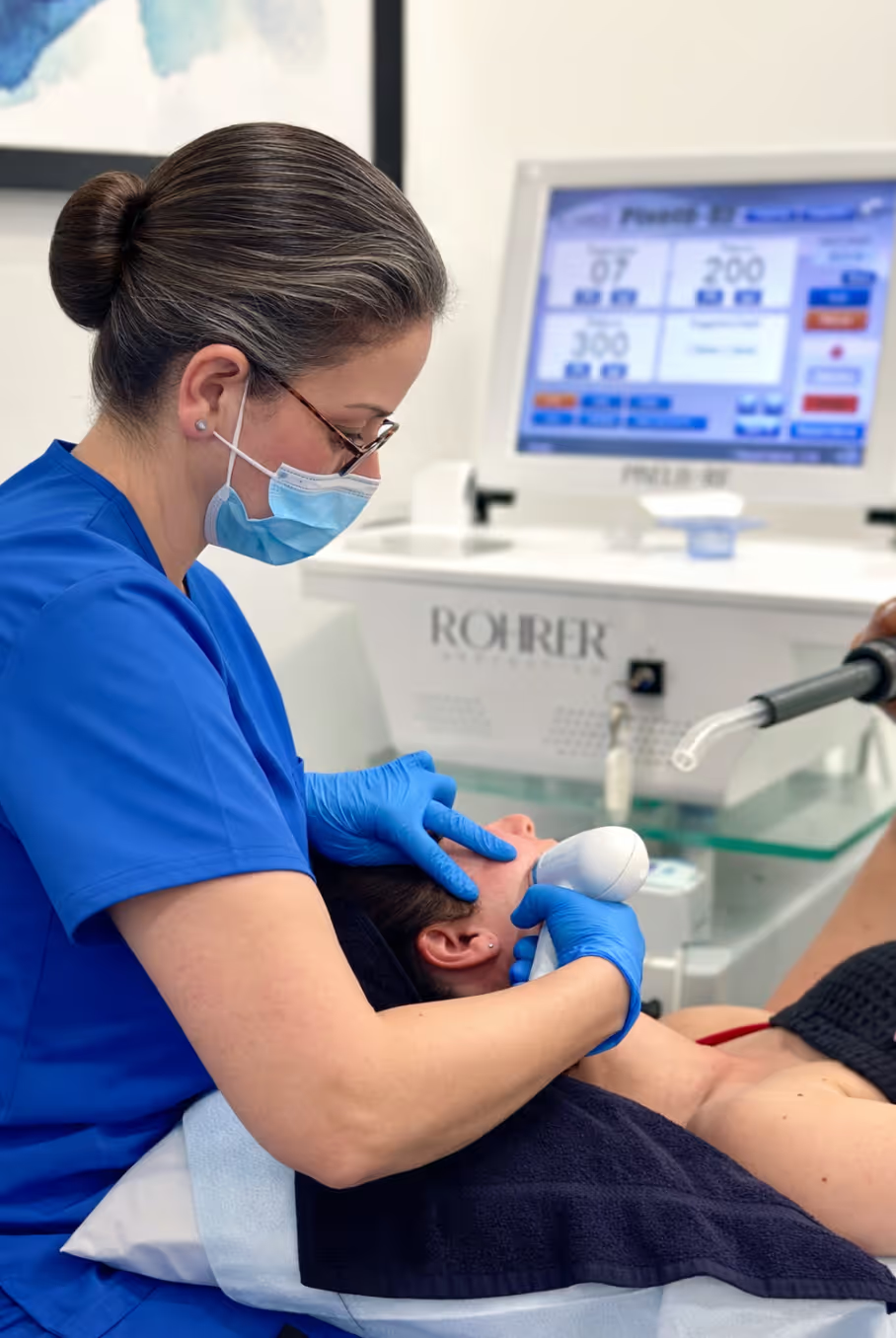
Yes — and in many cases, a thoughtful combination is more effective than either treatment alone. At Tysons Elite Esthetics, we often discuss pairing polynucleotides with energy-based treatments like Pixel8-RF radiofrequency microneedling to address both the structural and cellular dimensions of skin aging simultaneously. When PRP or PRF is used in this context — layered over microneedling to enhance recovery and initial collagen signaling — it complements rather than competes with a polynucleotide protocol focused on longer-term tissue repair.
Sequencing matters here. Adding treatments without a clear rationale for their order and timing rarely produces the best outcomes. Our post on why sequencing matters speaks to this principle broadly, but the same logic applies to regenerative treatments specifically.
For patients who are also navigating body changes from GLP-1 medications like semaglutide, the tissue repair properties of polynucleotides are increasingly part of the conversation. Ozempic-related skin changes — particularly the loss of dermal quality that accompanies rapid weight loss — often respond well to treatments that work at the cellular level rather than simply adding volume.
What We Look for in a Polynucleotide Patient at Tysons Elite Esthetics
Not everyone is an equal candidate for polynucleotides — and part of the value of consulting with an experienced team is understanding whether this is the right tool for your specific concern at this moment in your skin aging journey. Generally speaking, patients who benefit most are those with visible skin quality deterioration that isn't primarily a volume issue, those who have tried surface-level treatments without lasting improvement, and those who are committed to a series of sessions and understand that this is a cumulative, progressive treatment rather than an immediate fix.
Polynucleotides also pair exceptionally well with a comprehensive skincare protocol. If your topical regimen hasn't been keeping pace with your skin's needs, our post on when skincare stops working is worth reading before your consultation. The treatments you use in the office are always most effective when your at-home care is genuinely supporting the results.
For patients searching for polynucleotides injections near me in the Northern Virginia area — serving McLean, Vienna, Falls Church, and across Fairfax County — Tysons Elite Esthetics offers a thorough consultation process where treatment recommendations are built around your skin specifically, not a protocol designed for someone else. If you'd like to explore whether polynucleotides, PRP, or a combination approach makes sense for where your skin is right now, we'd be glad to have that conversation.
Start your transformation
Schedule your consultation with our knowledgeable and friendly team.