
Northern Virginia summers have a particular quality that anyone who has spent a July afternoon in Tysons, McLean, or Falls Church knows well: the heat is one thing, but the humidity is something else entirely. That dense, wet air that settles over Fairfax County from late May through September doesn't just make your morning commute uncomfortable. For many patients in their 40s, 50s, and 60s, it's quietly compounding skin aging in ways that aren't obvious until the damage is already done.
The connection between climate, moisture, and skin laxity is more clinically meaningful than most people realize. And for high-achieving professionals who are already investing in their skin, understanding how the local environment interacts with your biology — and your treatments — matters.
What Humidity Actually Does to Skin Structure
High humidity does something that, on the surface, seems beneficial: it keeps the outermost layer of your skin hydrated. In a genuinely dry climate, transepidermal water loss accelerates, the skin barrier weakens faster, and fine lines appear more pronounced. Northern Virginia's humid summers do prevent some of that surface dryness — but that's where the good news largely ends.
The deeper issue is what persistent heat and humidity do to collagen. Collagen is a protein, and like most proteins, it's sensitive to heat. Chronic thermal stress — the kind that accumulates over years of hot, humid summers — contributes to the degradation of collagen fibers in the dermis. This is distinct from acute sun damage, though the two often occur together. The result is a gradual loosening of the skin's structural scaffolding: the dermis loses tensile strength, elastin fibers become less resilient, and the skin begins to appear less taut even in areas that haven't been significantly sun-exposed.
What this means practically is that skin laxity in Northern Virginia patients often presents earlier and more diffusely than in patients from cooler, drier climates. The jawline softens. The neck loses definition. The cheeks develop a subtle but unmistakable heaviness. Many patients describe it as looking "tired" rather than "aged" — which is actually a useful clinical observation, because it speaks to the nature of laxity-driven aging versus volume-loss-driven aging. Understanding this distinction is foundational to treatment planning; our blog post on sagging skin versus volume loss explores exactly why getting that diagnosis right changes everything about your treatment approach.
Skin Laxity vs. Cellulite: Why the Distinction Matters Here
One confusion that comes up frequently — particularly as patients begin noticing changes in the face, neck, and body simultaneously — is the difference between skin laxity and cellulite. These are related but distinct conditions, and the Northern Virginia climate plays differently in each.
Skin laxity is a loss of structural integrity in the dermis itself: the collagen and elastin network weakens, and the skin no longer snaps back or sits firmly against the underlying tissue. It's what creates jowling, crepey neck skin, and looseness along the jawline. Cellulite, by contrast, is a structural issue in the subcutaneous fat layer — fibrous septae pull downward on the skin while fat lobules push upward, creating the dimpled surface texture most visible on the thighs and buttocks. Humidity and heat don't directly cause cellulite, but they can worsen its appearance temporarily by increasing fluid retention and vascular congestion in the subcutaneous layer.
The reason this distinction matters clinically is that the treatments are completely different. Skin laxity responds to energy-based devices that stimulate collagen remodeling — radiofrequency microneedling, focused ultrasound, CoolPeel fractional laser — as well as to biostimulators like Sculptra and Radiesse that rebuild the dermal scaffold over time. Cellulite requires different interventions targeting the structural fat and fibrous bands. When patients come in saying their skin "looks loose and lumpy," accurate diagnosis determines whether we're treating one condition, the other, or both. Our comprehensive overview of skin laxity and what medical aesthetics can do to address it is a useful starting point for patients who want to understand the full landscape of options.
The Compounding Effect: Humidity Plus UV Plus Inflammation
Northern Virginia's summer skin story isn't just about humidity in isolation. The real damage comes from the combination: UV radiation accelerating photoaging, heat degrading collagen thermally, humidity disrupting the skin barrier's lipid matrix (which paradoxically makes it more vulnerable to environmental penetration), and the chronic low-grade inflammation that follows. This inflammatory burden — what researchers have increasingly called "inflammaging" — is a meaningful driver of accelerated skin aging, and it's more pronounced in climates where environmental stressors are layered and persistent.
For patients who spend significant time outdoors in the Tysons, McLean, and Vienna area — whether commuting, exercising, or simply moving through daily life — the cumulative UV and heat exposure across a career is substantial. Sun damage doesn't always announce itself immediately; it often surfaces years later as diffuse laxity, uneven tone, and textural changes. Our post on why sun damage shows up years later explains the delayed timeline that catches many patients off guard.
The inflammatory component also matters for patients managing rosacea or reactive skin. Humidity triggers vasodilation, which worsens flushing and redness. If you've noticed your skin behaving differently in summer — more reactive, more flushed, more prone to breakouts — that's a real physiological response to the environment, not a coincidence. Getting that correctly diagnosed before treating is essential, which is why we always recommend starting with a proper assessment rather than jumping to a protocol. Our overview of distinguishing rosacea from general flushing and redness is worth reading before any skin-tone treatment.
What Treatments Actually Work — and When to Have Them
This is the question that matters most to busy professionals who don't have time for treatments that don't deliver. The honest answer is that managing humidity-accelerated skin laxity in Northern Virginia requires a multi-modal approach — no single device or injectable resolves structural laxity comprehensively — but there is a logical sequence that makes each intervention more effective.
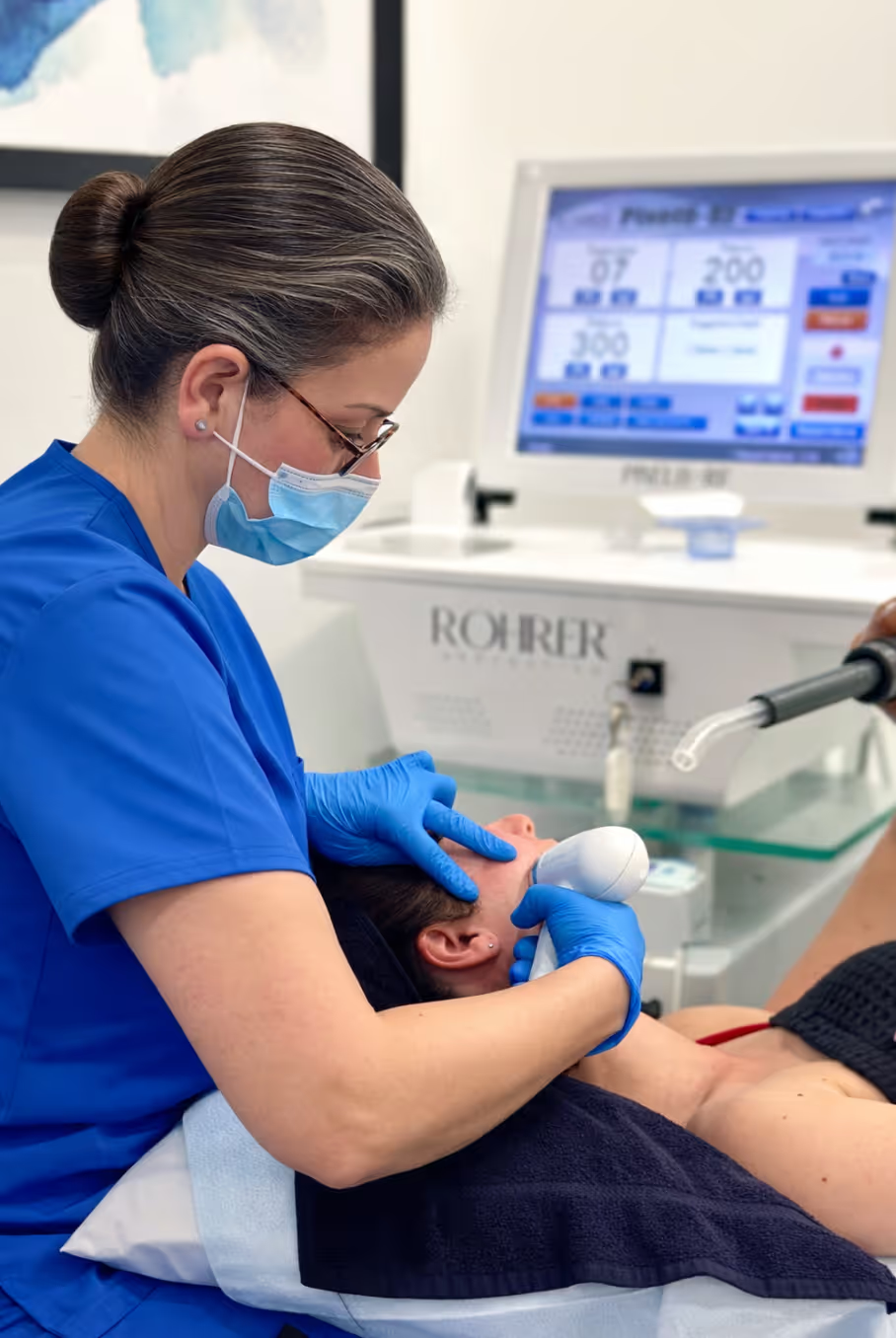
Radiofrequency microneedling is one of the most clinically effective tools for skin laxity because it delivers thermal energy precisely into the dermis, stimulating collagen remodeling and elastin production without significant surface disruption. At Tysons Elite Esthetics, we use the Pixel8-RF, a device that allows for precise depth control — important when treating the varying skin thicknesses across the face, neck, and décolletage. Results build over three to six months as the collagen remodeling process matures. For patients over 50, we've seen particularly meaningful improvements in skin firmness and jawline definition with a series of treatments. Our post on how skin type affects Pixel8-RF results after 50 addresses the nuances that matter most for patients in this range.
Biostimulators like Sculptra and Radiesse work differently — rather than delivering immediate volume, they stimulate the body's own collagen production gradually, rebuilding the dermal infrastructure that humidity and time have eroded. For patients in their 40s and 50s who are noticing diffuse laxity rather than a discrete volume deficit, biostimulators often deliver more natural-looking, structurally meaningful results than hyaluronic acid fillers alone. The question of when to start and how early is one our team addresses regularly; our post on optimal timing for Sculptra walks through the clinical logic.
Focused ultrasound (Ultherapy) targets the deepest structural layer — the SMAS — with precision that no topical or superficial treatment can reach. It's particularly well-suited for patients whose primary concern is jawline or neck definition, and it's one of the few non-surgical treatments that addresses the same anatomical layer a surgeon would access during a facelift. Our post on Ultherapy's effectiveness after menopause is relevant here, since hormonal changes layer on top of climate-driven laxity for many of our patients.
Exosome therapy is where Tysons Elite Esthetics offers something genuinely distinctive. As the only med spa in Northern Virginia authorized to use Human Progenitor-Derived Exosomes, we can offer a regenerative add-on to energy-based treatments that accelerates tissue recovery and amplifies collagen signaling. For patients dealing with inflammation-driven skin degradation — which describes much of what humidity and UV exposure produce — exosome therapy paired with microneedling or laser can meaningfully extend and deepen results. Learn more about our microneedling with exosomes offering and the STEMEX Exosome protocol that sets us apart.
Timing also matters. Summer isn't always the wrong time for treatment — some protocols are entirely appropriate in warmer months — but certain energy-based treatments are better positioned for fall and winter, when UV exposure is lower and the skin's healing environment is more predictable. Our post on which treatments still deliver in summer humidity helps patients make smart scheduling decisions rather than simply waiting until October to address concerns they've had since May.
A Note on Combination Approaches
One of the things our team — with over 70 years of combined experience in medical aesthetics — has learned is that the patients who see the most significant and lasting results are typically those following a coordinated treatment plan rather than treating concerns in isolation. Skin laxity driven by Northern Virginia's climate responds best when you're addressing collagen stimulation, structural remodeling, and skin quality simultaneously, with each treatment reinforcing the others.
That might mean pairing Pixel8-RF with a biostimulator like Sculptra across a two-to-three-season plan, supporting it with medical-grade topicals that maintain the skin barrier through humid summers, and layering in exosome therapy after energy treatments to amplify recovery. It's not about doing everything at once — it's about doing the right things in the right sequence. Our overview of combination skin tightening approaches explains how these protocols work together clinically.
For patients who are newer to this kind of planning, our guide for patients starting at a med spa is a grounded starting point — no pressure, no assumptions, just a clear explanation of how thoughtful treatment planning actually works.
What to Do Now
If you've been noticing changes in your skin's firmness, definition, or overall texture — and especially if those changes seem to worsen during or after the summer months — it's worth having a proper skin assessment rather than waiting. The patients who see the best long-term results are typically those who start addressing laxity before it becomes advanced, when the structural work required is less extensive and the outcomes more predictable.
Our team in Tysons sees patients from across Northern Virginia — McLean, Vienna, Falls Church, Reston, and the broader Fairfax County area — and we approach every consultation the same way: by listening first, assessing carefully, and recommending only what genuinely makes sense for your skin, your goals, and your life. If you're not sure where to start, that's exactly what a consultation is for.