Does Ultherapy Still Work After Menopause?

If you have noticed that your skin started behaving differently after menopause — less elastic, less forgiving, slower to recover — you are not imagining it. The hormonal shift that comes with perimenopause and menopause does not just affect how you feel. It fundamentally changes the structure of your skin. Collagen production accelerates its decline. Elastin fibers lose their resilience. The dermis thins. And the structural support that once kept your jawline defined and your neck smooth begins to give way in ways that no skincare routine can fully address on its own.
This is the context in which a lot of patients start asking about Ultherapy. They have heard it described as a non surgical facelift alternative. They have seen before-and-after images of lifted brows, sharper jawlines, and tighter neck skin. And they want to know whether those results are still achievable after estrogen has already done its damage — or whether Ultherapy is most effective in younger skin that still has the biological infrastructure to respond.
The honest answer is more nuanced than a simple yes or no. Ultherapy works by delivering focused ultrasound energy to the SMAS layer — the same structural tissue that surgeons target in a traditional facelift. That energy creates controlled thermal injury at a precise depth, triggering a wound-healing response that stimulates new collagen and elastin production over the following months. The mechanism does not depend on estrogen. It depends on your skin's ability to respond to that stimulus and build new structural tissue — and that capacity, while diminished after menopause, does not disappear.
What changes after menopause is the magnitude and timeline of that response. Younger skin with more collagen reserves tends to respond more quickly and visibly. Post-menopausal skin may produce a more modest initial result, and it may take longer — sometimes six months or more — before the full benefit is apparent. That does not mean Ultherapy is ineffective after 50. It means expectations need to be calibrated carefully, and treatment planning needs to account for what your skin can realistically do given where it is today.
One of the most common concerns we hear at Tysons Elite Esthetics is about jowls. This is where menopause tends to make its most visible mark on the lower face. As midface volume decreases and skin loses its elasticity, tissue descends along the jawline, creating that characteristic heaviness that patients describe as looking tired or older than they feel. Patients searching for information about jawline ultherapy jowls before and after are often looking for reassurance that something noticeable is possible without surgery — and the evidence does support that, with the right candidacy and realistic expectations.
Ultherapy targets the lower face and neck specifically well. The SMAS tightening effect can improve the definition of the jawline, reduce the downward pull of early jowling, and lift the submental area — the zone just beneath the chin — in a way that softens the transition between the face and neck. For patients in their early to mid-50s with mild to moderate laxity, these results can be genuinely meaningful. For patients with significant tissue descent or extensive volume loss, a more comprehensive approach is usually warranted — and that is a conversation worth having before committing to any single device.
The question of whether you are dealing with true skin laxity or primarily volume loss matters enormously here. Ultherapy addresses laxity and structural support — it does not replace lost volume. If the jowling you are seeing is largely driven by hollowing in the cheeks and midface pulling everything downward, then ultrasound energy alone will not fully resolve it. This is why our team spends real time in consultation understanding the specific nature of what each patient is experiencing, rather than defaulting to a single treatment recommendation.
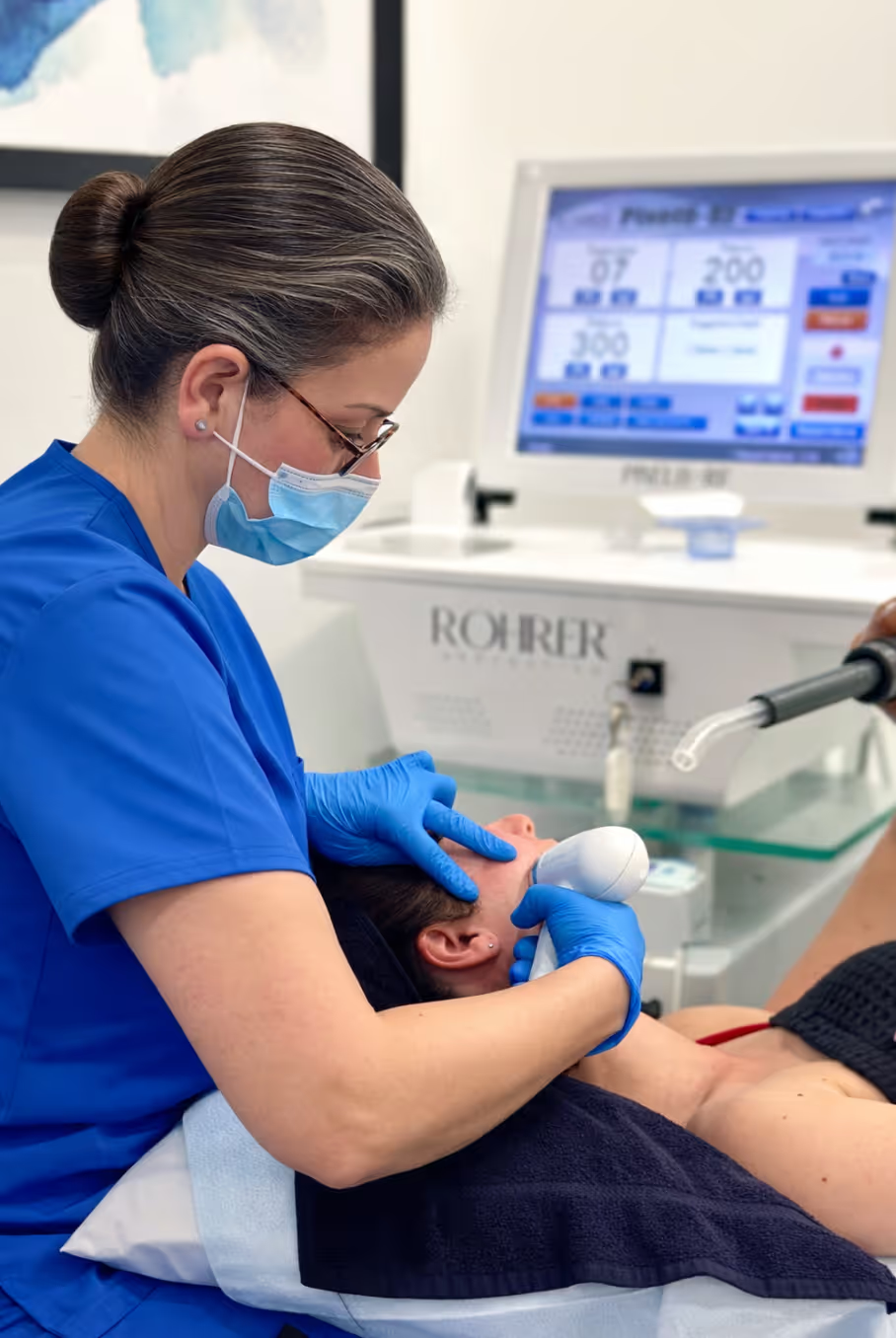
For patients concerned about loose skin beyond the face — and this is a question we hear more frequently from women over 50 — Ultherapy can also be applied to body areas, including the décolletage and, in some protocols, the arms and thighs. For those specifically looking for guidance on how to tighten skin on legs after 50 or on the inner arms, it is worth noting that ultrasound-based tightening has more evidence for facial and neck applications than for larger body surface areas. RF microneedling — particularly with a device like the Pixel8-RF — often performs more consistently for body skin tightening, and a thoughtful clinician will help you understand which modality fits your specific anatomy.
One thing that does improve outcomes for post-menopausal patients considering Ultherapy is supporting the skin's collagen-building capacity before and after treatment. This is where combination approaches become genuinely valuable. Patients who are on collagen-stimulating biostimulators like Sculptra or Radiesse, or who have incorporated exosome therapy into their skin health protocol, tend to have a more robust regenerative response. The skin is not being asked to build collagen from a depleted baseline — it has been primed. Similarly, patients who have addressed skin laxity with a layered approach over time generally see more sustained results from any energy-based treatment.
There is also a meaningful difference between Ultherapy and other tightening devices that is worth understanding before making a decision. As we have written about in our comparison of Morpheus8 vs. Ultherapy for facial tightening, the two modalities work at different tissue depths and through different mechanisms. Ultherapy's ability to reach the SMAS — depths of 3.0mm, 4.5mm, and in some applications deeper — makes it uniquely suited for structural lifting. Morpheus8 works closer to the surface and excels at skin quality, texture, and superficial tightening. For many patients over 50, the most effective plan involves both, not one or the other.
What does candidacy for Ultherapy after menopause actually look like? Generally, the patients who see the strongest results are those with mild to moderate tissue laxity — noticeable softening of the jawline, early jowling, some looseness in the neck — but who still have reasonable skin quality and thickness. Patients with very thin, heavily sun-damaged skin, or those with significant tissue descent, may find that results are more limited, or that a different primary approach makes more sense. Our team — with 70+ years of combined experience in medical aesthetics — has had these conversations many times, and the goal is always to align what a treatment can deliver with what you actually want to see.
If you are in Tysons, McLean, Vienna, or the broader Northern Virginia area and have been wondering whether Ultherapy is worth pursuing at this stage of life, the answer is not a blanket yes or no — it is a conversation that starts with an honest look at where your skin is today and where you want it to go. That conversation is one we are glad to have, without any pressure toward a particular treatment path. Because the right answer for you may be Ultherapy, or it may be something else entirely, or it may be a combination that addresses laxity, volume, and skin quality all at once. The only way to know is to take the time to understand your skin — and to work with a team that will do exactly that.
Start your transformation
Schedule your consultation with our knowledgeable and friendly team.