Sluggish Skin in Winter? Treatments That Actually Restore Your Glow

If your skin has felt flat, congested, or just off since the cold months settled in, you're not imagining it. Winter creates a specific set of physiological conditions that work against your complexion: low humidity strips moisture from the skin barrier, reduced sun exposure slows vitamin D synthesis, indoor heating accelerates transepidermal water loss, and circulation to the skin's surface decreases as your body conserves warmth for vital organs. The result is skin that looks dull, feels rough, and doesn't respond the way it did in warmer months — no matter how faithfully you layer on serums and moisturizers.
At-home skincare can support your skin, but it cannot reverse what's happening at a structural level. There are meaningful biological limits to what topicals can reach, and winter dullness is often a sign that the skin needs clinical intervention — not more product. The team at Tysons Elite Esthetics has spent a combined 70+ years working with skin across every season, and they're precise about which treatments actually address the underlying causes of dull skin in winter, versus which ones simply feel good in the moment without producing lasting change.
What's Actually Happening to Your Skin in Winter
Dullness is not a single condition — it's the visible expression of several overlapping issues that tend to compound during colder months. Understanding what's driving it makes it easier to select a treatment path that genuinely works rather than one that temporarily brightens the surface.
- Impaired barrier function. Cold air and indoor heating dehydrate the stratum corneum, causing microscopic fissures in the skin barrier. When the barrier is compromised, skin can't retain moisture effectively and becomes more reactive, flaky, and visually dull.
- Slowed cellular turnover. Cell renewal slows in winter, which means dead skin cells accumulate at the surface longer than they should. This creates that characteristically heavy, grayish appearance that even well-moisturized skin can't seem to shake.
- Reduced microcirculation. Blood flow to the skin's surface decreases in cold weather, which is why skin looks pallid and lacks the healthy warmth that signals good perfusion and oxygenation.
- Collagen stress. Low humidity environments increase oxidative stress on collagen fibers, which over time contributes to a loss of that surface-level luminosity that comes from structurally healthy, well-hydrated dermis.
Each of these mechanisms responds to different treatment approaches. A thoughtful provider won't recommend one treatment for all of them — they'll assess where your skin is and what it most needs right now.
Treatments That Genuinely Restore Winter Glow
Exosome Therapy: Cellular Renewal From the Inside Out
Tysons Elite Esthetics is the only med spa in Northern Virginia authorized to use STEMEX Human Progenitor-Derived Exosomes — a distinction that matters when you understand what exosomes actually do. These are extracellular vesicles derived from human progenitor cells that carry messenger RNA, growth factors, and signaling proteins directly into your skin cells, instructing them to repair, regenerate, and produce collagen at a level that no topical ingredient can replicate.
In winter, when cell turnover is sluggish and the skin's natural repair mechanisms are working at reduced capacity, exosome therapy provides a direct biological signal to restart those processes. The results are not cosmetic in the surface sense — they reflect genuine tissue regeneration, which is why skin looks fundamentally different afterward rather than just temporarily more radiant. Learn more about what exosome therapy involves and what to expect from this regenerative approach.
Exosomes are frequently used in combination with other treatments — particularly microneedling — to deepen penetration and amplify the regenerative response. Understanding how exosomes compare to PRP as a microneedling add-on can help you determine which pairing makes the most sense for your skin at this time of year.
Oxifusion Facial: Oxygenation and Barrier Restoration in One Session
The Oxifusion Facial is one of the most well-suited treatments for winter dullness because it directly addresses two of the season's primary culprits: compromised microcirculation and depleted hydration. The treatment delivers concentrated oxygen infused with targeted serums under gentle pressure, allowing active ingredients to penetrate more deeply than standard application allows while simultaneously stimulating blood flow to the skin's surface.
The immediate result is a visible awakening — the kind of color, translucency, and softness that clients describe as their skin looking like itself again. But beyond the visible effect, Oxifusion also supports barrier repair, which means the skin holds onto moisture more effectively after the treatment rather than reverting to dehydration within a day or two. For clients dealing with reactive or sensitized winter skin, it's one of the gentlest yet most visibly impactful options available.
IPL Photofacial: Clearing the Residue of Sun Damage and Uneven Tone
Many clients don't realize that some of what reads as winter dullness is actually cumulative pigmentation that becomes more noticeable when the skin's natural warmth and vitality are reduced. Sunspots, diffuse redness, and post-inflammatory pigmentation that were partially masked by summer color become more visible in winter — and they prevent skin from reflecting light evenly, which is what creates true luminosity.
IPL Photofacial (Photo Rejuvenation) targets both melanin and hemoglobin with precise wavelengths of broad-spectrum light, clearing irregular pigmentation and visible vascularity without disrupting the surrounding skin. Winter is actually an ideal time for IPL because reduced UV exposure during the recovery period lowers the risk of post-treatment hyperpigmentation. Clients typically see progressive clearing over several weeks, with skin looking significantly more even-toned and luminous after a series of treatments.
Understanding how to correctly identify and treat different types of hyperpigmentation is important before choosing IPL — the team at Tysons Elite Esthetics takes the time to do this assessment carefully rather than applying a standard protocol to every concern.
Vi Peel Precision Plus: Accelerating Cellular Turnover When It's Stalled
When sluggish cell turnover is the primary driver of dullness, a medical-grade chemical peel is often the most direct solution. The Vi Peel Precision Plus combines trichloroacetic acid, salicylic acid, retinoic acid, and vitamin C in a formulation specifically designed to address uneven tone, texture irregularities, and the kind of flat, congested surface that accumulates when dead cells aren't clearing efficiently.
What distinguishes the Vi Peel from lower-grade peels is the depth of action and the precision of the formulation. It works below the surface to stimulate collagen and accelerate dermal renewal, not just exfoliate superficially. The result is skin that sheds its dull outer layer and reveals a clearer, brighter, more refined surface beneath — typically visible within seven to ten days of treatment. Winter is a particularly appropriate season for this kind of resurfacing work because patients are not immediately re-exposing treated skin to strong UV radiation.
Comparing microneedling and chemical peels for texture and tone can help you understand which approach — or which combination — is right for your specific skin concerns this season.
Pixel8-RF Radiofrequency Microneedling: Structural Renewal for Skin That Has Lost Its Firmness and Glow
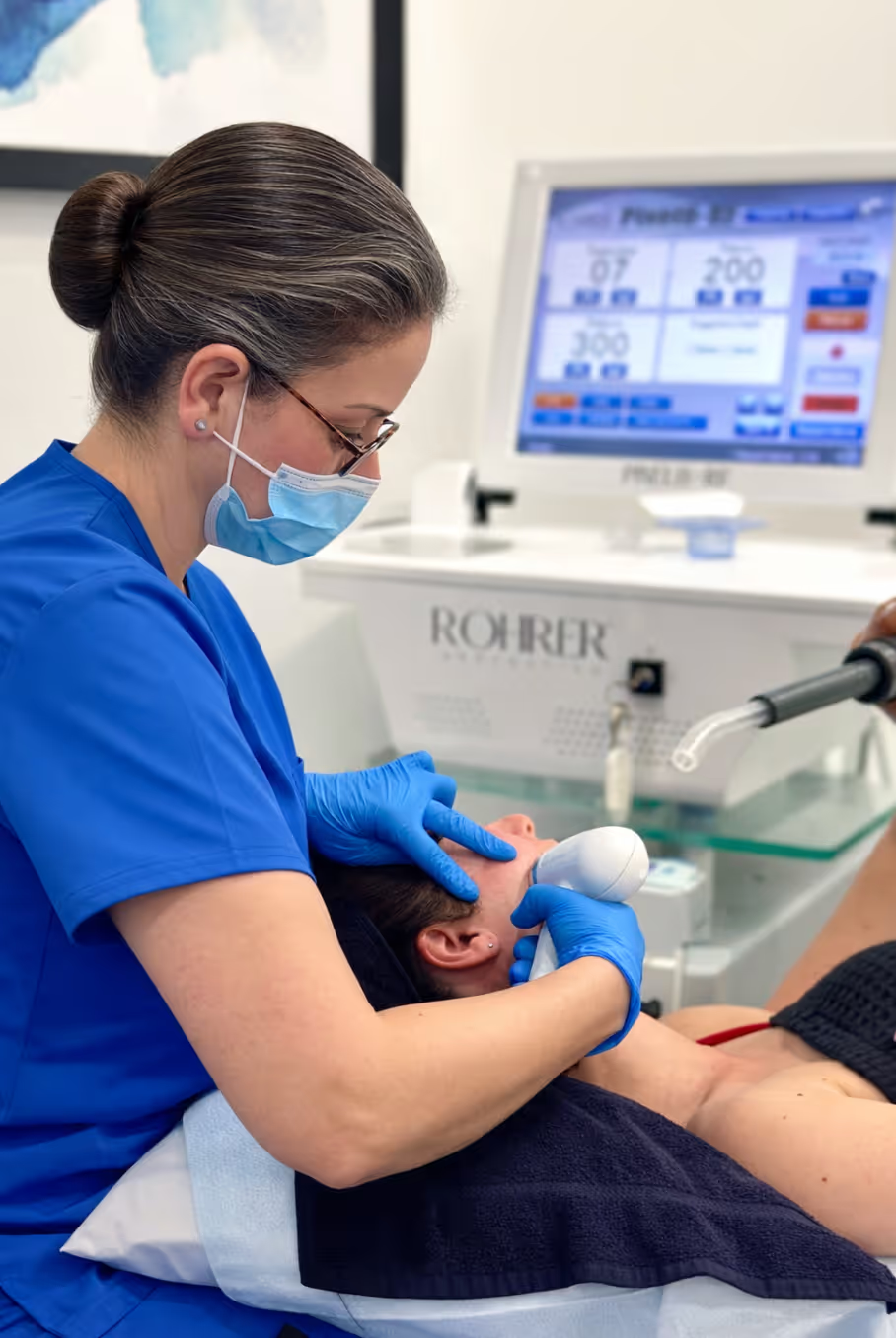
For clients whose winter dullness is accompanied by a loss of firmness, mild laxity, or enlarged pores, Pixel8-RF Radiofrequency Microneedling addresses the structural dimension that surface treatments cannot reach. The device combines precision microneedle channels with targeted radiofrequency energy delivered at controlled depths, triggering a robust collagen remodeling response in the dermis while also improving surface texture at the entry points.
The collagen and elastin produced in response to Pixel8-RF is the same tissue that gives youthful skin its firmness and the subtle three-dimensionality that reads as healthy and luminous. This is not a treatment with immediate overnight results — the remodeling process unfolds over twelve to sixteen weeks — but the quality of improvement is structural and lasting in a way that no topical or surface treatment can replicate. Understanding what to expect from RF microneedling for skin laxity will help you plan your timeline realistically.
CoolPeel Fractional Laser Resurfacing: The Most Comprehensive Reset for Chronically Dull or Sun-Damaged Skin
For clients who have noticed that their skin simply doesn't recover the way it used to — that winter dullness has become a persistent baseline rather than a seasonal fluctuation — CoolPeel Fractional Laser Resurfacing offers the most comprehensive renewal available without surgery. The ablative CoolPeel fractional laser removes the outer layers of damaged skin with precision, stimulating significant dermal remodeling and collagen synthesis in the weeks that follow.
The results are correspondingly more dramatic than milder treatments: a genuine reset of texture, tone, and radiance that reflects real structural change in the skin rather than temporary surface improvement. Downtime is real and requires planning, but for the right candidate — someone dealing with accumulated sun damage, textural irregularity, and loss of luminosity that has become chronic — winter is the ideal time to commit to this level of renewal. The team will assess your skin thoroughly before recommending CoolPeel to ensure it's the right match for your concerns and lifestyle.
Learning about CoolPeel Fractional Laser Resurfacing for sun damage before your consultation will help you arrive with informed questions about candidacy, downtime, and what the recovery process looks like in practice.
How the Team Approaches Dull Skin Treatment
One of the things clients consistently say about the team at Tysons Elite Esthetics is that they don't take a one-size-fits-all approach — that every treatment feels thoughtfully selected and tailored specifically for their skin. That specificity is not incidental. It reflects a deliberate clinical philosophy: winter dullness looks similar from the outside, but the underlying drivers are different from person to person, and the right treatment plan starts with understanding which mechanisms are at work in your skin before recommending anything.
For some clients, the priority is barrier repair and hydration. For others, it's cellular turnover or pigmentation clearing. For others still, the real issue is structural — a gradual decline in collagen density and dermal quality that has reached the point where surface treatments alone won't produce meaningful change. Often, the most effective approach combines two complementary treatments — a surface-level intervention like the Oxifusion Facial or Vi Peel alongside something that works at a deeper structural level, such as Pixel8-RF or exosome therapy.
If you've been layering products at home and still feel like your skin is stuck, that's usually the signal that it's time for a clinical conversation. Understanding what actually happens at your first med spa appointment can help if you've been hesitant about where to start.
When to Start, and What to Expect
The honest answer is that the best time to address dull skin is before it becomes a chronic pattern. Skin that is addressed seasonally — reset in late fall or winter when UV exposure is low and the skin's repair capacity can be directed toward treatment recovery — tends to look significantly better year-round than skin that is only treated reactively when concerns become pronounced.
Many of the most effective winter treatments — IPL, CoolPeel fractional laser, chemical peels — benefit specifically from the reduced sun exposure that winter provides. Others, like exosome therapy and RF microneedling, produce results that unfold over months, which means starting in winter positions clients to see peak improvement by spring. Planning a winter-to-spring skin transition is something the team thinks about with clients who want to arrive at warmer months with genuinely renewed skin rather than scrambling to address concerns after they've been visible all season.
Tysons Elite Esthetics serves clients across McLean, Vienna, Falls Church, and the greater Fairfax County area. A consultation begins with a real conversation — one that takes into account your skin history, your lifestyle, your goals, and how much downtime is realistic for you — before anything is recommended. That conversation is where the right treatment path becomes clear.
Start your transformation
Schedule your consultation with our knowledgeable and friendly team.